Electroplated Chrome Steel Tube Furniture
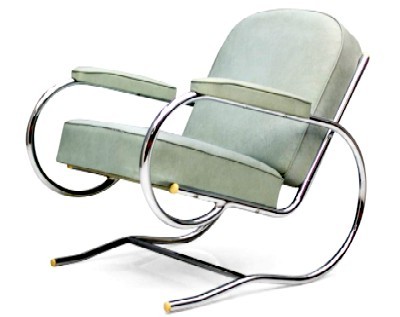
Lounge Chair, Chromed Steel, Original Mint Green Uphostery,
Baptistin Spade, 1930s, Vintage
Steel tube furniture was popular during the Art Deco era, having its origins in Bauhaus and French Art Deco. Although not all steel tube furniture during the 1920s employed chrome, it was a key element in popularizing the use of steel tubes in furniture. "Compared to nickel, chromium provides a harder surface that resists scratching and does not rust, tarnish, or oxidize. Another advantage of chromium plating is the pleasing blue-white appearance, compared to the yellowish tinge of nickel-plating." (Jim Linz, "There's No Plate Like Chrome", Art Deco Society of New York website)
Chromium (Elemental symbol Cr) is very hard and provides excellent corrosion resistance. Its first known use on metals dates to the ancient Chinese who tipped their weapons with chromium oxide. Yet it wasn't until the late 1790s when chrome was positively identified by French chemist Louis Vauquelin who purified it by heating a chromium trioxide sample that chrome could be effectively used. Initially, there wasn't much in the way of commercial use for chromium. It was primarily used during the 19th and early 20th centuries as a pigment in chemical applications. Something else was needed to give chrome life in the commercial realm.
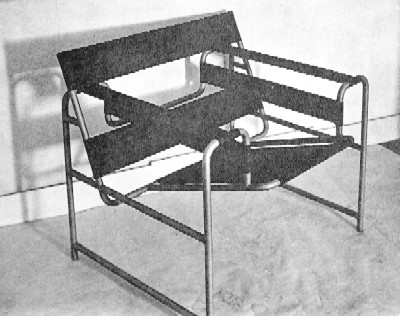
An Early Version of the Wassily (B3) Chair, Probably with Nickel Chrome
or Unfinished Steel, Marcel Breuer, 1926, From Les Arts de la Maison,
Winter, 1926, p. 31
This was provided by creating a commercially viable process for electroplating chrome. A variety of people contributed to this in the mid-19th century. Yet it wasn't until 1894 that the first American patent for chrome plating was filed by French photographer and engraver Emile Placet and Joseph Bonne. The process was improved by George J. Sargent in 1914 who established an optimal chemical mixture for chrome electroplating which is still in use today. He published a paper on the topic in 1920 allowing Colin Fink and Charles Eldrich at Columbia University to make the process commercially viable. Two companies began chroming metal, eventually merging to form the Chromium Corporation of America which chromed metal in Waterbury, Connecticut. Within two years, chromed metal began to gain popularity, becoming an important element in home goods around 1927.
The use of chrome in furniture has its roots in the products created by a Hungarian-German Bauhaus designer Marcel Breuer. In 1925, Breuer, working with a locksmith from the test workshop at the Junkers aircraft plant in Dessau, Germany, built a stool, side tables and a prototype for a club chair out of tubular steel. He was inspired by the tubular-steel handlebars of his bicycle, feeling that if metal could be bent into handlebars, it could also be bent to create furniture. The chair's design was a Modernist take on the overstuffed club chairs popular at the time. Breuer initially attempted to make the chair's steel tubes more appealing by coating them with nickel, but wasn't happy with the result.
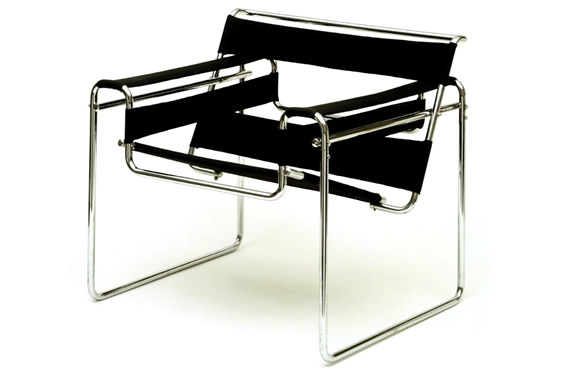
The B3 (Wassily) Production Chair, Chromed Steel with Canvas, Marcel Breuer for Thonet, 1927-8
Breuer refined his chair design with steel bars forming a skeletal outline of a club chair supporting a leather seat, back and arms around 1927. (See the image at right.) He was advised to get in contact with the Thonet company to manufacture his design because their bent wood process was similar to what was required to bend steel for his chair. Thonet began manufacturing the B3 (aka. Wassily) chair around 1927. The popularity of electroplated chrome in the home market proved to be a better alternative to nickel coating and was adopted for the B3. Breuer sold his own furniture company, Standard Möbel, to Thonet in 1929. This design proved to be popular and is still manufactured today. Likely because of the popularity of Breuer's chair, Thonet saw the appeal of chromed steel tube to the market and established a steel department at their Frankenberg production facilities in 1930. They produced a variety of Breuer's designs with chromed tube supports including other chairs, couches, tables, stools, carts and bookshelves.
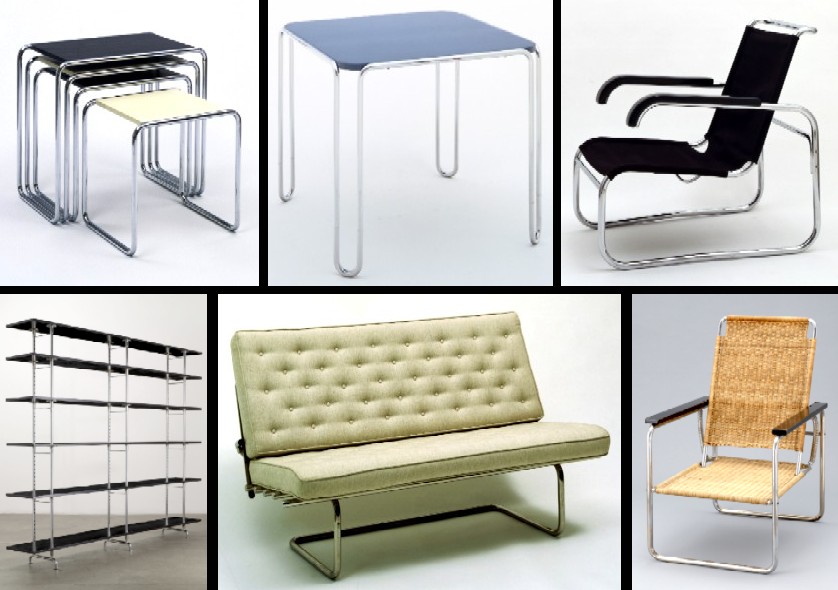 Marcel Breuer Chromed Tube Furniture Mostly for Thonet (from MoMA) [Top] Nesting Tables B9, 1925-6; Table B10 of Painted Wood, 1927; Armchair B35, 1928-9
[Bottom] Bookshelf of Painted Wood for Embrel-Werke, Mantel & Cle., 1932-5; Couch, 1930-1; Lounge Chair B25, 1928-9
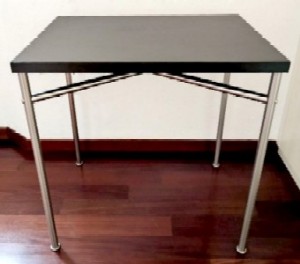
LC19, Desk, Nickel-Plated Metal Legs, Sheet Metal Top,
Pierre Jeanneret 1925, Reproduction, Deesup
Breuer wasn't the only one to hit upon the idea of making steel tube furniture in 1925. That year Charles Edouard Jeanneret (Le Corbusier) and his cousin Pierre Jeaneret created some tubular steel furniture for their public displays. They featured tubular metal furniture at their Pavilion de l'Esprit Nouveau at the 1925 Exposition Internationale des Arts Décoratifs in Paris. However, the tubes on this furniture were painted rather than plated. They also produced the 'Table Esprite Nouveau' writing desk in 1925 which had a sheet metal top and nickel-plated steel tube legs.
Although Le Corbusier's studio did not use chromed steel at the time, it was adopted as what would become the LC furniture line began to take shape under the guidance of newly hired Charlotte Perriand's who used chrome in her 1927 designs for her dining room of her Saint-Sulpice apartment-studio in Paris and her Bar sous le Toi (Attic Bar) which she re-created from the design at her home for the 1927 Salon d'Automne in Paris. The 1925 table would eventually become LC19 in the LC line of furniture. This was presented at the 1929 Salon d'Automne in Paris by Le Corbusier's studio. As seen in the image of the display below, all of the furniture there used chromed steel tubing.
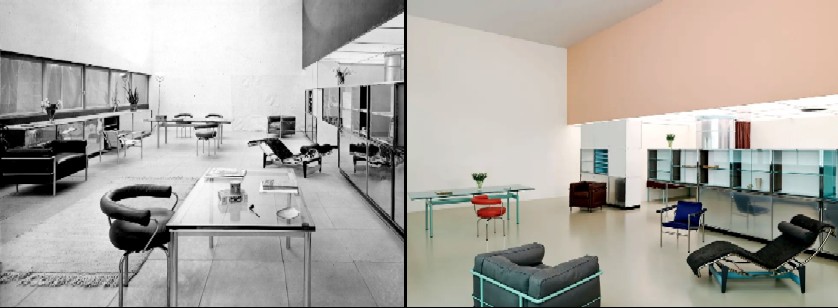
LC Furniture at the Salon d'Automne. At left, a photo of the 'Equipement intérieur d'une habitation' Display in 1929; At right is a Modern Reconstruction of the Display by Cassina in 2019
In 1926, Dutch architect Mart Stam created a rigid chair with no back legs made from ten pieces of gas pipe. Stam sketched his design on the back of a wedding announcement at a dinner party in Germany. Ludwig Mies van der Rohe, who was also at the party, took the idea and developed it into an elegantly curved, flexible chair. As with Breuer's chair, the tubes of Stam's and van der Rohe's chair were chromed to appeal to the market. (See the second image below.) Although van der Rohe's design was quite different from Stam's, Stam was eventually recognized by the courts as the originator of what came to be known as the cantilevered chair. Because tubular steel is light, strong, stable and flexible, it was a perfect medium for the design.

Mart Stam B 263 Chair, Chromed Steel Tube with Lacquered Beech Seat and Back, Thonet, 1932, Wright Auctions; MR 20 Armchair, Chromed Steel Tub with Leather Seat and Back, Mies van der Rohe for Berliner Metallgewerke, 1926-7, Art Institute of Chicago; BRNO Chair, Chromed Steel Tube and Leather, Mies van der Rohe for Berliner Metallgewerbe, German, 1929-30, Minneapolis Museum of Art
The release of such designs in the market created "a veritable design explosion" of chromed steel tubular furniture. Designs in Germany, France, Italy and the Netherlands began to incorporate steel tubing into many of their furniture designs. Several other prominent Art Deco era designers began using bent steel including Eileen Gray, Baptistin Spade, Jindrich Halabala, Anton Lorenz, Gerrit Rietveld, Hans Luckhardt and Erich Mendelsohn. Chromed tubes were prominently used in most such designs.

European Designers Using Chrome in Furniture - [Top] Lounge Chair, Chromed Steel, Mint Green Upholstery, German, 1930s, Vintage; HOPMI Chair, Chromed Steel Tube with Plywood Back and Seat, Garrit Rietveld, Designed 1932, 2013 Reproduction, Whoppah; ST16 Swivel Chair, Chromed Steel Tube, Painted Wood and Iron Yarn, Hans Luckhardt, Germany, 1931, Rago
[Bottom] Chrome, SS 34 Armchair, Erich Mendelson for Thonet, 1931, Invaluable; Adjustable Side Tables for E1027 House, Chromed Steel Tube and Glass, Eileen Gray, Designed in 1927. Reproduction, Archive of Objects; SS33 Armchair, Chromed Steel Tube, Reupholstered in Cotton Velvet, Anton Lorenz for Thonet, 1930s, Vivamus
In England, Tube Investments in Abingdon, Oxfordshire (UK) created the furniture company Practical Equipment Ltd (PEL) in 1931 to take advantage of the popular international chromed metal tube furniture trend. Fpr PEL's line of furniture, they purchased several designs from British architects including Oliver Percy Bernard, known for his work in theatre design and architecture, Wells Coates, a Modernist architect who primarily designed office furniture for PEL and Russian architect and designer Serge Chermeyeff. PEL produced a variety of interesting desks, chairs and tables which feature chromed steel tubing throughout the 1930s.
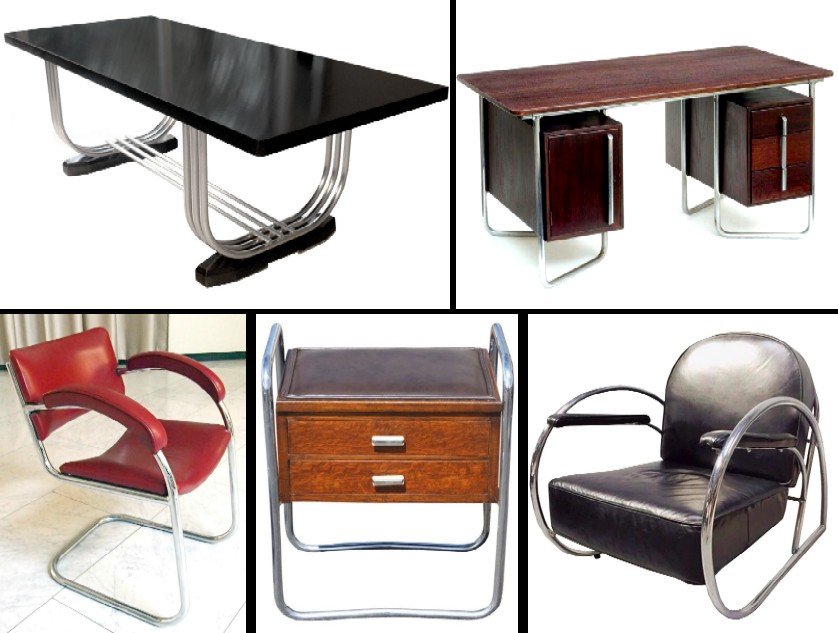
PEL Chromed Steel Tube Furniture [Top] HT-21 Table, Wood Top with Chromed Steel Legs with Enameled Feet, 1933-6, 1st Dibs; Desk, Stained Oak with Chromed Steel Tubing, c. 1931, Victoria and Albert Museum
[Bottom] Armchair, Red Leather with Chromed Tube Frame, Serge Chermayeff, 1933-6, 1st Dibs; Side Table, Chromed Steel Tube, Oak with Leather Top, 1930s, 1st Dibs; Lounge Chair, Chromed Steel Tube and Leather, 1940s, Clavel
America was not to be left out
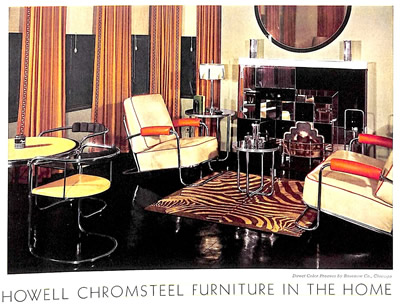
Advertisement for Howell Chrome Steel, Home Furnishing Art, 1933
of this trend. Like the Europeans, they began including tubular steel into their furniture designs in the late 20s. Donald Deskey was one of the earliest American adopters of chrome, creating chrome furniture in 1927 for his newly formed partnership Deskey-Vollmer. He continued to use chrome throughout the 1930s including some designs for Royal Metal Manufacturing Company in 1939.
In 1929, the Howell Company of Geneva, Illinois began manufacturing seamless chromium-plated tubular steel frames for their furniture which they called 'Chromsteel'. They hired Wolfgang Hoffmann in 1934 to design furniture for them using their new Chromsteel. Hoffmann continued working for Howell through the rest of the Streamline Moderne period, This was displayed at the Chicago World's Fair in 1933, the seminal event for Streamline Moderne design in America. He continued to do so until the company converted to war production in 1942.
1934 proved to be an important year for the development of chrome furniture in America, probably in part because of the chrome furniture seen at the 1933 Worlds Fair. Like Hoffmann and several other well-known designers in America began partnering with manufacturing companies to produce this type of furniture. K. E. M. Weber designed a line of chromed steel tube furniture for Lloyd Manufacturing Company that year. Gilbert Rohde began working with the Troy Sunshade Company the same year, creating seating and tables for them.
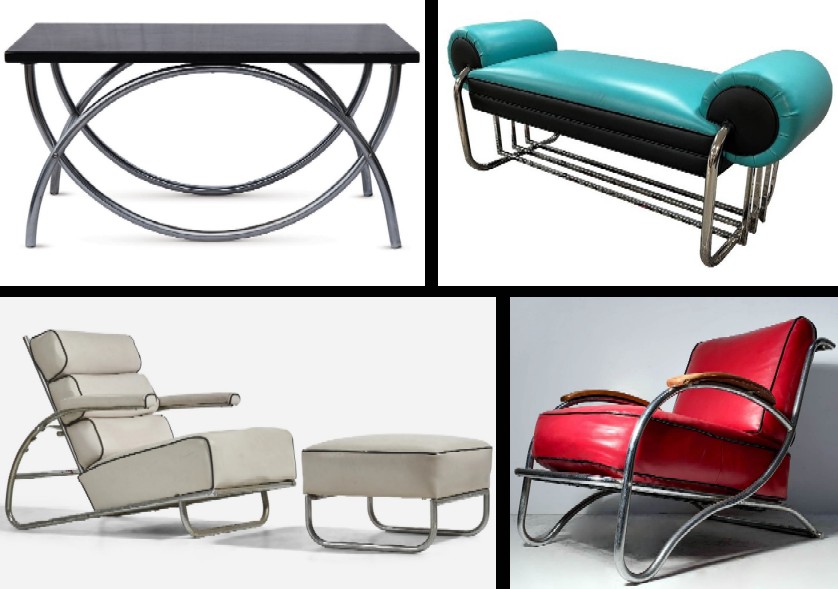
American Designers Using Chrome in Furniture - [Top] Table, Chromed Steel Tube, Bakelite and Laminated Hardwood, Wolfgang Hoffman for Howell, 1936 , Governor's Mansion Illinois; Bench with Bolster Arms, Chrome, Blue and Black Vinyl, Donald Deskey, c. 1934, Encore Furniture Gallery
[Bottom] Lounge Chair and Ottoman, Chromed Steel and Vinyl, Gilbert Rhode for Troy Sunshade Company, 1940s, PRB Collection; Lounge Chair, Chromed Steel, Original Red Uphostery, Bent Wood Arms, K. E. M. Weber for Lloyd, 1930s, 1st Dibs
As indicated, chromed metal tubing continued to be popular during the 1930s Streamline Moderne era. Thonet's success with the style made it the largest manufacturer of tubular steel furniture in the world in the 1930s. However, the onset of the second World War put a stop to chromed steel tube furniture production. Steel and chrome production were needed for the war effort. It would resume after the war, although it took decades to regain some of the popularity of the 20s and 30s.
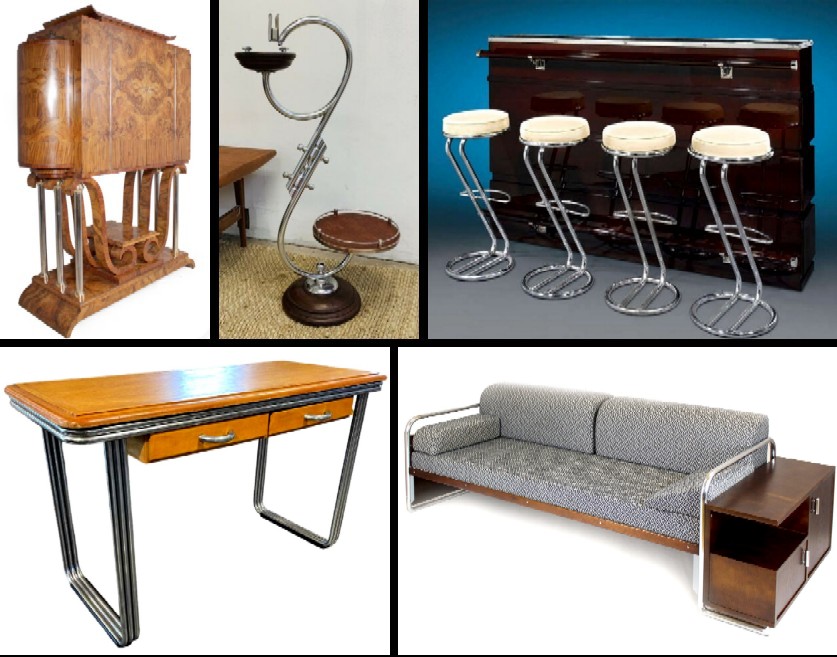 Unsigned Chromed Steel Tube Furniture [Top] Cocktail Cabinet, Walnut with Maple Lining, Chromed Steel and Brass Pillar, c. 1930, Antiques Atlas; Smoking Table, Chrome Steel Tube, Ashtray with Pipe and Matchbook Holders and Wood, The Design Ark; Bar Stools and Bar, Mahogany Bar with Chrome Accents and Mirror Top, Chromed Steel Tube Stools with Upholstered Seats, c. 1920, 1st Dibs
[Bottom] Desk, Chromed Steel Tubes and Wood, 1920s-40s, Arta Plaza; Bauhaus Sofa with Table C10, Chromed Tube and Wood, Reupholstered, Czech, 1930s, Vinterior
Sources Not Mentioned Above:
"Emile Placet", French Wikipedia, gathered 8/28/25
Eric Svensen, Sr., "The Future of Hard Chrome", Finishing and Coating website, gathered 8-28-25
Anders Sundman, "Chrome Plating History", Finishing website, gathered 8-28-25
"Marcel Breuer's Cesca chair – a brief history", Future Antiques website, gathered 3/3/25
"Chromium", Wikipedia, gathered 3-3-25
"Marcel Breuer: Club chair (model B3)", MoMA website, gathered 3-3-25
"The Design History of the Iconic Cantilevered Chair", Forum Shop website, gathered 3-3-25
"As if drawn into the room: Thonet and tubular steel", Thonet website, gathered 3-3-25
"Wolfgang Hoffmann", Wikipedia, gathered 8-29-25
"TI Group", Wikipedia, gathered 5-23-25
"PEL Furniture", Wilson 55 website, gathered 5-23-25
"PEL – Britain's modernist furniture manufacturer (1931)", Modernist Tourists website, gathered 5-23-25
"Manning, Bowman & Co.", Wikipedia, gathered 8-28-25
John Moody, "Throw Back Thursday, 2-20-14", The Patriot Woodworker site, gathered 8-28-25
Original Facebook Group Posting Chrome - Original Facebook Group Posting PEL
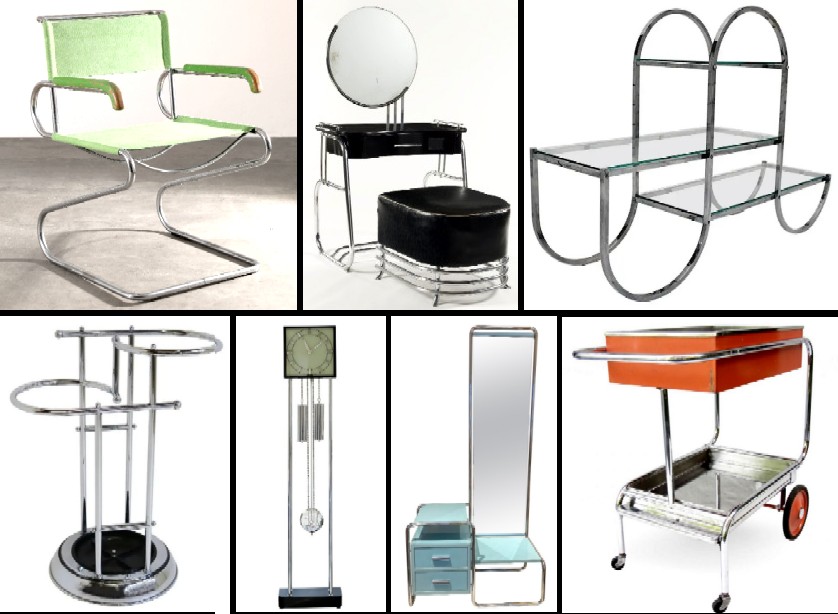
Unusual and Interesting Chrome Furniture Designs [Top] Cantilevered Chair, Chromed Steel Tube, Painted Wood and Cotton Fabric, Atrributed to Jindrich Halabala, c. 1930, Kunstund Design, Small Vanity with Stool, Chromed Metal, Wood and Probably Leather, KEM Weber, 1934, Brooklyn Museumx; Etagere, Chromed Metal and Glass, German, 1930s,1st Dibs
[Bottom] Umbrella-Stick Stand, Chrome and Bakelite, 1930, Demeyere, 1st Dibs; Grandfather Clock, Chromed Steel Tubes with Ebonized Wood Base, Square Face with Glass Dial, c. 1925, 1st Dibs; Blue BauhausDressing Table, Steel with Chromed Features, 32.6 Inches Wide Mücke & Melder, Czechoslovakia, 1930s, 1st Dibs; Rolling Bar Cart for Troy Sunshade, Gilbert Rohde, Chrome, Stainless Tray, Pumpkin Lacquer, c. 1933, Incollect