The LC Furniture Line
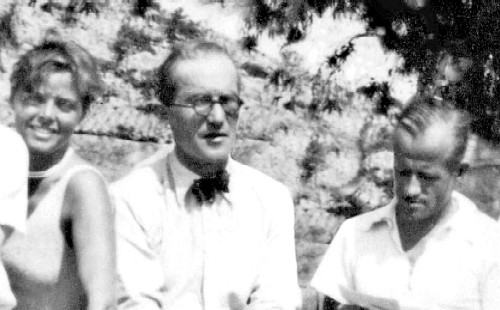
Charlotte Perriand, Le Corbusier, Pierre Jeanneret, (Probably early 1930s) Inform
The LC line of furniture is often attributed to Le Corbusier (Charles Edouard Jeanneret) although many of the pieces were developed by Charlotte Perriand with help from Pierre Jeanneret, likely with suggestions from Charles. Several of the pieces now considered part of the line were created before the Le Corbusier put together a collection of pieces that were considered the first example of the LC line at the 1929 Salon d'Automne. To fill out the collection some commissioned pieces were used from the mid 1920s along with pieces originally created for Charlotte Perriand's apartment. They were all distinctly Modernist, inspired by Charles' 'machine for living' concept, exemplifying the principles of function over form with simple, undecorated designs.
The furniture was often attributed solely to Le Corbusier in the past (and is still so attributed by some websites today). The pendulum has largely swung the other way on many websites, with some suggesting almost no involvement on his part. For example: "Corbusier openly confessed to having very little interest in designing l'équipement intérieur (furniture and fittings), something for which he had very little patience or aptitude: 'Le Corbusier always interested himself in the 'why' of things,' [Charlotte] Perriand explained in a 1984 interview for Architectural Review. '[He] had no time for what he called 'le blah blah blah'.' (Ben Weaver, "Le Blah Blah Blah", The London List, gathered 7-10-25) However, Perriand had reason to be frustrated with Le Corbusier and her observations concerning him should be taken with a grain of salt.
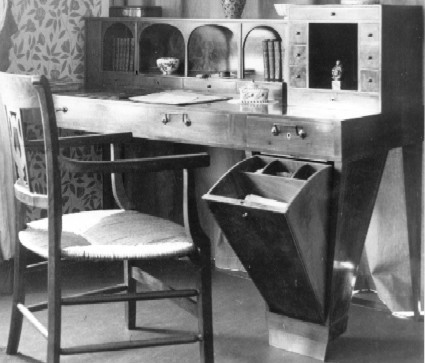
Desk at Villa Jeanneret-Perret, (c. 1915-6) Fondation Le Corbusier
Le Corbusier's relationship with furniture was complex. He did not dismiss furniture as the above quote seems to suggest. In fact, like many beginning architects, he started designing furniture in the very beginning of his career. While working with architect René Chapalaz, he designed a wooden table, chairs and a built-in sideboard for a dining room at Villa Fallet (1906-7) as well as a wardrobe with an integrated sofa for Villa Stotzer (1907-8). He spent a great deal of time on the interiors and furniture for his first independent commission, Villa Jeanneret-Perret (1911-12) designed for his parents.
Le Corbusier continued to provide interior design including some furniture on projects through the 1910s and the very early 1920s. His involvement in interior design and furniture appears to have tapered off somewhat after that, although there are examples of his furniture designs from the mid-1920s.. Elise Koering suggests that his furniture theory during this period was based partly on "a principle inspired by Adolf Loos", a Modernist architect who eschewed decoration and emphasized function over form. (Elise Koering, "Le Corbusier et la construction d'un intérieur androgyne", Histoire de l'art, 2015 , Vol. 76, p. 83) This should not be surprising, given his promotion of Modernism during this period.
Koering goes on

Études sur les différentes manières de s'asseoir, auxquelles nos sièges devraient
s'adapter, Le Corbusier (1927), French Wikimedia
to suggest that he began to focus his interior designs on the female figure in 1926. In April 1927, he undertook "Études sur les différentes manières de s'asseoir, auxquelles nos sièges devraient s'adapter" (Studies on the various manners of sitting, to which our seats should adapt). Koering indicates he expressed an interest towards developing modern seats which were gender specific, although this line of design was abandoned when Charlotte Perriand was added to his team later that year.
Koering says that this may have been at Perriand's suggestion, although it is also possible that once Perriand was on board, Le Corbusier decided he could leave many of the practical aspects of furniture design to Perriand. This would have allowed him to focus on the development of his Five Points theory, realized in Villa Sovoy which was designed and built between 1928 and 1931. Le Corbusier did return to his studies of how people related to architecture in 1943 in an attempt to address French National Organisation for Standardisation's requirement for standardising all objects related in the construction process, publishing books on the subject - Le Modulor (1948) and Modulor 2 (1955). Here again, he concerned himself with the development of good furniture, specifically looking at how it related to his. Yet one gets the impression that his primary focus was on larger architectural concerms, with less interest in room furnishings.
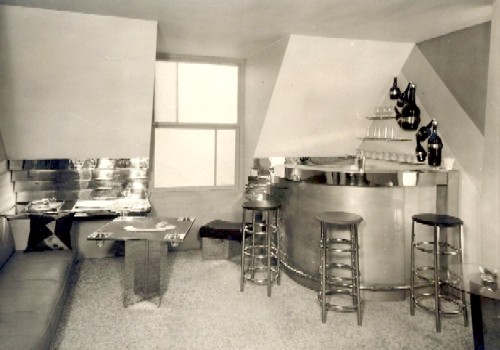
Bar sous le Toi (Attic Bar). Aluminum and Nickel. Phonograph Table. Blue, Pink, and White
Walls. Charlotte Perriand, Photo: Therese Bonney (1927) Smithsonian Institute
Whatever the case, the LC line of furniture had much of its design roots in Charlotte Perriand's Bar sous le Toi (Attic Bar) which she (re)created for the 1927 Salon d'Automne in Paris. Working with Perriand and his cousin Pierre Jeanneret between 1928 and 1930, the trio developed the LC line. (LC apparently stands for Le Corbusier.)
Although he had designed some furniture In the mid-1920s before Perriand was with the company, Le Corbusier primarily used furniture manufactured by other companies during this time. Most of the practical design credit for the furniture created between 1927 and 1930 belongs to Perriand. Her notebooks containing sketches and notes on her design ideas include some of the LC furniture pieces created for specific clients. In fairness, she was inspired by Pierre and Le Corbusier's books Vers une architecture (1923) and L'Art décoratif d'aujourd'hui (1925). Both preached Modernism, with the latter emphasizing the use of function over form and chastizing unnecessary decoration in furniture (p. 35) as well as recommending the use of modern materials in furniture design. (p. 47) Perriand also drew upon Le Corbusier's 'Studies', creating her own images of male and female silhouettes and their interactions with furniture.
The LC Furniture Pieces
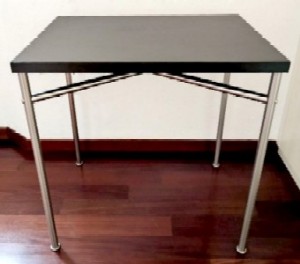
LC19, Desk, Nickel-Plated Metal Legs, Sheet Metal Top,
Pierre Jeanneret 1925, Reproduction, Deesup
Some of the designs preceded the creation of the LC line, with their 'LC' designation coming later when the furniture was first presented to the public in 1929. The first furniture piece that would later be labeled an LC piece is generally attributed to Pierre Jeanneret, designed in 1925, probably with Charles' cooperation or approval. This was a writing desk or dressing table which was called Table Esprit Nouveau, a name apparently taken from the journal Esprit d'Nouveau (1920 - 25) which Le Corbusier published and for which Pierre provided graphic design. It is tempting to tie this to the Jeanneret's Pavilion de l'Esprit Nouveau which appeared at the 1925 Exposition Internationale des Arts Décoratifs in Paris and featured painted tubular furniture. However, there is no evidence that this table had been used there. It was eventually added to the LC line as LC19. It featured chromed tubular legs.
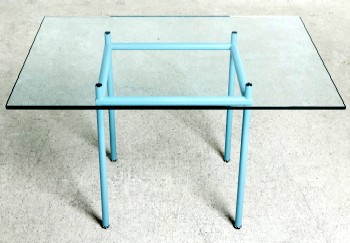
LC12 La Roche Table, Glass and Enameled Metal,
Designed 1925, Reproduction, Auctionet
A second table was developed by Le Corbusier and Pierre Jeanneret for Maison la Roche-Jeanneret (1923-1925). This commissioned project consisted of two dwellings. The first was designed for Raoul La Roche, a banker and a collector of modern art and who wanted a gallery space attached to a private apartment. Adjacent to this was the second dwelling, the Jeanneret house for Le Corbusier's brother Albert Jeanneret. This table was eventually labeled LC12.
Three other pieces that were added to the line came from Charlotte Perriand's 1927 designs for the dining room of her Saint-Sulpice apartment-studio in Paris. They included a swivel chair, a swivel stool and a stationary stool with a metal frame and a woven rattan seat. The swivel stool was basically the same design as the swivel chair without the sides and back. The swivel chair would become LC7 when the LC line was introduced in 1929, the swivel stool LC8, and the stationary stool LC9.
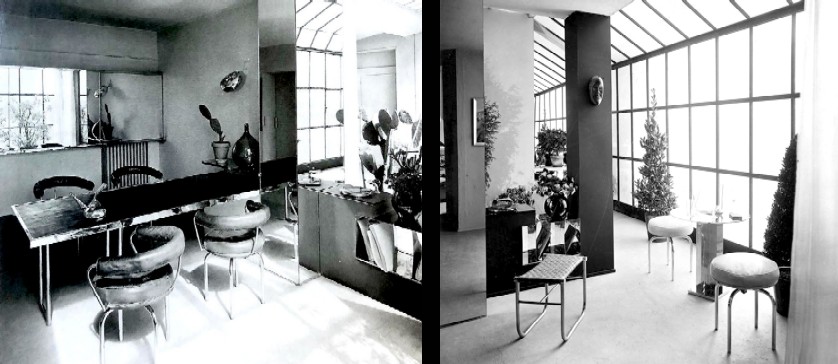
LC7, LC8 and LC9 in Dining Room, Saint-Sepulchre Apartment, Charlotte Perriand, 1927, Instagram and In/Out
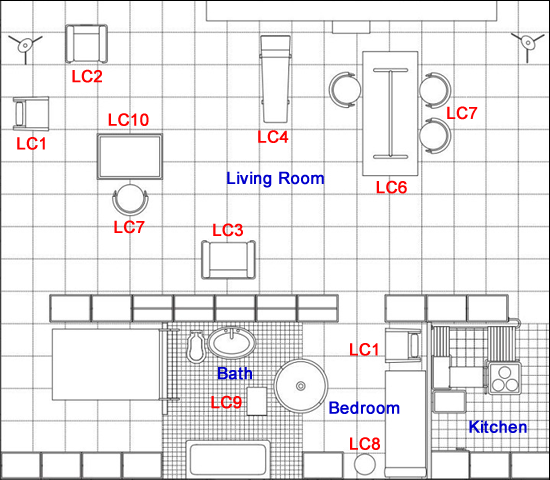
Floor Plan for the 'Equipement intérieur d'une habitation' at the Salon d'Automne (1929)
Plan by Dick van Gameren from Équipement intérieur d'une habitation, Delft Architectural Studies
on Housing, 7(11), p. 106
The LC furniture line was exhibited to the public for the first time at the Salon de Automne in 1929 under the title 'Equipement intérieur d'une habitation'. This display was meant to provide a complete example of modern living spaces, consisting of a large living area and a small bedroom, kitchen and bathroom. The rooms were separated by locker-like cabinets to be used as storage. (These would later be labeled as LC20 by the Cassina furniture company when they acquired the rights to the furniture in the 1960s.) The use of lockers in place of walls provided the open floor layout specified in the Jeanneret cousins' Five Points theory.
Included in the display were some of Charlotte Perriand's furniture which she had created for her dining room. These include the LC7 swivel chair in the living room and the LC9 which was repurposed as a bath stool. It is suggested on the web that Jeanneret's LC19 desk also appeared at the Salon, paired with Perriand's LC7 armchair. However, I found no pictural evidence to support this and I suspect this is meant to refer to a table developed specifically for the show, LC10.
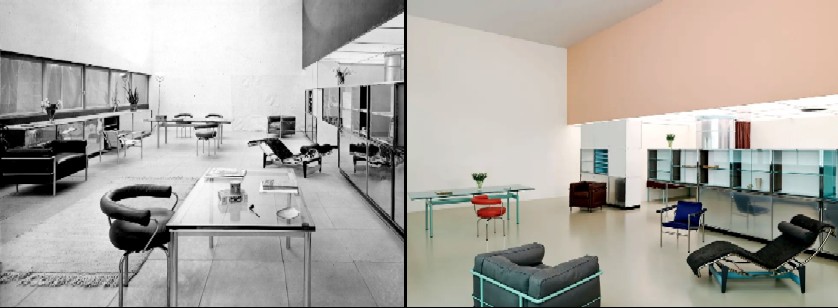
LC Furniture at the Salon d'Automne. At left, a photo of the 'Equipement intérieur d'une habitation' Display in 1929; At right is a Modern Reconstruction of the Display by Cassina in 2019
Several pieces were developed in 1928
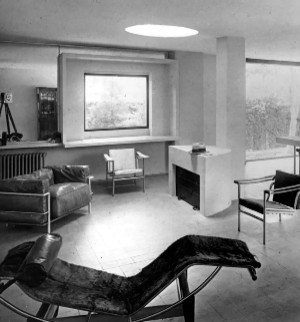
Church Pavillion, LC1, 3 and 4, Photo circa 1930,
Fondation Le
Corbusier
specifically for inclusion at the Salon. Let's look at each of them in more detail.
Among the better known pieces today are four chromed tube chairs - LC1 - 4.. LC2 and 3 were first sketched by Charlotte Perriand during 1927-8 for the rehabilitation of the pavilion of Barbara and Henry Church in America. A period photo of the pavillion shows LC1, 3 and 4 in place. Technically, then, these pieces were developed for both the Salon and this commission, which was designed between 1927 and 1930 according to Fondation Le Cobusier. ("Villa Church - Ville d'Avray, France, 1927-1930", Fondation Le Cobusier website, gathered 7-17-25)
The LC1, also called the Basuclant, is a sling chair with an adjustable back. "[T]he LC1 armchair is characterised by its strict, minimalist form, a form 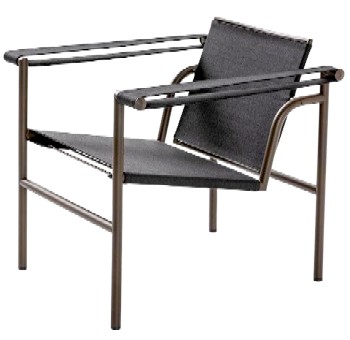
LC1 Basuclant - Sling Chair, Developed 1928, Modern Example
by Cassina, Chairish
reduced to elementary geometric shapes yet which results in maximum comfort. Largely responsible for the very high comfort levels are sophisticated details such as the movable backrest or steel springs behind the seat and backrest." ("1 Fauteuil dossier basculant", smow website, gathered 7-17-25) This chair was created to be a Modernist version of an 'expedition' chair originally being made with cowhide or black leather on a chromed steel frame.
LC2 and LC3 were basically the same design. LC 2 was the Grand Confort, petit modele armchair and LC3 was a larger version of the Grand Confort, referred to as the grand modele. The LC2 and LC3 chairs were a modernist redesign of of the English armchair. "The LC 3 (and the LC 2) were considered so incredibly comfortable to sit in that the Le Corbusier Group referred to them as 'cushion baskets'." ("Le Corbusier Furniture - Comprehensive Guide (LC1 - LC19)", The Shelfist website, gathered 7-8-25)
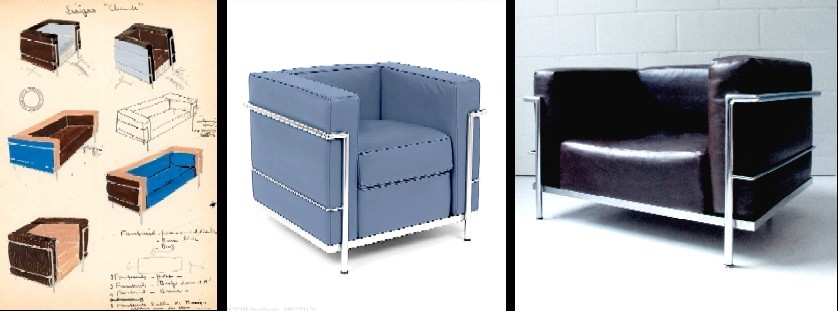
LC Furniture Designed for Commissions by Charlotte Perriand, Le Corbusier and Pierre Jeanneret, From Left:Sketches of LC2 and LC3 for Church Pavilion, Charlotte Perriand, c 1927-8, House and Garden; LC3 Grand Confort, grand modele, Designed in 1928, 1970 Cassina Repro Model, Birnbaum
LC4 is the Chaise Longue recliner, a particularly distinctive design and one of the best known piece in the collection. Le Corbusier, in his machine parlance, called it a 'relaxing machine' because it was curved like the body in repose. This is likely the description he gave to Perriand who did most of the actual design research and work. Sketches and notes by Perriand indicate her importance to the design, fabrication and specification of materials used.
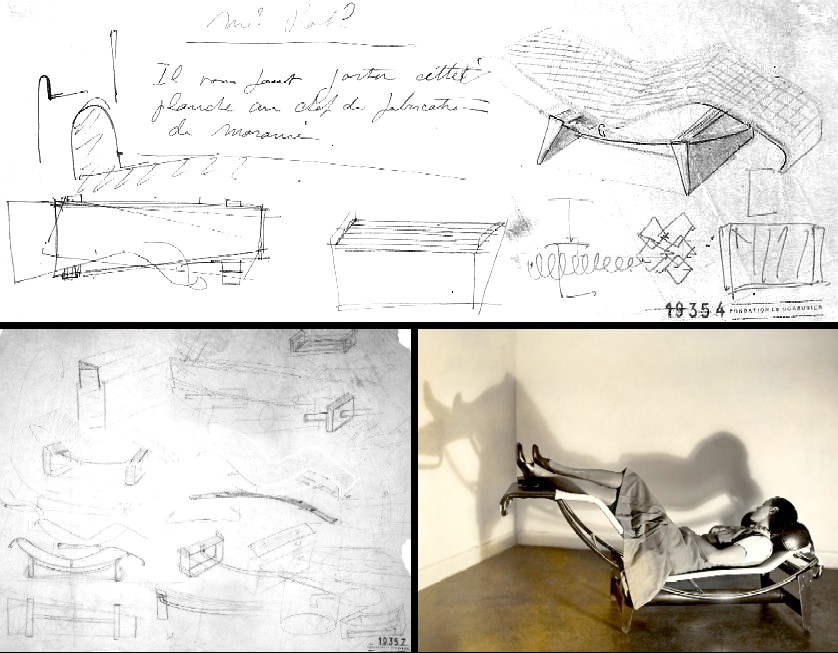
LC4 Chaise Longue recliner Sketchs and Photo, Charlotte Perriand, 1928. Sktetches from Le Corbusier Facebook Page, Photo from Gagosian.
LC6 was referred to as the 'Table Tube d'Avion' (Airplane Tube Table). The name refers to the round steel tubes which are similar in profile to those found in aviation, thought to resemble the spacers between the wings of a biplane. The table top was originally held in place by four corner adjacent supports which could be adjusted to change the height of the top. (Some of the modern models have an added support in the center.)
The LC10, also called 'Table en Tube' (Tube Table) was a fairly simple design with a thick glass top, chromed tube legs and a narrow, painted apron. The table served as a desk at the Salon. Being so simple and functional, In 1984, Perriand worked with Cassina (who acquired the license to produce the LC furniture) to modify the design so that it could be made in different sizes, shapes and heights. This allowed it to work in other capacities such as serving as a dining room, coffee or end table.

LC10 Table en Tube (Tube Table) and LC6 'Table Tube d'Avion' (Airplane Tube Table), Designed in 1928, Modern Reproductions by Cassin
Three pieces which were included in the LC line were designed by Perriand with assistance from Le Corbusier and Pierre Jeanneret after its introduction at the Salon d'Automne in 1929. (Whether they were included in the line by Le Corbusier or by Cassina when they got the rights to produce the furniture is not known. Based on the history of LC13, it seems like at least some of them may have been added later.)
The LC13 the wagon fumoir arm
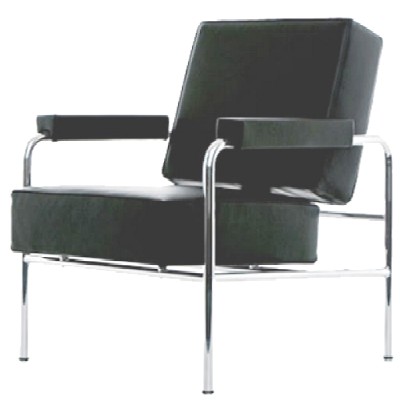
LC13 Wagon Chair, Originally Designed 1931, Cassina Reproduction, 2006
chair which was designed in 1931 to be used in the smoking carriages on French Railways.. The black leather upholstered seat and back cushions were meant to look as if they were floating inside the tubular chromed steel frame. It is not clear whether any of these chairs were actually sold to French railways during the 1930s - no specific railroad company is identified as being the client for this chair and there appear to be no photos of them in a railroad smoking car. One source says, "The design was found in Charlotte Perriand's archive after her death, after which the armchair was put into production by Cassina from 2006. However, this production only lasted a few years". ("
Set of Vintage Smoking Wagon Armchair by Le Corbusier for Cassina, 2006", Pamono website, gathered 7-16-25) From this description, it seems possible that this chair may have never actually been produced during the 1930s.
Other pieces of the LC line of furniture were designed for Le Corbusier's apartment in Paris. Perriand would have been the primary designer of this furniture.
The first of these was the LC5 Sofa, a simple, modernist sofa without arms. "Legend has it that his wife Yvonne insisted on having a sofa, persistently enough that Le Corbusier was eventually compelled to design this famous piece for her". ("Le Corbusier Furniture: Modernist Objects that Changed Design", Archive of Objects website, gathered 7-16-25) Like the LC10 Tube Table, when Cassina acquired the rights to produce the LC line of furniture, they worked with Perriand to to update the couch design for modern buyers.
The second piece for Le Corbusier's Paris apartment was the LC 11 Table Pieds Corolle (Table with Corolla Feet). Both pieces were designed in 1934. The LC11 was initially created with a marble top for the apartment. A second table was manufactured for the Maison du Jeune Home which appeared at the Brussels Universal Exposition which had a slate top.

Top: LC5 Couch and LC11 Table, Both Designed by Charlotte Perriand in 1934 with Assistance from Le Corbusier and Pierre Jeanneret for Le Corbusier's
Paris Apartment. Couch is 3 Seat Version, Chromed Metal with Leather Cushions, Reproduction by Cassina, Table is Original from the Apartment. Bottom left: LC11 Marble Top Table (center, rear) in Le Corbusier's Apartment;
Bottom right: LC11 Table Slate Top, 'Study in La Maison du jeune ( House of a Young Man)' at Exposition Universelle, Brussels, 1934
The four remaining pieces of the furniture included in the LC line were designed in the 1950s, apparently by Le Corbusier himself. Perriand was no longer associated with him and so had no hand in thier creation. While Modernist in character, they emphasized simple wood rather than employing modern materials. This may be explained by Le Corbusier's shift from his sleek, machine-like style of the 1920s and 30s to one which incorporated more primitave elements after the Second World War.
The earliest design in this group was the LC14 Tabouret (Stool), which is basically an open wood box with cutout handles and dovetail joint corners. This was originally 'designed' in 1952 for his small, seaside retreat Le Cabanon (Shed), although, in truth, it was more of a borrowed design. "Le Corbusier found it as a Scottish whisky crate washed up on the beach near his tiny experimental Cabanon home at Roquebrune-Cap-Martin on the Côte d’Azur in France; modernists back in the day loved nothing more than to see what could be done to make small living spaces comfortably habitable." (Mark Holgate, "Matthieu Blazy on taking cues from Le Corbusier and his new Bottega Veneta furniture collaboration", Vogue website, gathered 7-16-25) Using the design, he created more of them for children’s rooms at the Unité d’habitation of Nantes Rezé in 1957. The stool was modified in 1959, making it larger and squaring the cutout handles for use in the studient residence hall at Maison du Brésil in Paris.
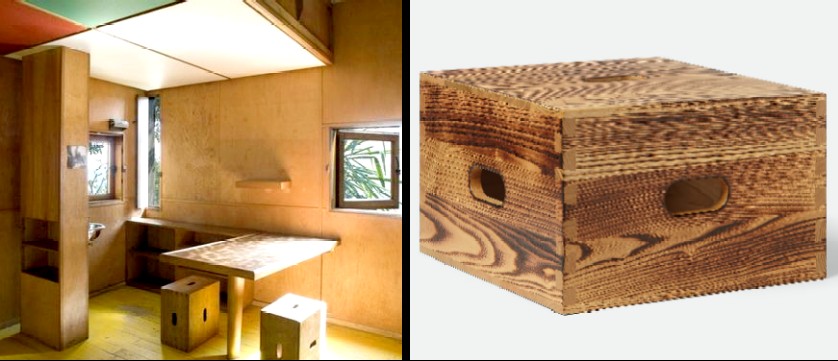
LC14 Tabouret, Left: LC14s at a table in Le Cabanon, Tumblr; Right: LC14 Tabouret Based on Original from 1952, Modern Example, Bottega Veneta
LC19 Portmanteau (Coat Hanger) is perhaps the most unusual piece in this group. Like the Tabouret, it was first created for his Cabanon at an unknown date. (The Cabanon was built in 1951 for his wife, so it
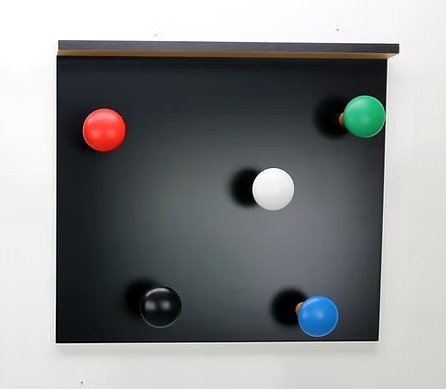
LC17 Portmanteau (Coat Rack), 1950s Design, Cassina Reproduction, Deja Vintage
would likely have been in the first half of the 1950s.) It is generally believed that he was thinking of the small space found in cruise ship cabins when he designed this piece. In 1957, Le Corbusier decided to use the coat hanger for the Unités de Camping (campsites), located next to his Cabanon. He gave each mushroom-shaped head a new paint job, employing matte white and vivd tints of red, blue and green.
The LC16 wooden desk was designed for the children's rooms in the Unité d'habitation in Nantes-Rezé, France in 1957. (This was also the first commission to employ his LC14 Tabouret.) In addition to providing a flat surface for writing, shelves were created along the side of the L-shaped desk to provide an integrated storage area.Le Corbusier's original design included the option to have the desk top finished in red lacquer.
One of the more intriguing pieces from the new batch of LC furniture was the LC15 Table de Conférence (Conference Table), created in 1958 for use in Le Corbusier's Paris atelier (studio workshop). It marries a round wooden top to an interestingly designed square base made of steel tubes arranged as rectangles, each bisected by a single diagonal. His design was intended to allow 10 people to gather around it. The table top is about 72" (1850 mm) in diameter. Despite the use of steel and wood, the table still has the rustic look of the other furniture in this group.
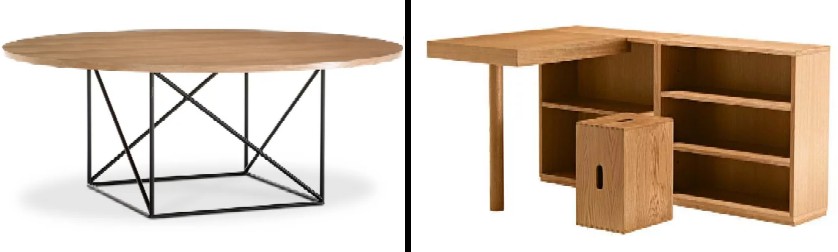
Left: LC15 Table de Conference, Designed 1958 for Le Corbusier's Atlier, Cassina Reproduction, Archiproducts
Right: LC16 Desk with LC14 Tabouret, Le Corbusier, Desk designed in 1957, Modern Example by Cassina, Dezeen
As has been mentioned as as the images indicate, most of the LC pieces seen on the market were reproductions. The original pieces from the 1920s and 30s were manufactured by the Thonet company. The reproductions are manufactured by the Italian Cassina furniture company who acquired the rights to the collection in 1964. They are marketed under the label 'Cassina I Maestri' (Cassina Masters). Some of the reproductions were produced only for a short time, while others have been in production since reproduction manufacturing began. While Cassina uses the original designs and sketches to build the furniture, they have expanded the materials, fabrics and finishes of the various pieces they produce. As noted previously, they worked with Charlotte Perriand in 1984 to redesign some pieces so that it would be more accepable to modern buyers. The Cassina line is more popular than the original line.
Sources Not Mentioned Above:
"Le Corbusier's Furniture", Wikipedia, gathered 7-8-25
"Furniture", Fondation Le Corbusier website, gathered 7-9-25
"Cassina – LC Le Corbusier Collection: did you know that?", Gerosa Design website, gathered 7-10-25
"Charlotte Perriand's notebooks and their fascinating insights into a designer's mind", House & Garden website, gathered 7-10-25
Becca Polak, "LC2 Chair: One Of The Most Iconic Le Corbusier’s Creations", Manhatten Home Design website, gathered 7-17-25
"LC19 Table Esprit Nouveau", ARAM website, gathered 7-10-25
"Villa Fallet", Fondation Le Corbusier website, gathered 7-10-25
"Villa Stotzer", Fondation Le Corbusier website, gathered 7-10-25
Alex Ronan, "The Woman Behind Le Corbusier's Iconic Chaise Almost Didn't Get the Job", dwell website, gathered 7-10-25
Dick van Gameren, Équipement intérieur d'une habitation, Delft Architectural Studies on Housing, 7(11), pp. 104-07
"6 Table tube d'avion", smow website, gathered 7-10-25
"Maison La Roche", Fondation Le Corbusier website, gathered 7-11-25
Eleanor Gibson, "Le Corbusier's Maison La Roche-Jeanneret was designed for his brother and a close friend", Dezeen website, gathered 7-11-25
"LC13" , Designer Pages website, gathered 7-16-25
"LC14 Tabouret Cabanon, Tabouret Maison du Brésil, Tabouret Nantes Rezé", Cassina website, gathered 7-16-25
"About Cassina", Architronic website, gathered 7-10-25