
David Saltman and Brown-Saltman Company (1923 - 1960)
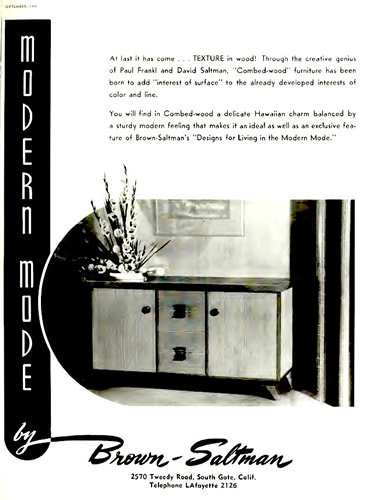
Brown-Saltman Ad, California Arts and Architecture, Sept. 1941
The Brown-Saltman was in 1923 in Los Angeles. The founders were David Saltman and his brother-in-law, William S. Brown. It may have been called the 'Brown-Saltman Upholstering Company', which was located in Los Angeles by 1926.. (See Furniture Buyer and Decorator, Volume. 112:1, January 1926, p. 42). It is possible that Brown-Saltman Upholstery was separate company which was incorporated in 1927 by David Saltman, 'S. Brown' and Isaac Fishman. ("Brief Notes of Trade Interest, Decorative Finisher, Volume 53, January, 1928, p. 115) However, the company t was located in the same place as the furniture company at this time and was incorporated by at least two of the same people.. The company's focus was initially on reproduction furniture (and perhaps upholstery).
David Saltman had emigrated to the United States from Russia around the turn of the century with his family and eventually settled in Los Angeles. Not much else about him is found on-line, other than he married a woman whose original last name was Brown. This is according to a report in a 1927 edition of Furniture Manufacturer magazine which has a number of interesting details about the company.
David Saltman has purchased the interest in Brown-Saltman Co. owned by his brother-in-law Wm. S. Brown. The furniture factore is at 2570 Tweedy Road, Southgate, California. The partnership, recently dissolved, was established in 1923, with the company making living room furniture in a factory whose site has now become that of Los Angeles City Hall. Mr. Saltman will continue to put his major emphasis on modern, particularly in the modification of American modern by Swedish and French trends. (Furniture Manufacturer, Volume 53, 1938, p. 30).
Among the points of interest in that quote is that the company moved from its previous address in Los Angeles to Southgate around this time. Even more notable is that Saltman was interested in [and possibly was] producing Modernist furniture based on in part on

Paul Frankl in the 1930s or 40s
European designs at least two years before he started working with notable American Modernist designers. One cannot help but wonder if his desire to change direction from reproducing older, ornate styles to more modern ones wasn't what led Saltman to buy Brown out.
1939 was important to the company's direction because, as Joshua Saltman's La Dorada Arts and Crafts furniture website explains, that was the year "David Saltman became enamored with the modern designs of Paul Frankl and together they began to mass-produce lines of contemporary furniture." ("Joshua Saltman", La Dorada Woodworx website, gathered 10-10-25) Frankl, the noted 'Skyscraper style' furniture creator, left both the style and the city in 1934, moving to Los Angeles to focus on developing and selling rattan furniture. (For more on this period of Frankl's life, see this post.)
One account claims that David Saltman called Frankl and asked him to design a line of furniture for him. Another says he met Paul Frankl at a party in 1939 which led to a discussion about working with him to create a line of Modern furniture. However it happened, Frankl wanted to bring Modernist designs to the American public, so he agreed to design a line of furniture for Saltman. Of his work with Saltman, Frankl wrote,
Dave Saltman was the most lovable and the most bewildered
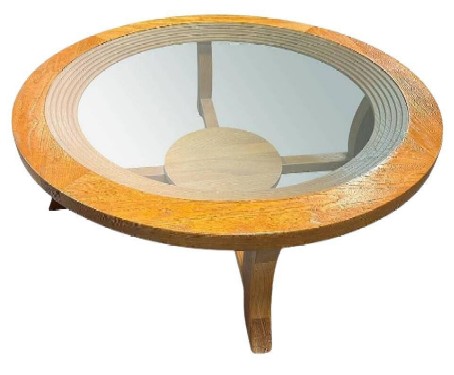
Stepped Circular Table, Blond Oak, Glass, Frankl for Brown-Saltman, 1940s, 1st Dibs character I ever ran into.His enthusiasm for modern, for California, and for America, his adopted country, was boundless and only limited by other enthusiasms that filled his overflowing soul. He was a rough diamond but had a warm heart, and I could listen to him untiringly as he told of his arduous early struggles that left him embittered to no one.
...
The furniture Dave brought out under my name was chiefly an adaptation of pieces I had made previously, the models of which he already held in abeyance. Added to them was a dining room suite copied from one in my own house and added were some occasional pieces to fill the gap. Even before they were put into production, we thoroughly remodeled their display space, making it into the first modern showroom in the Los Angeles Furniture Mart, a fitting, appropriate background for their extensive showings.The new line did us both credit, and Saltman promoted it well, putting his firm at the head of California furniture manufacturers, also calling it to national attention. (Paul T. Frankl, Autobiography, Christopher Long and Auror McClain, eds., 2013, p. 198)
The sales of Frankl's designs for Brown-Saltman exceeded both Saltman's and Frankl's expectations. Frankl quickly designed a second line relying on simpler designs which were painted or made from less expensive yet interesting materials such as textured plywood (which Frankl
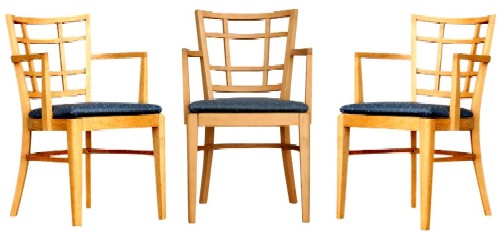
Dining Room Chairs by Frankl for Brown-Saltman, Wood & Fabric, 1940s, Tropical Sun Rattan
referred to as 'combed wood'). An article about some of their designs in 1941 explained,
[i]t derives its character from the material from which it is made - combed wood, a new type of plywood with deep, irregular grooves cut into its surface through a patented process. This brings a new wood texture which subtly but forceful complements the excellence and simplicity of it's design. Combed wood has a texture all its own, differnet from that achieved by sandblasting steelbrushing, or other processes." ("New Designs", California Arts and Architecture, September, 1941, p. 23)
In fact, combed plywood was invented by Donald Desky in 1940 who called it Weldtex. It was originally manufactured by U.S. Plywood, becoming popular in the 1950s.
This line did well enough for Frankl that designed a third line in the fall of 1941. This line sold even better than the previous two had, leading to David Saltman and Paul Frankl signing an extended contract in 1942. Saltman was extremely pleased, and, according to Frankl, "with true Saltman exuberance and too true to ever be forgotten, he said, 'now all my worries are over-I have a designer for life-tomorrow I go fishing!'". (Frankl, p. 199) On his way to the High Sierras, Saltman hit a truck head-on and was killed instantly. "The California furniture industry lost in him its biggest booster, we who loved him a true friend." (Frankl, p. 199)
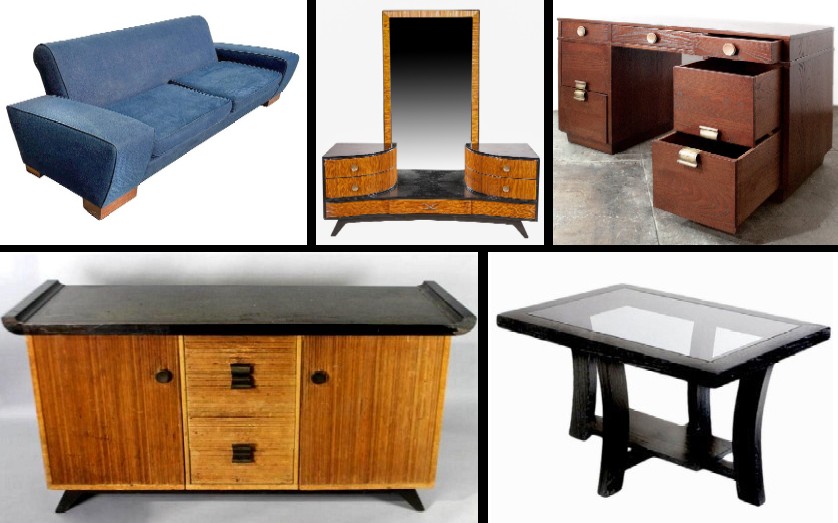 Paul Frankl Designs for Brown-Saltman, <Top> Speed Arm Sofa, Mahogany and Blue Fabric, Paul Frankl attr., 1940s, 1st Dibs; Vanity, Black Lacquered Wood with Combed Oak Plywood, Mirror, Abell; Desk, Oak with Walnut Stain, Brass Hardware, 1940s, Rehab Vintage
<Bottom> Asian-Inspired Credenza, Black Lacquered Wood with Combed Oak Plywood, Mirror, 1940s, Potomack Company; Side Table, Black Lacquered Wood, 1940s, Tropical Sun Rattan
Brown-Saltman had an interesting method for promoting their furniture during the 1940s. "Universal Studios set designers had a standing contract to buy every piece manufactured by Brown-Saltman, [so] the company gained wide exposure which encourage new markets for whatever it produced." (Harvey Molotch, Where Stuff Comes From, 2004, p. 177) It wasn't just the promotion that encouraged sales, however. Their pricing and quality were well-balanced enough to attract mid-market consumers. "Together, they created stunning mid-century modern solid wood furniture with Art Deco influences. Brown Saltman side tables, cocktail tables and credenzas are known for their thoughtful designs and exquisite details." ("Brown-Saltman", 1st Dibs website, gathered 10-10-25)
War restrictions put in place in 1943 caused the cessation of furniture production in the United States. When Brown-Saltman recommenced production after the war, Frankl designed not to continue working with them. Comments from owners of Brown -Saltman furniture found online indicate that Frankl's designs are not signed.
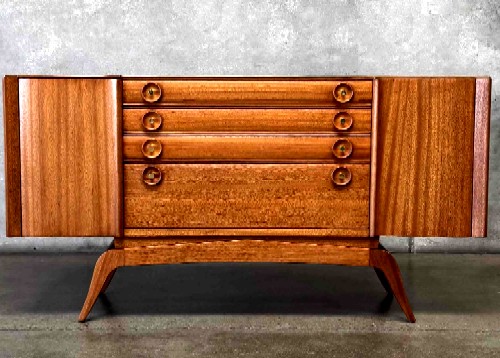
Credenza for Brown-Saltman bu Gilbert Rohde, Sol/id Wood with Lucite Pulls, c. 1940,
Urban Americana
Oddly, several on-line sources claim that Brown-Saltman was started in the early 1940s by David Saltman and Paul Frankl, something which cannot possibly be true based on information from various printed sources from 1938 about Saltman purchasing Brown's share of the company.
In the early 1940s, Brown-Saltman also began working with Modernist furniture designer Gilbert Rohde. According to biographer Phyllis Ross, Rohde designed furniture for them around 1940, although she doesn't provide any detail about their relationship. Many of the furniture pieces attributed to him today are tables with U-shaped bases. However, discussion in the Art Deco and Streamline Moderne Home Decor Facebook group revealed that such tables are actually by a Wisconsin company by the name of A. A. Laun who produced them beginning in 1949. (An example from their catalog appears here in the discussion.) Most of Rohde's work for Brown-Saltman that I've seen were his ever-reliable bedroom sets with designs very similar to those he designed for Herman Miller. From what I can tell, the furniture he designed for them is solid wood like that Frankl. Some, if not all, of it is Mahogany and has Lucite drawer pulls. Everything I've seen is in the same style which may suggest that he only designed a single line for them. Without better substantiation, it is difficult to say for sure.
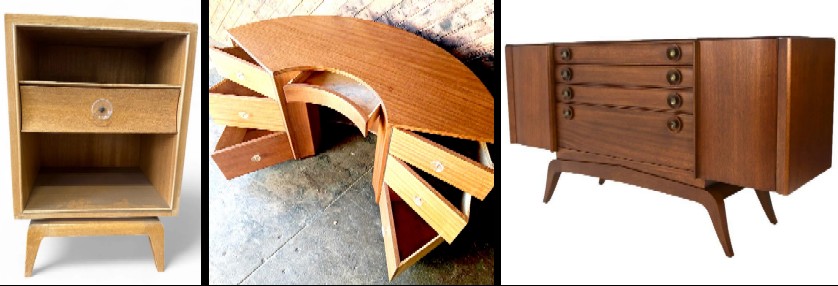 Gilbert Rohde Furniture for Brown-Saltman, c. 1940 (From Left): Nightstand, Solid Wood with Lucite Pulls, 1940s, Live Auction; Crescent Desk, Mahogany and Lucite, Attic; Buffet, Solid Mahogany with Lucite Pulls, Early 1940s, 1st Dibs
Brown-Saltman
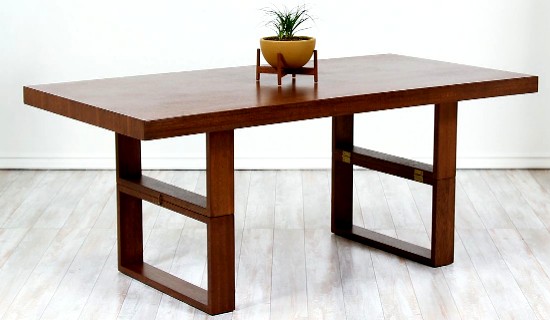
'Camel Table' with Adjustable Legs, Wanut Stained Mahogany, Hendrik Van Keppel and Taylro Green,
1950s, Danish Modern LA
resumed production after the war, focusing primarily on Midcentury Modern style furniture. Following their success partnering with Frankl and Rohde, they continued to work with notable designers including John Keal and Paul Lazlo. A sideboard designed by Hendrick Van Keppel and Taylor Green was included in the Museum of Modern Art's 'Good Design' exhibition in 1950-1. Some sources indicate that the company ceased to operate in 1960, although there are examples of them advertising in the mid-1960s and early 1970s.* They established a contract with 'the largest furniture manufacturer in Japan" in 1967. (Transcript of the Hearing on the California Institute of Applied Design, October 17, 1967, California Legistlature Assembly, Interim Committee on Government Efficiency and Economy, p. 15) As the furniture below indicates, Brown-Saltman was still producing furniture in the 1960s and 70s.
* See for example House & Garden, Volume 147, Parts 1-6, 1974, p. 9 , Woodworking Digest. Volume 66, 1964, p. 31 and Interiors, Volume 129, 1969. p. 58
 Midcentury Modern Furniture by John Keal (From Left): Dining Room Chair, Bleached Mahogany with Red Upholstery, 1970s, 1st Dibs; Side Table with Magazine Rack, Walnut Veneer, 1960s, 1st Dibs; Expanding Coffee Table, Walnut and Formica, 1st Dibs
Sources Not Mentioned Above:
"Vanished Makes: Brown-Saltman Furniture Manufacturing Company", Progress is fine, but it's gone on for too long Blog, gathered 10-10-25
Marsha Pillers, Facebook discussion on October 3, 2023, gathered 10-11-25 - Pillers photographed a page from a book talking about David Saltman which is unfortunately not identified by name.
Alison J. Clarke and Elana Shapira, Emigre Cultures in Design and Architecture, 2017, p. 87
Furniture Manufacturer, Volume 53, p. 30
Furniture Age, Volume 44, p. 54
"Weldtex", Vintage Plywood Millworks website, gathered 10-14-25
Erin Murphy Budzen, Facebook post, gathered 10-24-25