Blanche-Jeanne Klotz-Gilles (1885-1964)
Decorator Blanche-Jeanne Klotz-Gilles, usually called Blanche Klotz or B. J. Klotz (and occasionally Jeanne
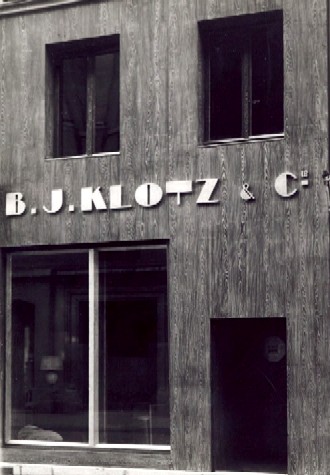
B. J. Klotz et Cie Store Front, Paris c. 1935, Smithsonian
Blanche Klotz), was born Renée-Blanche Dreyfus in Paris on 13 September 1885. She was most widely known in design circles as Blanche Klotz or "B. J. Klotz". Little is known of her early years. She married Jean-Paul Klotz in 1910 and became a war widow in November of 1914. Although nothing is said about her schooling, an article written by Renê Chavance for Art et Decoration states that she was self-taught.
It could be said that this artist was driven by a natural inclination. Her vocation came effortlessly, from the normal exercise of her domestic skills. She began by furnishing her own home before even thinking about furnishing others'. Charmed by the good taste and ingenuity she had displayed in her own home, discerning friends convinced her not to keep to herself the resources she was so successfully utilizing. She began, tentatively at first, by designing lampshades, cushions, and curtains. And then, as her confidence grew, she designed furniture, created ensembles in collaboration with Mrs. Perrera, and finally ventured into [interior] architecture. (Chavance, "Mme B. J. Klotz et le Dêcor de la Maison", Art et Decoration, Septembre, 1928, p. 66)
Klotz appears to have established a business at some point during her early years, most likely shortly after the First World War, at 62, rue La Boétie in Paris. A list of exhibitions from December of 1922 lists her at that address with the display featuring "Wood engravings; printed fabrics, endpapers by Mme Henches; bindings by Rose Ailler; sculptures by Ernest David, up to January." ("Programme des Expositions", La Semaine à Paris: Paris-guide, December 15, 1922, p. 31) The next week, that journal gave a review of Mme. Henches and her ability to work with wood. It does not say anything significant about Mme. Klotz.
In July of 1924, Klotz established a partnership with Thérèse Pereya. Like Klotz, Pereya, "on the encouragement of her relatives... turned her love of beautiful things into a profession" by opening a shop at 3 rue de Miromesnil. ("Thérèse Pereyra", French Wikipedia, gathered 11-2-25 & Dominique Missika, Therese, Le Grand Amour Cache de Leon Blum, 2016, p. 108)
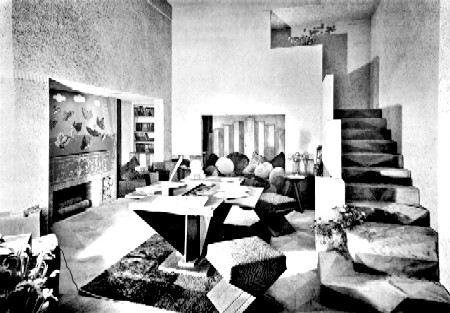
Photo of the Montagnac Hall, 1925 Exposition Internationale des Arts Décoratifs et
Industriels Modernes, Paris, NYPL Digital Collection
They established a simple general partnership together, naming their business 'B. J. Klotz et Cie'. It was located in the heart of the antiques and art gallery district with the pair designing and creating Modernist-influenced furniture and decor which had a precise and delicate look. According to Wikipedia, Blanche sketched the furniture and Thérèse realized it. ("Thérèse Pereyra") Dominique Missika expands upon this brief description: "Blanche designed furniture and rugs with abstract geometric patterns for wealthy clients: artists, businessmen, bankers, and collectors. Thérèse, with her customary energy, created curtains and cushions.." (Missika, p. 110)
Among the early examples of designs from Klotz & Cie are their entry in seminal 1925 Exposition Internationale des Arts Décoratifs et Industriels Modernes in Paris. It was Klotz's first known exhibition. Her display was located on the Esplanade des Invalides, showing a hall/studio for a villa in Montagnac. Of the design, modern Art Deco expert Alastair Duncan says it was, "in effect, a large lounge at the foot of a flight of stairs. The furniture, including a desk and X-shaped walnut stools upholstered in beige satin, was characteristically neat and angular. Large vases of white arum lilies

Drawing >of the Montagnac Hall, 1925 Exposition Internationale,
Paris, From Albert Levy, Interieurs en Coleurs, 1926, Plate 3
added a fresh look, as did a panel of butterflies painted by Raoul Dufy." (Duncan, p. 114) Not only was Klotz's first public display at this important event, it received a Bronze Medallian. It was certainly an auspicious beginning.
Exhibitions and salons were one of the ways many French designers advertised themselves and their style during this period. Curiously, given Klotz's stunning start in the 1925 exhibition, Chavance states, "As a matter of principle, Ms. B.-J. Klotz avoids the Salons." (Chavance, p. 67) He does not explain what this 'principle' was and no other source mentions it. In a similar vein, Alistair Duncan says, "Why Klotz participated in only one of the annual Salons [sponsored by the Societe des Artistes Decorateurs] remains unclear", mentioning a desk she displayed at the 1934 Salon d'Automne. (Alaistair Duncan, Art Deco Furniture - The French Designers, 1984, p. 114) However, in their book about the Societe, Yvonne Brunhammer and Suzanne Tise include a Appendix which lists the artists who exhibited at the Salons and Pavilions of the Societe des Artistes Decorateurs between 1904 and 1942. For Klotz, they list her participation in the 1934 Salon as well as events in which she participated in 1928 and 1936. (Yvonne Brunhammer and Suzanne Tise, The Decorative Arts in France, 1900-1942, p. 277) Unfortunately, they do not identify the specific events where Klotz had displayed. For their part, Klotz & Cie were not shy about promoting some of their honors vis-a-vis exhibitions. The company's letterhead proclaimed that they had received 'Diploma of Honor, International Exhibition of Modern Decorative Arts', (referring to the 1925 event.
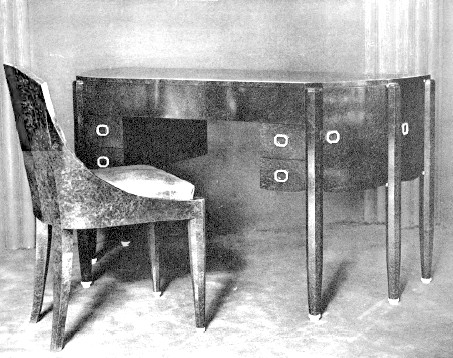
Man's Bedroom Desk and Chair, Interieurs IV, 1926, Plate 27
Leon Moussinac's 1926 book Interieurs IV contained two examples of Klotz's designs: a woman's
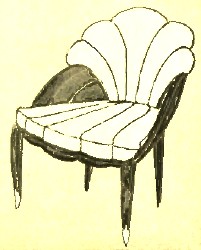
Woman's Bedroom Shell Back Chair,
Interieurs IV, 1926, Plate 23
and a man's bedroom, along with individual drawings of the furnishings used in each room design. In his introductory comments, Moussinac calls Klotz a 'sensitive artist' who is "enamored of beautiful harmonies, supple arrangements, and carefully prepared atmospheres." (Moussinac, Interieurs IV, 1926, not paginated) Duncan was particularly impressed with her design for a woman's bedroom. He calls it "a remarkable achievement - fresh and feminine - its chairs and bed with scalloped fan-shaped backs of Louis-Philippe influence, similar in inspiration to designs by Sue et Mare in the early 1920s." (Duncan, p. 113)
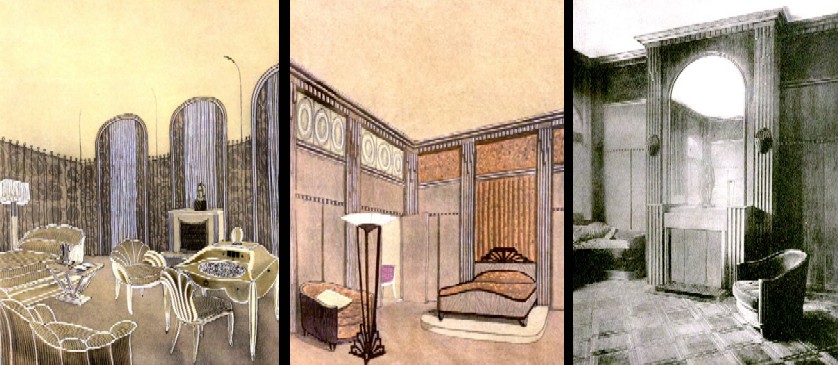 Woman's and Man's Bedrooms, Interieurs IV, 1926 (From Left): Woman's Bedroom Sketch, Plate 20; Man's Bedroom Sketch, Plate 24; man's Bedroom Photograph, Plate 26
The Klotz & Cie letterhead also mentioned their participation in the 'International Colonial Exhibition' noting that their work was 'out of competition' meaning it was ineligible for award. This event was held in 1931 with the intention of showcasing France's Colonial Empire. Competitions for architects were held to design various country-specific pavilions. However, their contribution were different. "The interior design and fitting of the main pavilion and the social services pavilion [were] entrusted to the B.-J. Klotz firm." (Ferdinand Rouget, Marcel Olivier, Roger Homo and Joseph Trillat, Rapport général / Ministère des Colonies, Exposition internationale de 1931, 1933, p. 447) Although not part of the competition, the company apparently felt the furniture they had designed for the event was an important enough contribution to put this fact on their letterhead.
Klotz also took up the challenge when invited to participate in the first Union des Artistes Modernes Exposition

Bureau d'un Chef d'Industrie Chimique, Exposition de l'Union des Artistes Modernes,
Varnished French Walnut, Glass Desktop, Metal with Red Leather, Fabric by Helene,
1930, Ma petite maison, Septembre, 1930, p. 22
at the Musée des Arts Décoratifs in 1930. For this, she created an office for a chemical industry executive. (See Exposition de l'Union des artistes modernes, 1930, not paginated) A description of the room explains,
The engineer [lighting designer Jean] Dourgnon gave an excellent demonstration of this "Tigralites" lighting (made by [Louis] Fontaine), which can be of considerable service to interior design. The copper desk by B.-J. Klotz is quite remarkable with its Angers slate display cases, its cork veneer (from the Liège company), and its elegant and very comfortable armchairs. The diffused lighting through the glass panels, which stand out brilliantly against the black background, produces a superb effect. (Ma petite maison, Septembre, 1930, p. 20-1)
Of this design, Duncan says "Metal mounts appear for the first time in her furniture, the desk showing a strong [Pierre] Chareau influence, its stepped rectangular wood top mounted on stainless steel supports and stretchers. The room lacked any form of conventional light fixture; light came from sources designed by Andre Salomon within the ceiling and walls." (Duncan, p. 114)
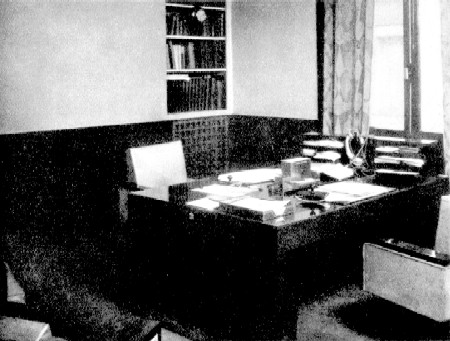
Office for Two Bankers, Polished Rosewood, Metal Box Lamp, 1929, L'Art Vivant,
Jan. 1929, p. 214
Klotz and Company seems to have been quite successful regardless of the number of exhibitions and salons in which they participated. Chavance commented in 1928, "Anyone who frequents modern design circles has likely seen some of her work." (Chavance, p. 66) Klotz's designs appear repeatedly featured in various French magazines and books including several profiles of her work and dozens of images of individual pieces, sketches and rooms.
Among Klotz & Cie's clients were Designer Jean-Michel Frank, Winemaker Philippe Georges de Rothschild, Sculptor Paul Landowski, Lawyer and Politician Henry Torrès, Julien Arpels of Van Cleef & Arpels, the French Ministry of National Economy and Department Store Galeries Lafayette. They also designed the building facade for florist André Baumann. Several pages are devoted to a bank she designed for J. C. & C. Bank in the January 1929 L'Art Vivant magazine (prefaced by a dissertation on the necessary ascendance of Art Deco over Art Nouveau). The author declared the finished product to be "a testament to her taste. We have mentioned Ms. Klotz's work several times in these articles, and we were pleased to see once again that her creativity shows no signs of slowing down." ("Chronique de L'Art Decoratif - Bureau", L'Art Vivant, January, 1929, p. 212)
In 1931, Blanche took the surname of her mother, Aimée Gilles (1833-1911). While her
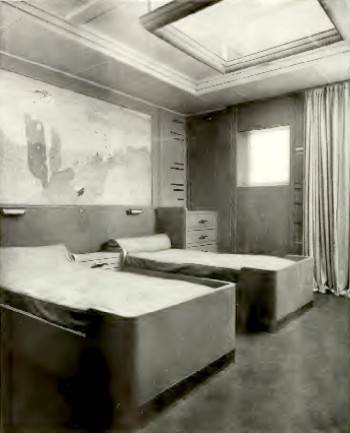
SS Normandie Stateroom by Klotz and Renaudot, Mural by Pierre
Lardin, 1935, Arts and
Decoration, Vol 43, No 2, June 1935, p. 19
name occasionally appeared as 'Blanche-Jeanne Klotz-Gilles' in magazines, she was primarily known as Blanche Klotz or B.-J. Klotz until well after the Second World War.
1931 also saw the construction of the French cruise ship SS Normandie. Amultitude of Modernist and Art Deco designers were employed in created rooms. Working with Lucie Renaudot, Blanche designed some of the Cabin-Salons including the partitions, wardrobes, beds, chairs, tables which were executed in lacquered aluminum and stainless steel with upholstery by Hélène Henri. Henri was a frequent collaborator with Klotz on designs during the 1930s.
At the beginning of 1932, Thérèse Pereya told Blanche she was retiring. She wrote an official letter to the company's patrons and supporters explaining that she was needed to resign from her position as co-director of Klotz & Cie. for personal reasons. The running of the company now rested on Blanche's shoulders. She continued to design rooms and furniture, appearing in publications under the company banner.
Klotz took the company in some new directions after Pereya left. At the 1934 Salon d'Automne she designed a lady's desk with an uncharacteristic top and side in verre eglomise (metal leaf designs applied to the back of glass) containing zodiac symbols which was produced for her by Pierre and Jacques Lardin. The desk used aluminum, a metal which was becoming popular in design during this period, not a typical choice for Blanche.This may have been inspired by her exposure to the metal in furniture designs for the Normandie staterooms. Around the same time, she offered her services to the administrator of the Mobilier National (National Furniture Collection). Her connection with politician Léon Blum and his artist and writer brother René gave her an in, leading to the design of furniture for Minister of Finance Vincent Auriol around 1936 or 1937.
In 1935 she began producing limited editions of furniture en serie manufactured by the cabinetmaker Schmit on rue de Charonne. Her focus until this time had been on pieces designed for individuals. Even so, no more than ten of each model of furniture was made and, although the base design was the same, each piece was unique from the others. Gaston Varenne wrote about her new line for Art et Decoration, explaining that it allowed
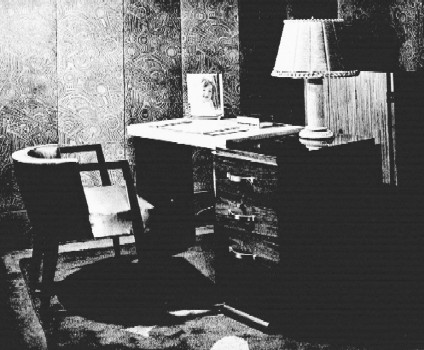
Desk Modifiable to One or Two Sections, French Walnut with Parchment Top,
Art et Decoration, April, 1935, p. 154
each client to modify, as far as possible, the exterior appearance of the piece of furniture, without the slightest impact on the cost price. Everyone has the right to choose their preferred veneer: mahogany, walnut, or another. The furniture, if desired, can be upholstered in leather of various colors or partially covered in parchment. Finally, the fabrics, specially made for Mrs. Klotz by the admirable artist Mrs. Hélène Henry, offer a fairly wide range of choices. ...Only the frame and structure cannot be modified. But a considerable diversity of finishes allows individual, personal taste to be expressed to a degree that mass-produced furniture had not yet experienced. (Varenne, Art et Decoration, April, 1935, pp. 151-2)
In the same article, Varenne mentions that Klotz was also creating furniture which could be adapted to more than one use. He mentions small tables which could be expanded with leaves, a sideboard designed to be transformed into a bookcase, a modifiable desk and a sofa bed with retractable tables. The desk shown at right is an example - the appears to me that the top could be slid to change the size of the desk. "These dual-purpose pieces of furniture are well-known; they are practical. The ingenuity with which they are presented, the good appearance they maintain in their transformations, are the sole merits of combinations where nothing is left to chance." (Varenne, p. 154) Such multi-purpose furniture became popular in the 1930s as the worldwide impact of the Great Recession caused people to economize. Multi-purpose Moderne furniture designs were championed and popularized by Pierre Chareau in the 1920s, which may have impacted Klotz's new designs.
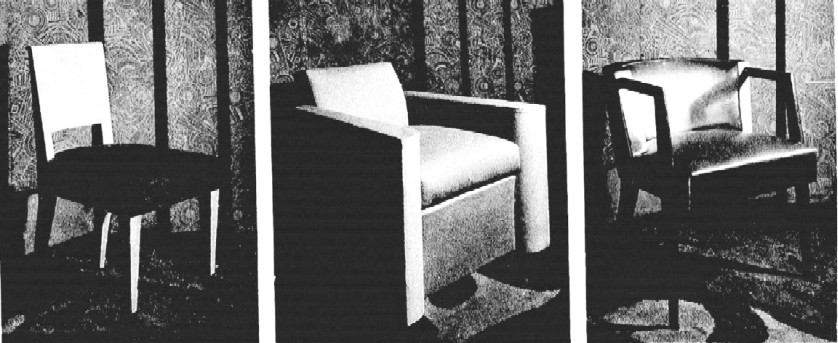 Seats from Art et Decoration, April, 1935, p. 152: Chair, Sycamore; Armchair with Fabric by Hélène Henry; Small Armchair, Rosewood and Satin
For the 1937 Expositionale des Arts et des Techniques dans la Vie Moderne in Paris, Klotz was involved in a several projects. The program lists her on three: first, as a collaborating artist with Jacques Lardin on the Aluminum Pavillion, second, as the designer of
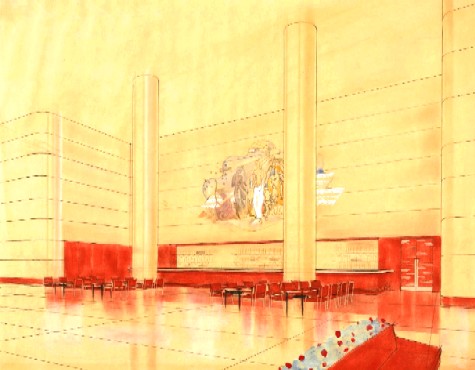
Bar-Fumoir, Ttrocadero Theater, Bronze Metal Alumilite, with Jacques Lardin, 1937,
Centre Pompidou
the Trocadero bar and smoking room and third as the designer of the Youth Hall furnishings. (See Exposition internationale des Arts et des Techniques dans la Vie Moderne. Paris, 1937, pp. 73, 151 & 481) Her furniture for the Aluminum office were made from hardboard and aluminum by the Jéric workshops. She likewise used "bronze medal color Alumilite" in the bar/smoking room. ("Le Salon des Artistes Decorateurs", L'Art Vivant, January, 1938, p. 7)
Klotz is mentioned several times in he Socialist newspaper La Populaire beginning in 1937. Most of these concern her involvement with the 'May '36' group which was concerned with the arts and culture in France. She explained in an article, "'Mal 36' teams have shown the way to those who, following in the footsteps of our great artists of the past, want to create a more beautiful environment for everyone, where a more beautiful life unfolds." (Blanche Klotz, "Le décor de la vie", La Populaire, March 5, 1937, p. 10) She worked as the group's treasurer as early as 1937. She also created decoration for various events held by the group. In an interview for the "La Femme" page of La Populaire, she explained that simple changes can make existing decor "take on an original character." She notes that 'Mai '36' existed to give free assistance to members. "If a colleague is having trouble choosing wallpaper or paint, we tell her what best suits the room, according to its dimensions and lighting. It doesn't cost her any more, but at least [she knows] she's truly made a wise purchase." (G. D. "Le Décor du Foyer", La Populaire, November 20, 1938, p. 10)
Blanche was made a Knight of the Légion d'Honneur in the Ministry of National Education category as a 'decorative artist' in February of 1938. She was also listed as a member of the council for 'L'ensemble de l'Art des Fêtes' at the Salon d'Automne of 1938. Despite her success working alone in the difficult economic times of the mid-1930s, Klotz decided to shut the company down in 1938. It is not clear why she did this, although a wistful letter written to Thérèse at that time hints that it may have been the stresses of running the company by herself.
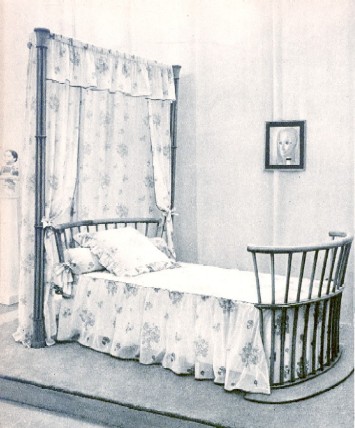
Post-War Guest Bedroom, 1948, Plaisir de France, July, 1948, np
"The guest room bed by Madame B.-J. Klotz-Gilles—where one
must have light dreams!"
I don't think I'm being foolishly sentimental in admitting that I feel a pang of sadness. It's also made up of so many precious memories of our close working relationship that I think of you even more intensely as I say goodbye to the Rue de Miromesnil. After your departure: my darling, I tried to continue my daily work as you had established it – which is to say, I found you at every moment. A tender affection remains from this past, with something extra, given by the joys and hopes of our collaboration. (Cited in Missika, p. 136)
Klotz was a member of the Festival Arts Committee in 1939, a group planning "to celebrate 'The Eiffel Tower's Golden Anniversary' via a series of original festivals and events which were began on March 29th. Unfortunately, by September of that year, France became involved in World War II and all non-war related work came to a halt. France was occupied by Germany in the summer of 1940. While there is no indication of what Klotz did during the war, being born Jewish and an active socialist, it seems likely that she either left France or went into hiding.
After the war, Klotz returned to design. She contacted the Mobilier National (National Furniture Collection). Her designs for Vincent Auriol became part of their collection in 1940. As a result, she received commissions between 1944 and 1956. Among these were a study for the Alliance Française in 1944, a bedroom and office suite for Rambouillet in 1946, a living and dining room suite (1949 and 1951), an office for the Élysée Palace in 1951. Blanche-Jeanne Klotz died on November 24, 1964 at the age of 79..
Many contemporary critics and journalists discuss Klotz's style in detail. Missika explains, "Adherents of modernity, Blanche
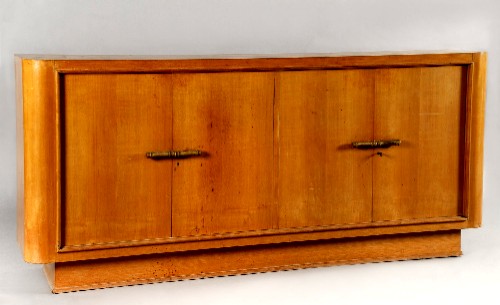
Sideboard, Varnished Cherry Wood, For Vincent Auriol (Mentioned Above), 1936-7
National Furniture Collection
of France
and Thérèse both embark on their ventures at the very moment when Art Deco seduces Paris." (Missika, p. 109) In presenting her work in Interieurs IV, Moussinac enthuses, "If her taste leads her to particularly love rich and rare, delicate, precious materials, she does not forget that their use should be determined solely by the interplay of practical needs and logic. The general harmony is not, therefore, sacrificed to the benefit of a... A subtle detail, an ingenious discovery. Such elegant art knows how to remain understated, refined, without losing its particular sensitivity." (Moussinac, not paginated)
The idea of harmony is a repeated theme when discussing Klotz's style. In 1928, Chavance wrote, "The interiors created by Ms. B.-J. Klotz are immediately recognizable by their understated and tranquil elegance. There is nothing jarring or even surprising, nothing that particularly attracts attention, but everything harmonizes, and the eye rests there with satisfaction." (Chavance, p. 67) He points to the 'clean, calm lines' of her designs, an aspect of Modernism. Of her use of color, he suggests that it
is used with equal restraint and moderation. There are no violent color contrasts in the ensembles by Ms. B.-J. Klotz, nor are there any bright notes standing out against a neutral background. Her palette consists only of limited ranges of muted tones, grouped around a dominant color, to provide delicately nuanced symphonies, almost monochromes. All the finesse lies in the relationships of values. (Chavance, p. 67-8)
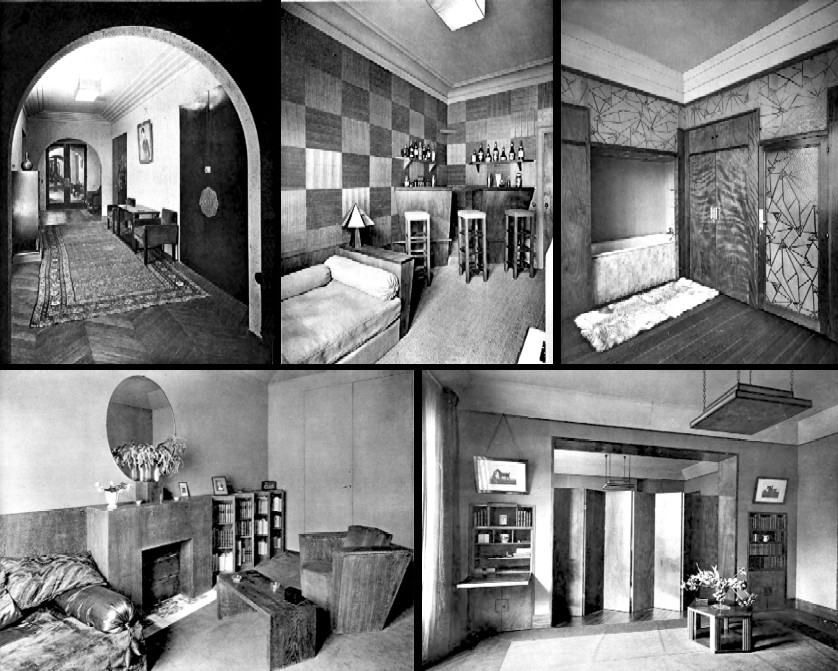 Rooms by Blanche Klotz Featured in the Art et Décoration Article of Sep. 1928: <Top> Antechamber, Cream Plaster, Brown lacquered Doors, Javanese Furniture, 1928, p. 74; Bar, Varnished Waxed Okoume Wood. Wallpaper, p. 69; Bathroom, Backlit Etched Glass Walls with Waxed Okumé Wood, p. 70
<Bottom> Small Salon-Library, Burnished Yellow Oak, p. 73; Living Room, Yellow Canvas Screens, Varnished and Waxed Okume Wood Furniture, p. 74
Her sense of composition is regularly given favorable reviews. In a 1929 article Georges Remon refers to her "exquisitely refined and impeccable taste which still possess the vanishing art of
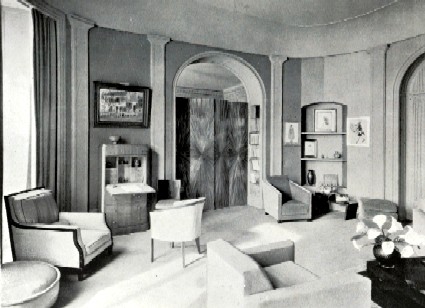
Salon for Charles B., Mobilier et Decoration, 1929 Revue, p. 117
composing an interior, of imagining an arrangement from which none of the graces we desire in a dwelling are excluded: harmony of lines and charm of color." (Remon, "Intérieurs de Mme B.-J. Klotz", Mobilier & Décoration, January - June, 1929, p. 112)
In 1934, Gaston Derys said,
Mrs. Klotz is one of the rare women who work in decoration, but there is something masculine, something firm, vigorous, and precise in her style and manner. However, we discover a feminine touch, a delicate grace in the freshness of the details. ...The secret of her art can be summed up in three words: harmony, balance, and comfort. (Gaston Derys, Mobilier et Decoration, March, 1934 p. 82)
He also pointed out that the materials she used generally favored wood, leather and unvarnished parchment. He added, "She maintains that a decorator is first and foremost an interpreter, and that considerable psychological insight is required to design furniture, to create an interior where the occupants don't feel as if they are looking in a distorting mirror, but rather in an atmosphere that reflects their personality." (Derys, p. 90) Klotz herself wrote that during the later interwar years, she wanted "to create a more beautiful environment for everyone, where a more beautiful life unfolds." (Klotz, p. 10)
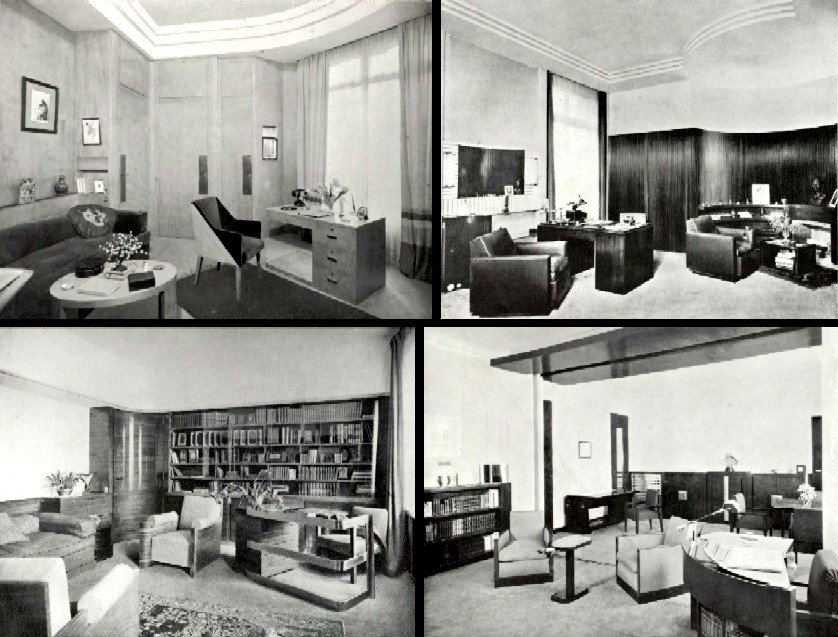 Rooms by Blanche Klotz Featured in Mobelier et Decoration, March, 1934: <Top> Boudoir, Blond Varnished Okume, Tobacco Velvet Sofa and Chairs, Cream and Orange Curtains by Helene Henry, p. 85; Man's Bedroom, Dark Walnut Furniture, Reddish-Brown Leather Armchair, Gray Curtains, Fabrics by Mme. Henry, p. 83
<Bottom> Bibliotheque, French Walnut Walls and Desk, Red Sofa and Curtains by Mme. Henry, p. 89; Studio and Dining Room, Separated by Sliding Panels, Varnished Rosewood Furniture and Ceiling Panels, Indirect Lighting, p. 87
Writing well after her death, Alastair Duncan provided a look back at the bulk of Klotz's early oeuvre. "Klotz's early preference
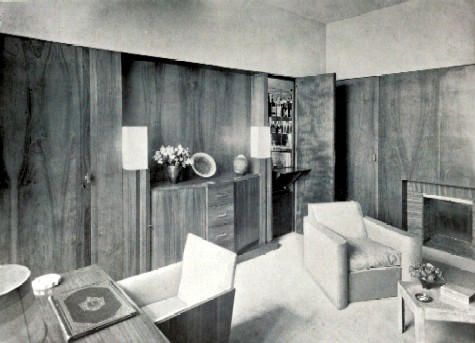
Office of Mr. Raymond B., Mobilier et Decoration, Mobilier et Decoration, 1929 Revue,
p. 119
[mid 1920s] in furniture was for warm, richly grained woods - gaboon, palisander and walnut - without marquetry or prominent metal mounts. Logic predominated." (Duncan, p. 113) He goes on to comment on the furniture featured in Chavance's 1928 article, calling it "characteristically functional, yet elegant and calm. The line - vertical and horizontal - ruled supreme. Curves were few, even in chairs, and there were few contours in armoires and cabinets. Preferred materials were gaboon, oak, and tussore silk." (Duncan, p. 114)
Since the majority of Klotz's furniture was designed on commission rather than being mass produced there is little available in the antique market. In the 1930s, she produced limited editions of mass-produced furniture which were, as mentioned, limited to 10 total pieces for each design. Although many images of her work appear in the magazines of the period in black and white, she doesn't appear to have signed it which adds to the difficulty in identifying it. At best, her furniture can usually only be 'attributed' to her based on the style and images from the magazines. Her style was Modernist, so the lines are typically clean and decoration spare.
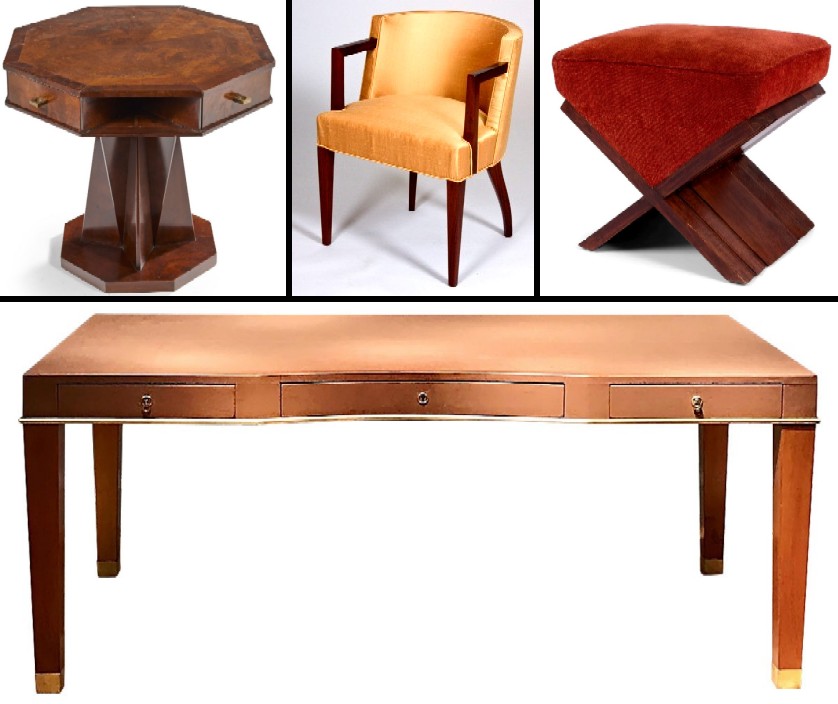 The Rare Furniture at Auction by Blanche Klotz: <Top>Octagonal 4 Drawer Table, Mahogany Veneer with Brass Fititngs, c. 1930, Tessier-Sarou; Armchair, Mahogany and Fabric, c. 1935, Iliad; X-Shaped Stool, Stained Beech, Reupholstered, c. 1925-30, Ader
<Bottom> Desk, Walnut and Bronze with Leather Wrapped Tray, c. 1930-5, Antic Store
Sources Not Mentioned Above:
"Renée Blanche GILLES (DREYFUS)", Geneanet website, gathered 11-20-25
"Les femmes et la Légion d'honneur", Ève, February 20, 1938, p. 6
"Légion d'Honneur - Ministère de l'éducation nationale", Le Journal, February 8. 1938, p. 4
Salon d'automne, Catalogue des Ouvrages de Peinture, Sculpture, Dessin, Gravure, Architecture et Art Décoratif, 1938, p. 221
"La promotion rouge du ministère de l'éducation nationale", Le Figaro, February 6, 1938, p. 2
"L'art Des Fêtes", La Renaissance, June, 1939, not paginated
Original Facebook Group Posting