Pierre Chareau (1883 - 1950)
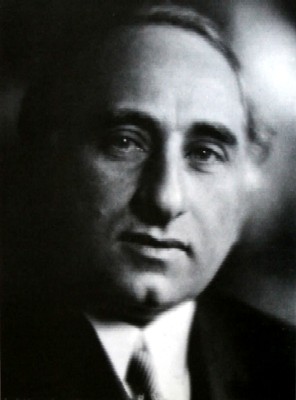
Pierre Chareau in Paris
Pierre Chareau was a French architect and designer, born in Bordeaux. Chareau failed the entrance exams at École des Beaux-Arts in Paris, so he took a job at a Paris branch of British furniture manufacturer Waring and Gillow in 1899. While there, he rose from being an apprentice to a head designer before leaving in 1914 to join the military. He served in the French artillery during World War I. Upon being discharged in 1919, he decided to start his own shop.
In 1919, Dr. Jean Dalsace hired Chareau to design a study and a bedroom for his house, one of Chareau's first independent commissions. "The project, which was exhibited at the 1919 Salon d'Automne, included an office for Dalsace containing an austere, angular desk with an extendable center piece, an early example of the moveable furniture that would become one of Chareau's signatures." ("Pierre Chareau: Modern Architecture and Design", Art Deco Society of New York website, gathered 8-19-25)
The display at the 1919 Salon earned Chareau a great deal of positive attention. He began to consider ways to make furniture flexible using sliding parts and mechanical components. He created a variety of lamps using sheets of alabaster, among which was his well-known 1923 La Religieuse floor lamp. He continued designing wooden furniture with mobile elements like his 1923 rotating Fan Table. That year, he joined the Société des Artistes Décorateurs. In 1924, he and Pierre Legrain were invited to create a joint booth at the Salon of Decorative Artists which took into account the 'intimacy of a modern apartment'. To further promote his work, he opened La Botique, a store in Paris in 1924.
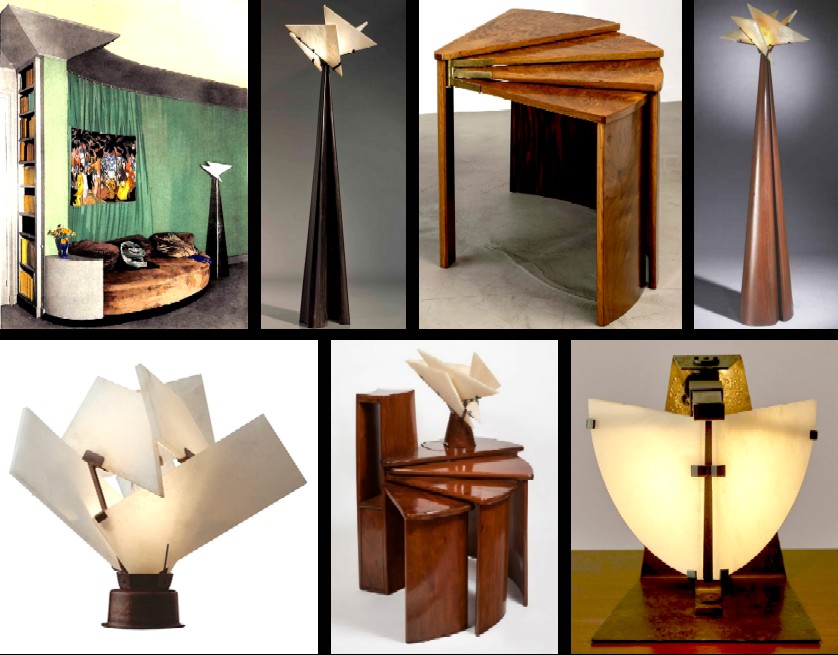 Examples of Early 'Flexible' Furniture by Chareau: [Top] Apartment of Jean and Annie Dalsace, Paris, ca. 1923. La Religieuse Floor Lamp in Black, Patinated Metal and Alabaster, From Interieurs Francais, 1925, p. 5; Christies; Fan Table, Flame Walnut Exterior, Macassar Ebony Veneer Interior, 1923, Galierie LeFebvre; La Religieuse Floor Lamp in Brown, Patinated Metal and Alabaster, Designed 1923, c. 1927, Christies;
 [Bottom] Flower Lamp, Alabaster Plates, Metal Fixture, Designed in 1924, Galerie MCDE Modern Reproduction, Rewire; Telephone Fan Table with La Religieuse Table Lamp, Walnut and Wrought Iron. 1924, Art Deco Soceity of New York; Potence Lamp, Alabaster Plates, Metal Fixture, Designed in 1922, Galerie MCDE Modern Reproduction, Invisible Collection

Office-Library from the International Exposition of
Modern Decorative and Industrial Arts, 1925
For the seminal Exposition Internationale des Arts decoratifs et industriels modernes, Chareau was asked by the Société des Artistes Décorateurs to create the office/library for their French embassy display. Just as he had started designing moving parts in his furniture, he included fan-shaped wooden panels in the ceiling so that the amount of light admitted into the room could be modulated by adjusting the fan. "This was a very important commission for Chareau, and proved that he had the expertise and the eye to become a driving force in twentieth-century decorative arts." ("Pierre Chareau", Primavera Gallery website, gathered 8-19-25)
As Chareau's work continued to gain notoriety, he designed more of his adjustable furniture in the second half of the 1920s including desks with sliding and rotating parts in metal and wood, chairs in metal and rattan, and beds suspended from metal bars, much of it for specific clients. He even designed a desk with a sliding platform for Robert Mallet-Stevens in 1927 which he apparently liked so much he made one for himself. Chareau also received commissions to design rooms and spaces including the decoration of the Villa Noailles at the request of Mallet-Stevens in 1928. He was hired to design a number of other projects including the reinforced concrete clubhouse for the Hôtel Le Beauvallon golf course near Saint-Tropez, the golf clubhouse at Satine-Maxime, a villa for industrialist Émile Bernheim and interior design for the Grand Hotel de Tours.
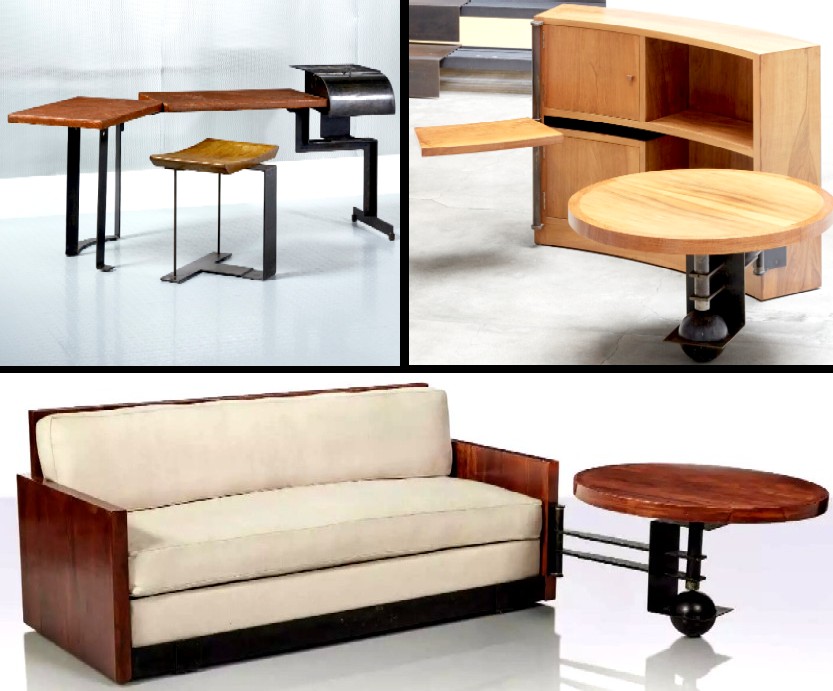 Examples of 'Flexible' Furniture by Chareau: [Top] Secretary's Desk with Stool, Desk in Birch, Patinated Iron and Leather, Stool in Brazilian Rosewood and Patinated Wrough Iron, c. 1927, Christie's; Bookshelf with Moveable Table and Desk, Walnut, Okume, Patinated Iron and Brass, c. 1930, Christies
[Bottom] Couch with Side Table Out, Mahogany, Patinated Wrought-Iron, Fabric Upholstery, c. 1930, Sotheby's
Perhaps his most famous design was begun in 1928 for Doctor Dalsace - la Maison de Verre (the House of Glass). Working with architect Bernard Bijvoet, he helped design the glass block and steel frame structure which housed the doctor's office in the bottom floor with the two upper floors of his house being accessed by a floating staircase. True to Chareau's design inclinations, the house featured sliding, folding and rotating screens in glass and metal including a rotating screen which hid the stairs from the office to the residential level from patients. A complication arose in the design of the house; the doctor had purchased a site with an existing building on it which he intended to demolish. Unfortunately, a man living in the top floor refused to sell, so they had to demolish the lower three floors and build the Glass House in that space, leaving the upstairs tenant's floor intact! (To learn more about the Maison de Verre, click here.)
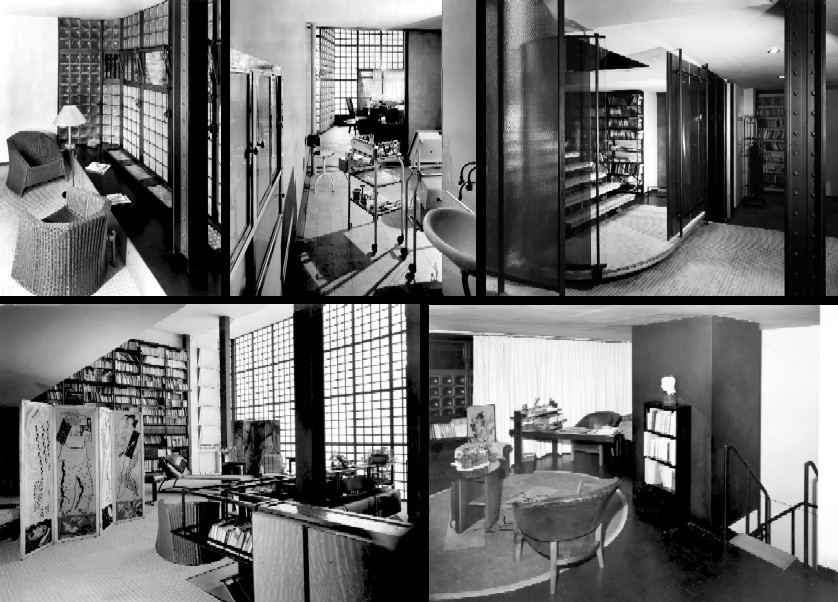
Office and Home Rooms in Maison de Verre by Pierre Chareau & Bernard Bijvoet, All Photos from the 1930s retrieved from Arch Daily, From top left -
Doctor's Office Waiting Space; Doctor's Office Practice; Stairs From the Office to the Home (Which Can Be Hidden); Living Room and Study
In 1931, Chareau started creating desks using glass and copper slabs.
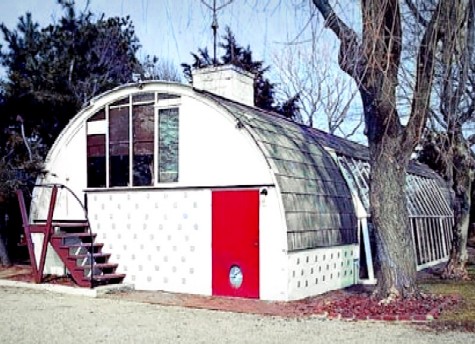
Robert Motherwell Quonset Hut Home, Long Island, New York, 1947, Of Houses
He continued to display his work at exhibitions, but as the Depression hit France, work began to dry up as it did for most of the Art Deco decorators during this period. When the Germans occupied France in 1940, Chareau had to leave the country. He had been raised Catholic, but he had Jewish roots and the German presence made it unsafe for him to remain. He emigrated to Morocco in 1940 and from there to New York, where he remained until his death.
Chareau continued to design furniture in the US although little of it was produced. He was involved in two architectural projects in the late 1940s after the war, including a design from a Quonset hut which served as the house and studio for Abstract Expressionist painter Robert Motherwell on Long Island, New York. The other was a villa for Mesdames Monteux and Laughlin, completed in 1950 in Spring Valley, New York.
Chareau's style was new and unusual, Standing out in a period when many other designers were creating new and unusual furniture. As already highlighted, he was fascinated with having moving parts which allowed his designs to be expanded and contracted as the need arose. "Unlike many of his contemporaries, his furniture and interiors deftly balanced a sense of the old world opulence with a lighter, more functional aesthetic. His sumptuous furniture bore clean and unfussy profiles and contained movable parts that resonated with the innovators of the day. Chareau's exquisite furniture is displayed in the exhibition's third section, which feature Recreations of four interiors designed by the architect and designer." ("Pierre Chareau", Present-Tense, Future Perfect website, gathered 8-19-25)
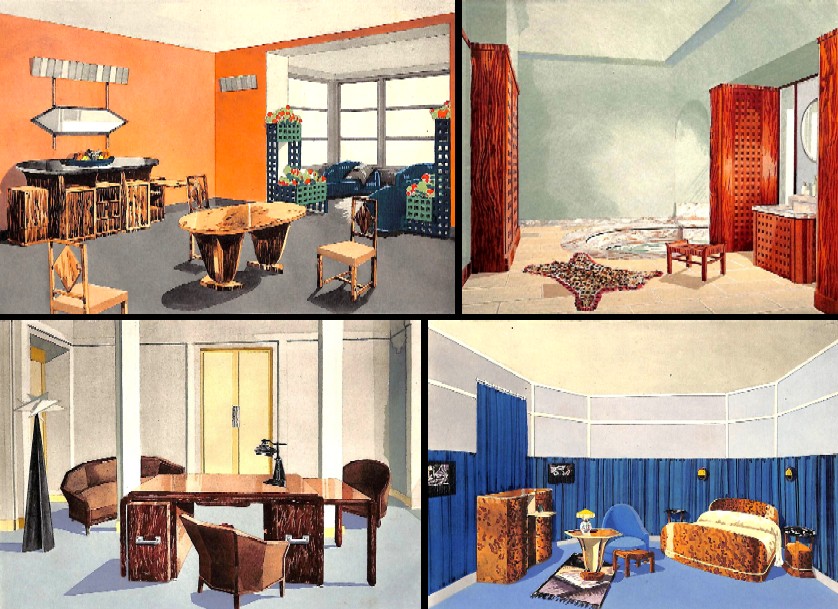 Chareau's Room and Furniture Designs: [Top] Dining Room, 1922-3, Jean Badovici, Interieurs Francais, 1925, Page 24; Bathroom, 1922-3, Les Arts de la Maison, Winter, 1924
[Bottom] Office, Les Arts de la Maison, Winter, 1924; Bedroom, 1922-3, Jean Badovici, Interieurs, 1925, Page 33
Sources Not Mentioned Above:
"Julia Keilowa", Polish Wikipedia, gathered 8-15-25
"Stryj (city)", Wikipedia, gathered 8-15-25
"Julia Keilowa – cross-sectional, in a broad context", Design Doc website, gathered 8-17-25
Magdalena Wróblewska, "Decorative forms: Objects of Julia Keilowa's project in the Photographs of Benedykt Jerzy Dorys", Meijsc Website, gathered 8-17-25
"Karol Tchorek", Wikipedia, gathered 8-15-25
"Institute of Art Propaganda", Wikipedia, gathered 8-15-25
"Adam Mickiewicz Gymnasium", Wikipedia, gathered 8-15-25
"Even seams, new lining, maybe she would have lived on.", Weekend Gazeta.pl website, gathered 8-18-25