The Client and the Gesamtkunstwerk ('Total Work of Art')
"... I don't intend to build in order to serve or help anyone. I don't intend to build in order to have clients. I intend to have clients in order to build." (Howard Roark, The Fountainhead, Written by Ayn Rand, 1941, p. 17)
One of the facets of the design arts such as architecture and interior design is the struggle between the vision of the designer
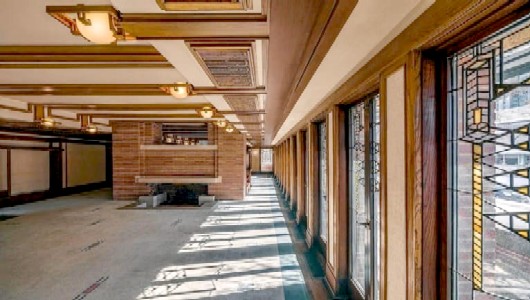
Living Room, Frederick C. Robie House, Chicago, Frank Lloyd Wright, 1910, Artland Magazine
and the desires of the consumer - most prominently the client but also groups such as governing bodies and the public. Few (if any successful) designers would have been quite so rigid in their view of the client's needs as Rand's character. Yet he was said to be based in part on her friend Frank Lloyd Wright, although she said Roark's philosophy was the character's own.
While Wright is not an Art Deco designer, his work has facets of Arts & Crafts and Modernism. He believed strongly in his overarching design vision. "He was notorious for his complete involvement in all aspects of his projects, which was often considered as verging on narcissism, an offshoot of his rather egoistic personality." (Naomi Martin, "Gesamtkunstwerk – The Total Work Of Art Through The Ages", Artland Magazine website, gathered 6-24-25) In a letter to a client, Wright wrote, "I can hardly believe you have allowed the builder to make changes from the plans as the affair of a house as a work of art is a sensitive affair as you well know and the contractor does not..." (Frank Lloyd Wright, "Letter to Mrs. Clinton Della Walker", May 21, 1951) Wright's designs after 1910 are generally regarded as being 'complete works of art' (or 'Gesamtkunstwerks' in Germans) in which all aspects of the design were overseen by him.
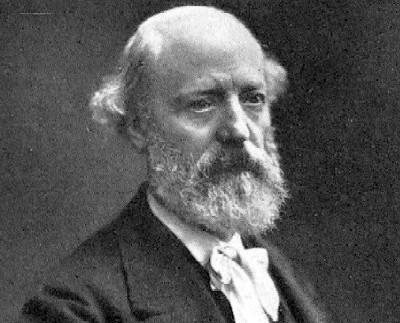
Eugène Viollet-le-Duc, Photo by Nadar, Wikimedia
The Gesamtkunstwerk ('total work of art') concept dates back to 1827, being first proposed by German philosopher K. F. E. Trahndorff. French architect Eugène Viollet-le-Duc was one of the first proponents to apply the concept to interior design. He felt that buildings should be rationally constructed, expressed as "form follows function", subjugating design elements to the requirements of a design. He also advised integrating architecture with the decorative arts (which encompass interior design) to create a total work of art. These ideas were rejected by the academic architects of the mid-19th century. However, they inspired the pioneers of modern architecture including Americans Louis Sullivan (the 'father of skyscapers') and Frank Lloyd Wright, German Ludwig Mies van der Rohe (a director of Bauhaus) and Frenchmen Auguste Perret (pioneer of reinforced concrete) as well as Modernist architect Le Corbusier about whom we'll talk more shortly. Such architects and designers promoted and executed the Viollet-le-Duc-inspired Modernist 'form follows function' mantra as well as, the Gesamtkunstwerk unified design concept. Such concepts underpinned the 'Art Modern' [later called Art Deco] design style.
The promotion of Gesamtkunstwerks is found in several design movements which occurred in the latter half of the nineteenth and early twentieth centuries. Such organizations included among their goals an interest in unifying decorative (interior) design with architecture and fine arts with the goal of presenting a cohesive whole. Among them were the Vienna Secession, the Arts and Crafts movement, Jugendstil, Art Nouveau, De Stijl and Bauhaus. The French Art Deco style was created, at least in part, as a response to the Munich Jugendstil's presentation of Gesamtkunstwerk at Paris Universal Exposition of 1900.
In contrast to the practice in most French pavilions [at the 1900 Paris Universal Exposition], where furnishings were either showcased individually as single masterpieces or as a collection of disparate objects, the Germans had built entire interiors within their pavilion, designed and decorated by a single artist or a group of artists working in collaboration. They astonished the French public by the conceptual unity of their ensembles and the originality and modernity of their work. Rene Guillere was one of many in France to realize that the success of the German presentation in 1900 was due to the organization of the artists into professional groups like the Werkstatten. (Yvonne Brunhammer and Suzanne Tise, The Decorative Arts in France, 1900-1942, 1990, p. 12)
In 1901, the Societe des artistes decorateurs was created. "[O]ne of the major goals of the Societe was to encourage designers and artists to work together to create unified decorative ensembles." (Brunhammer and Tise, p. 25) This goal was pursued by the Societe during the next two decades, culminating in their sponsorship of the seminal 1925 Exposition internationale des arts décoratifs et industriels modernes,
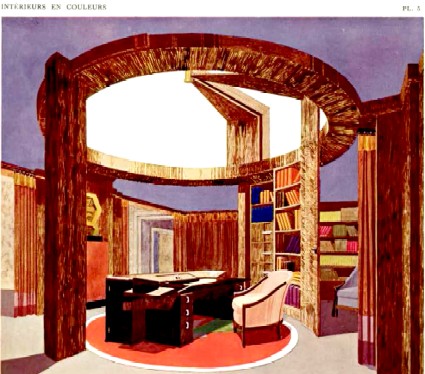
Pierre Chareau's Office-Library Design with Adjustable Roof for the 1925 Paris
Exposition, Plate 5 From Interieurs and Coleurs by Albert Levy (1926)
from which Art Deco gets its name.
The 1925 Exhibition, in which numerous luxurious ensembles had demonstrated the renaissance of French taste, had consecrated the practice of the interior designer. The coherence between all the elements was intended to be perfect: everything was studied, from floor to ceiling, from furniture to ornaments to lighting. The decorators were then at the height of their function: the creations presented in the Salons and the various exhibitions were transposed as they were to private homes, when it was not the other way around. And there was no question of changing a single element, for fear of creating an imbalance in the decor: 'The user did not live at home but at his decorator's and [...] he would be a prisoner of the latter's wishes to such an extent that he no longer dared to change anything in the arrangement of his walls, in the layout of his furniture, even though it had been calculated according to the most meticulous rules of a particular aesthetic.' (Alaine-Rene Hardy and Gaelle Millet, Jacques Adnet, 2009, p. 107)
Although the word 'Gesamtkunstwerk' isn't mentioned in the above citation, this is what the French intended to represent. They were attempting to follow the example of the German displays at the 1900 Exposition, particularly the comprehensive vision presented by the Vienna Successionists. Emile-Jacques Ruhlmann was "one of the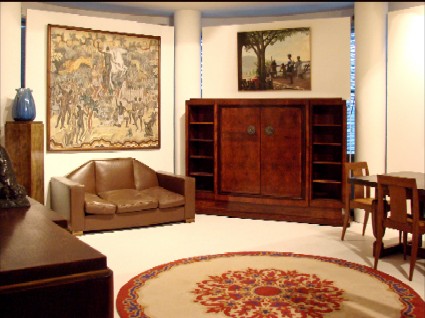
'Furniture From The House of Joseph Bernard', Designed by Jacques-Emile
Ruhlmann in 1920, Display from Museum of the Thirties, Wikimedia
first artists to showcase his work in exhibitions alongside other craftsman and designers, specifically curated to complement one another, his constructed pavilions allowed potential buyers to visualize an overall environment rather than just view a singular, staid object." ("Émile-Jacques Ruhlmann", The Art Story website, gathered 5-15-25)
Yet, the design of a commissioned house usually had to take other factors into account. The truly successful commissioned dwelling had to consider the client's needs and desires. The client was paying for it, after all. Many of the Art Deco decorators from the 1920s were hired by the wealthy to decorate rooms and houses based on their reputations, previous designs and/or 'showpiece' designs which appeared at exhibitions and salons. The latter had the potential to represent the purest form of a designer's vision when there was no specific client. (Many rooms were designed for organizations or major department stores. Here, the designer had to meet whatever specifications their 'client' had.) Even when designing for themselves, such designs still had to be desirable in the eyes of some of the public if the designer wanted to gain clients.
It was often when a designer or architect became well-known enough to be associated with a particular style that they were more likely to be able to create a Gesamtkunstwerk with minimal input from the client. With this in mind, let's look at five designers and their Gesamtkunstwerks from the Art Deco era: Robert Mallet-Stevens, Pierre Chareau, Adolf Loos, Charles Jeanneret (Le Corbusier) and Pierre Petit.
Robert Mallet-Stevens
The first architect who created a 'total work of art' was Robert Mallet-Stevens, who created the Villa Cavrois in 1928, more than twenty years after his career began. As the restored Modernist style Villa Cavrois website explains,
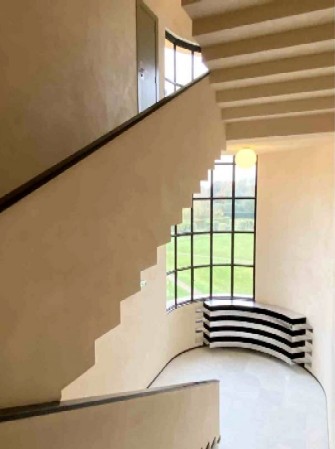
Main Staircase of Village Cavrois, Chiara Columbini
When Paul and Lucie Cavrois entrusted Robert Mallet-Stevens with the project for their home, the architect was given carte blanche to design and build their main residence. For the first time in his career, the architect created an architectural work in which he imagined and designed every detail. Like a body inseparable from its components, every line, color and shape interacts with its surroundings, elevating the villa to the status of a total work of art. ("A total work of art", Villa Cavrios website, gathered 5-7-25)
One critic of this statement opines,
The 'total work of art' was a recent affectation but Mallet-Stevens produced it by coordinating the efforts of others. The glass ceiling in the Pink Room at Villa Noailles is stunningly beautiful, but was designed by Louis Barillet, for example. The light boxes and the ceiling light reflectors at Villa Cavrois were designed by André Salomon. I get the feeling Mallet-Stevens had nothing to prove. This does not fit the accepted narrative of ambitious architects and career trajectories." (Graham McKay, "Architecture Misfit #30: Robert Mallet-Stevens", Misfits Architecture website, gathered 5-7-25)
While Mallet-Stevens may or may not have wanted to prove something, the fact that other designers were involved in the creation of the Villa Cavrois does exclude it from being a Gesamtkunstwerk. An overly rigid interpretation of the concept may require a work to be created by a single person, but in an undertaking as large as the design of an entire dwelling, it would be nearly impossible unless the artist had unlimited time and skills. While there were some polymath designers, it would be challenging to design structural elements, walls, lamps, furniture, accessories and the dozens of other elements required to create a completed home. None of the examples presented here did so; they all had co-creators, students, assistants or contractors.
What is essential to classifying Villa Cavrois as a Gesamtkunstwerk is that Mallet-Stevens designed or oversaw other artisans producing the various elements. While other artisans designed elements, he would have final approval of the deisgns. A good leader relies on his or her subordinates, particularly in areas where their skills are stronger. Mallet-Stevens was definitely placed in charge of the project by the Cavrois' and they appear to have given him minimual input.
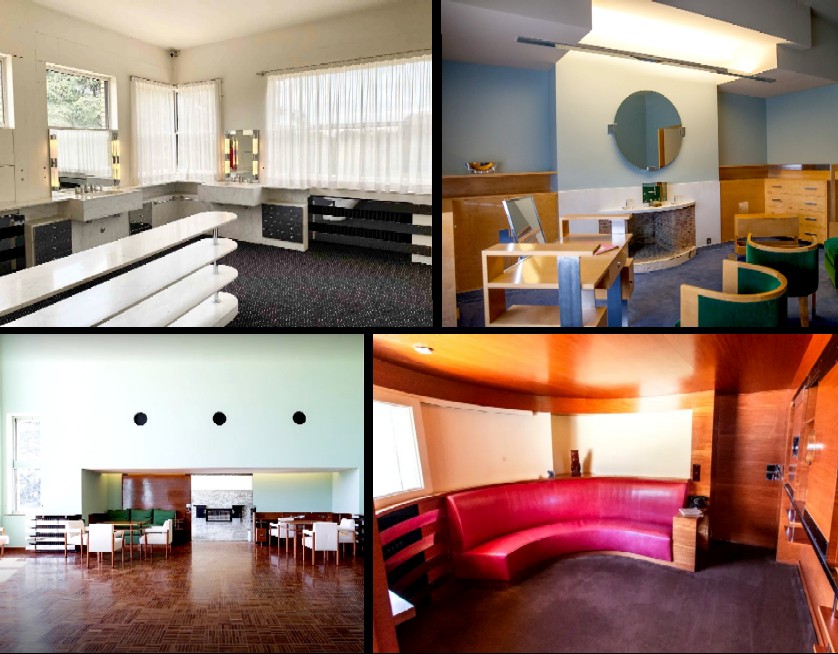
Select Rooms in Villa Cavrois by Mallet-Stevens, From top left - Master Bath with Marble Shower, Chiara Columbini; Boudoir, Gloria Photo; Salon/Living Room, Google Arts and Culture; Smoking Room, Cuban Mahogany Wood Paneling, Corriere Della Sera Living. For more photos and information on each of these rooms, see the linked sources or visit this Facebook post.
Pierre Chareau
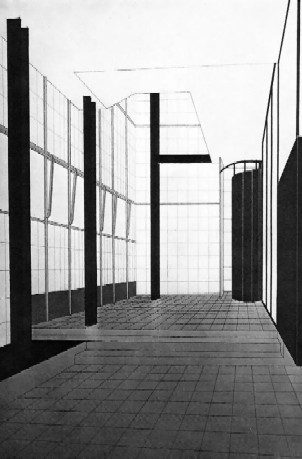
Corridor - Living Space Sketch, Pierre Chareau and
Bernard Bijvoet, Maison de Verre, 1932, Arch Daily
Another designer who was able to co-create a Gesamtkunstwerk was French designer Pierre Chareau. With Dutch architect Bernard Bijvoet and ironworker Louis Dalbet, he designed the Modernist Maison de Verre (House of Glass) for gynecologist Dr. Jean Dalsace and his wife Annie Bernheim. Dalsace
had hired Chareau ten years earlier to design a study and bedroom for him. How much instruction he gave Chareau when he commissioned his new house I have not been able to determine. Most commenters simply say that Dalsace wanted a Modernist house, intended to be something of a political statement, with space for a doctor's office.
Like some of his esteemed peers, Chareau aimed at authoring a Gesamtkunstwerk, a German word that roughly translates as a "total work of art," describing the creative process where different art forms are combined to create a single cohesive whole. Hence the iconic furniture pieces and lighting fixtures that the French maestro designed specifically for his Glass House. Combining industrial materials with traditional craftsmanship, these designs were a feat of flexibility and practicality and, ultimately, an ode to sophistication. ("Pierre Chareau Lights the Lights", Invisible Collector website, gathered 6-20-25)
Whether Chareau was 'aiming at' creating a total work of art or not is debatable, but the Glass House has ultimately proved to be an interesting example of just that. Another commenter says, "Chareau did not aspire to the 'integrated whole' that IS generally a judged a hallmark of fine architecture. Instead he chose to work additively, addressing difficulties piecemeal as they arose and finding often striking solutions to them". ("Maison de Verre", Architecture History website, gathered 6-20-25 ) This makes it sound as if it isn't a total work of art and yet is still very interestingly and creatively designed. The same author gushes,
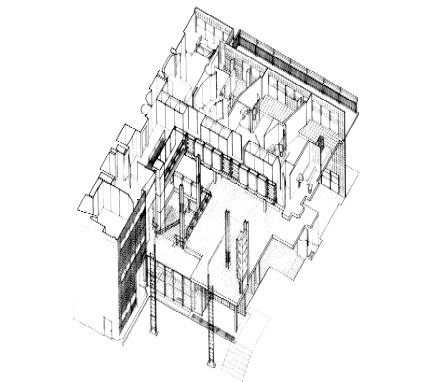
Isometric Plan Sketch, Bernard Bijvoet, Maison de Verre, 1932, Arch Daily
The interior bristles with fascinating technical and visual details: balustrades double as bookcases, a frankly nautical stair is designed to lift up and away when not needed, and electrical wires pass through exposed metal conduits onto which the switches are mounted. In contrast to the deliberately over-sized column sections, the full-height doors were fabricated with utter economy of means from a single piece of bent sheet-metal; industrial Duralumin was used to make sleekly efficient wardrobes and drawers; and the bath- rooms are screened by curving panels of finely perforated aluminium... ("Maison de Verre", Architecture History)
The intricacy of design, blending of form and function and incorporation of furniture suggests Glass House was a 'total work of art'. Interestingly, when assembling a retrospective of Chareau's work at The Jewish Museum in New York, the organizers pointedly noted,
Organizing a Chareau retrospective presented a challenge as very little of his production has survived except the Maison de Verre and a diverse array of singular furnishings, now dispersed to all corners of the globe. Removed from their original settings, the surviving pieces have lost their relationship to space, architecture, time, and function; they are truly orphaned. ("Pierre Chareau, Modern Architecture and Design", Diller, Schofidio and Renfro website, gathered 5-7-25)
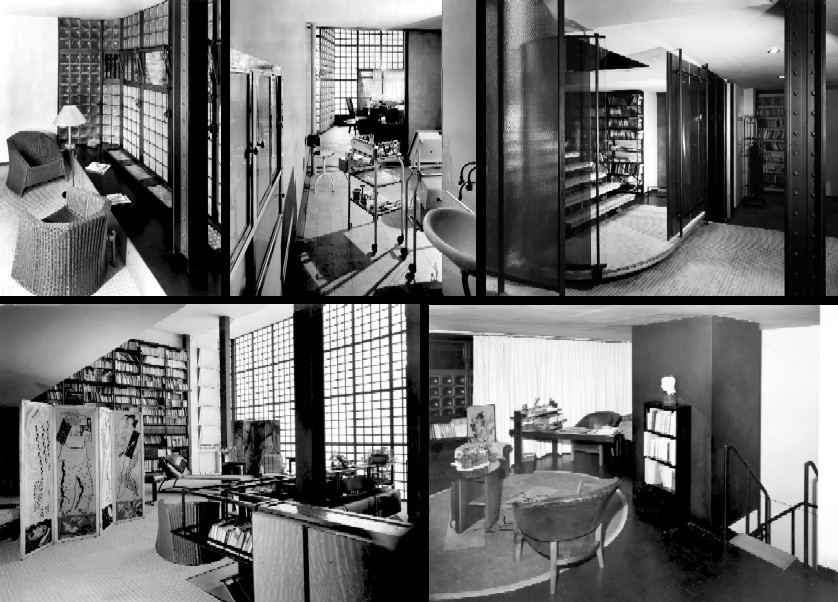
Office and Home Rooms in Maison de Verre by Pierre Chareau & Bernard Bijvoet, All Photos from the 1930s retrieved from Arch Daily, From top left -
Doctor's Office Waiting Space; Doctor's Office Practice; Stairs From the Office to the Home (Which Can Be Hidden); Living Room and Study
Adolf Loos
One of the more curious examples of what appears to be a 'total work of art' is Adolf Loos' Modernist

How Raumplan was Used to Create the Flowing Space at Villa Müller
Image From Rethinking the Future
Villa Müller built for civil engineer and building contractor František Müller between 1928-30. It was designed by Loos, a strict functionalist architect, in the style of his somewhat esoteric 'Raumplan'. Raumplan makes the interior design of a building more important than the exterior, dividing the interior into theoretical cubes which allow a natural flow from one cube to another with minimal division between them. It is not entirely clear how much input František Müller had into the interior design. He was co-owner of Kapsa-Müller construction company in Plzeň, Bohemia (later Czechoslovakia) which specialized in new construction techniques involving reinforced concrete. Concerete would have been an important facet of the design to him, so he was almost certainly involved in that aspect.
Müller was young, a builder acquainted with modern construction techniques and a man eager to make his way in cosmopolitan circles. ...But at heart Müller was conservative and practical; he wore tailored suits, had an extensive art collection, appreciated order and calm, and was painfully reserved, his social engagement limited by a stutter. Müller knew Loos's high reputation and work in Pilsen and wanted a Loosian creation of his own. A Czech architect, Karel Lhota, was hired to collaborate on the job, but Müller, knowing that Loos was in bad health, stipulated that the chief architect be involved at every stage of the project. There would be no compromises. (Jan Otakar Fischer, "White Walls in the Golden City", Harvard Design Magazine website, gathered 6-24-25)
From this, it would appear that
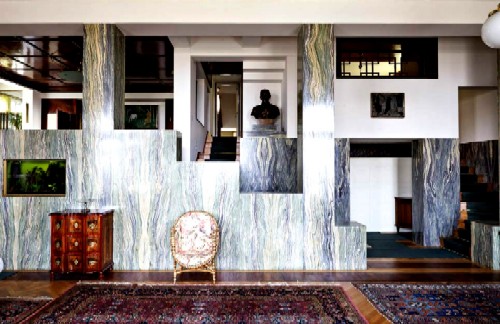
Villa Müller Living Room View of Stairs, Prague, Czech Republic, 1930, Instagram
Müller handed the design almost entirely over to Loos, even insisting upon his involvement throughout to be sure the plan came from him. This suggests it was a Gesamtkunstwerk. Yet there is an curious wrinkle in making such a declaration: Loos' would probably have denied that the villa was a Gesamtkunstwerk.
Loos was also opposed to the concept of the Gesamtkunstwerk (total work of art) as well as the 'dictatorial' attitude of architect designers who determined every detail of the domestic dwelling as well as its furnishings and decoration ...Loos expounded an alternative approach to modernist design, placing the individual and their need to live 'in a modern way' at the centre of architecture. For Loos, 'the house did not belong to art because the house must please everyone, unlike a work of art, which does not need to please anyone.' ("Adolf Loos (1870–1933)", National Gallery of Victoria website, gathered 6-24-25)
Loos' problem with the idea of a home as a 'total work of art' is a practical one, although it seems to have more to do with terminology than it does with the underlying idea that everything in a design should work together to produce a satisfying and artistic whole. His Raumplan concept is very evident in Villa Müller with its underlying flowing cubes dictating the structure along with the inclusion of select pieces of built-in furniture. (If he were alive to see it today being used as a museum, he would likely be appalled.) Yet his point about designing in such a way that would best serve the needs of his customer rather than the desire of the architect is important. An effective design would be in the intersection of the two and yet could still be 'a total work of art'.
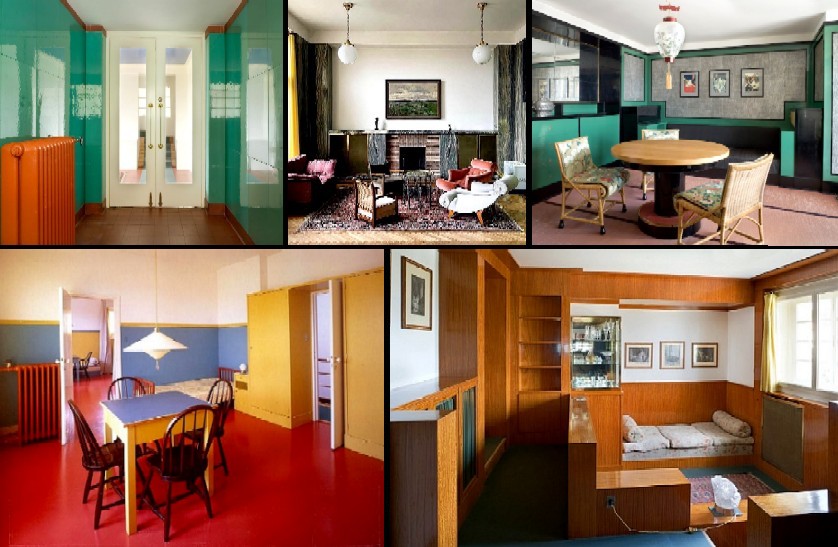
Villa Müller Rooms Planned by Adolf Loos, Prague, Czech Republic, 1930, from left - Entrance in the Basement, Design Mag; Living Room Alternate View, Instagram; Summer Dining Room, Tres Bohemes; Children's Play Room and Bedroom, EUmiesaward; Ladies Boudoir, Tres Bohemes
Charles Jeanneret (Le Corbusier)
Speaking of the needs of the customer, let us consider the final Modernist architect of a Gesamtkunstwerk who had strong views on this topic. In 1931, Charles Jeanneret (Le Corbusier) wrote, "We are well aware that a great part of the present evil state of architecture is due to the client, to the man who gives the order, who makes his choice and alters it and who pays. For him we have written 'eyes which DO NOT see.'" (Le Corbusier, Towards A New Architecture, Translated by Frederick
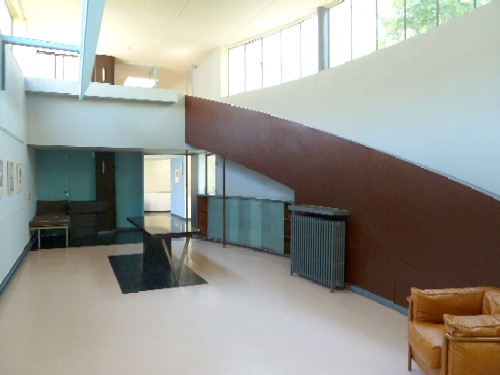
Painting Gallery, Maison la Roche, Paris, Le Corbusier, 1925, Flickr - Steve Silverman
Etchells, 1931, p. 18) While you can sense his frustration with changes to his plans likely at the hands of indecisive clients (not unlike Wright), you can also hear Howard Roark's declaration in such a statement. As pointed out by one author, "In his purist houses, Le Corbusier imposed his overwhelming personality on the clients, somehow expressing his own ideal dream of the city of the future and foreseeing the visionary scenarios of a modernist utopia." (Tiziano Aglieri Rinella, "Decoding The 'Machine A Emouvoir': A Psychoanalytic Reading Of Le Corbusier's Interiors", Meeting of the National Association of Research and Postgraduate Studies in Architecture and Urbanism Porto Alegre, July 25-29, 2016, p. 4)
Le Corbusier's 'purist' houses were designed in the 1920s and included Maison la Roche, Maison Jeanneret, Maison Guiette, and Villa Savoye. 'Purism' was a movement Le Corbusier co-founded with painter Amédée Ozenfant after World War I to restore regularity to art and design. It was intended as a counter-movement to the fragmentation which the Cubist movement espoused. The original document proposing this sytle is rather esoteric and spends a great deal of time discussing the problems the pair found with Cubism. What Le Corbusier took from it and applied to his work were familiar Modernist ideas: designs should be rational, useful, and without ornamentation. One can almost here the Modernist mantra 'Form follows function'. "Purism reached a climax in Le Corbusier's Pavillon de l'Esprit Nouveau (Pavilion of the New Spirit), built in 1925 for the International Exposition of Decorative and Industrial Arts in Paris." ("Art Term: Purism", Tate website, gathered 6-24-25) Of course, this was not built for a customer.
Instead let us consider his Modernist Villa Savoye, a country retreat Le Corbusier built for the Pierre and Eugénie Savoye's family between 1928 and 1931 in Poissy, France. Except for a brief specifying
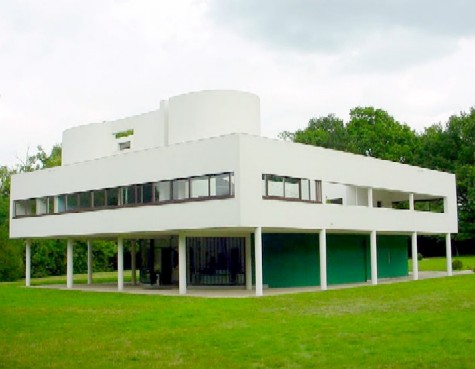
Villa Savoye Exterior, Le Corbusier, 1931, Wikipedia
the desire for a summer house, space for cars, an extra bedroom and a caretaker's lodge, the design was left entirely up to Jeanneret. They gave him a substantial budget so that "Le Corbusier had such freedom in executing the commission that he was limited only by his own architectural aesthetic." ("Villa Savoye", Wikipedia, gathered 6-24-25) He built his Purist houses to make sure that every design feature was justified - what he called the precision of architecture. "The freedom given to Le Corbusier by the Savoyes resulted in a house that was governed more by his five principles than by any requirements of the occupants." (Wikipedia)
Le Corbusier referred to a house as a 'machine for living', which impacted nearly every aspect of his design style. The 'five principles' or 'five points of architecture' mentioned previously first appeared in L'Esprit Nouveau in 1920. The first four points were based on the writings of Eugène Viollet-le-Duc. The first simply says the structure should be built off the ground. The other four had more impact on the interior design. They included: a rooftop garden gave back some of the earth taken to build the house (point 2), an open floor plan (point 3), long horizontal windows (point 4) and a design free from architectural restrictions (point 5). (For a more complete overview of the five points, see "Le Corbusier's Five Points of Architecture" on Wikipedia.) Because Le Corbusier was able to build it with minimal instruction from his client, this is probably the most complete example of an Art Deco Gesamtkunstwerk discussed.
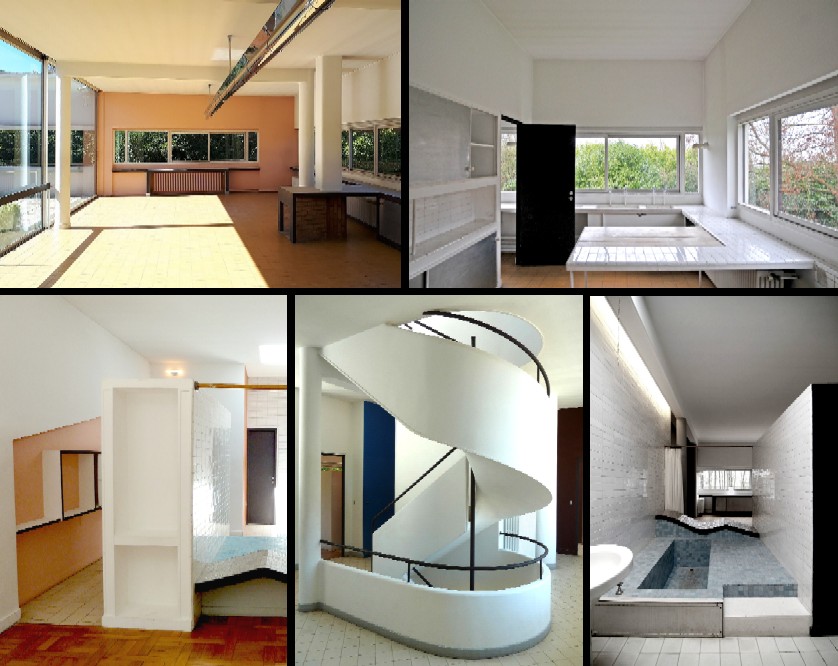
Villa Savoye Rooms Planned by Le Corbusier, 1931, From top left - Salon, Wikipedia; Kitchen, m-louis on Flickr; Hallway and Bathroom, Steve Silverman on Flickr; Helical Staircase, Steve Silverman on Flickr; Bathroom Bath and Sink, Scarlet Green on Wikimedia
Pierre Petit
While the four Modernist architects and designers mentioned previously were fairly well-known, this was not necessarily a requirement for someone being given the opportunity to create a Gesamtkunstwerk dwelling during the Art Deco era. Pierre Petit, an Art Deco era furniture and interior designer, was contracted to design a hunting lodge for shoe company owner Maurice Philbois.

Foyer, Maurice Philbois' Hunting Lodge, Poigny-la-Forê, Paris, Designer
Pierre Petit, Photo-Adam Štech, late 1930s, World of Interiors
Pierre Petit trained with famous mannequin maker Siegel et Stockman, where he honed his skills designing façades, interiors, furniture, and lighting, preparing for his career as what was known as a 'decorator-ensemble designer.' This profession gained prominence in the 1920s: decorator-ensemble designers focused on creating cohesive, functional, and stylish interiors, mastering every detail – from furniture and lighting to wall coverings and accessories."VIII - RIMOWA visits Pierre Petit’s Maison: An Art Deco Time Capsule", RIMOWA website, gathered 6-25-25)
Most of what is known about Petit's involvement with Philbois online comes from an article written by Adam Štěch who photographed the lodge when it came up for sale. He notes that in addition to designing interiors for Siegel and Stockman, Petit also created furniture and designed diverse items including stained glass, lighting, wallpapers, fabrics, carpets, railings and signs. Philbois' had met Petit while working on designs for some of his shoe stores and window displays. This, in combination with seeing Petit's display at the 1937 Paris Exposition Internationale des Arts et Techniques dans la Vie Moderne encouraged Philbois to have Petit design his a hunting lodge for him. "Philbois was immediately seduced by Petit’s work and signed him up to design his new house." (Adam Štěch, "Hot Pursuit", World of Interiors Website, gathered 6-24-25)
The hunting lodge is the only known example of Petit’s oversight of such a habitation. He was in charge of the layout and furniture, collaborating with numerous artists and craftsmen to bring the project to completion. I did not discover how much instruction Philbois gave Petit in designing the hunting lodge. Štěch notes, "Hunting was Maurice Philbois’s passion, and the sport provides motifs for the ornamentation both inside and outside the house." This may indicate that Philbois was involved in specifying the design. However, Štěch also says the design "is an amalgamation of period styles from Art Deco and Neoclassicism to Functionalism, combining these aesthetics in an almost fantastical and surreal way." This seems to suggest the hand of the creative and multi-talented Petit. Štěch points out that the first floor living room is practically a reproduction of what Petit exhibited at the 1937 Paris exhibition, where he would have been free to design as he pleased.
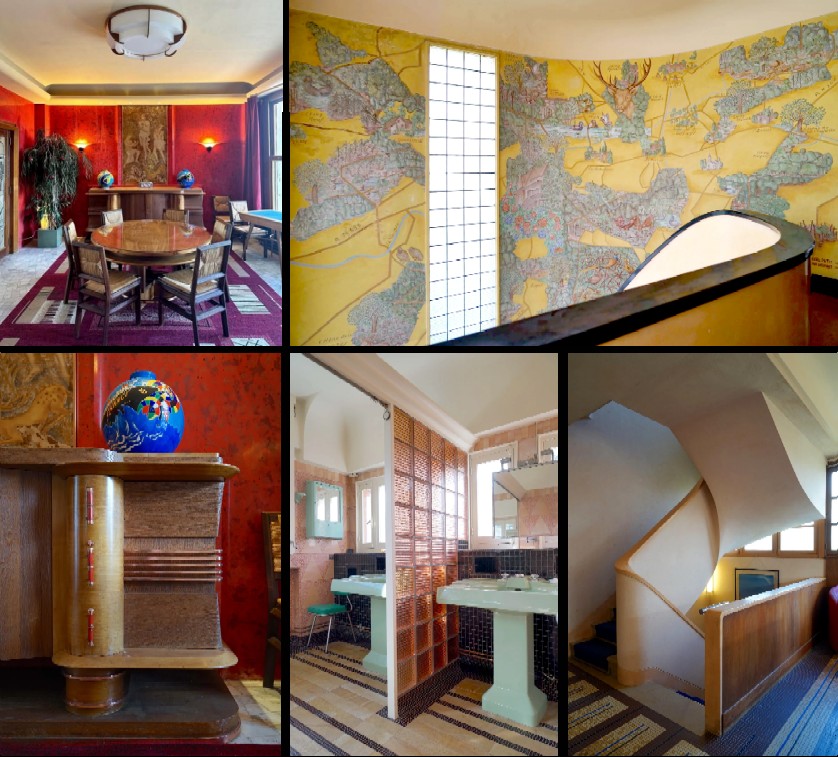
Maurice Philbois' Hunting Lodge Images, Poigny-la-Forê, Paris, Pierre Petit, Photos: Adam Štech, late 1930s, World of Interiors, From top left - Dining Room; Foyer Stairs with Map Mural; Bar with Globe; Bathroom; Upper Floor Stairway
As the final example suggests, it is not always easy to determine where the customer's desires end and the designer's begins unless it is known that the designer was given a free hand. Nor can one definitely state that a 'complete work of art' is undermined by the requests of a client, except perhaps in the strictest meaning of a Gesamtkunstwerk. Nearly all structural decoration requires a client's approval unless the client specifically states the design is completely up to the architect or designer.
"Gesamtkunstwerk" Wikipedia, gathered 5-7-25
"Gesamtkunstwerk –The Total Work Of Art Through The Ages", Artland Magazine, gathered 6-20-25
"Eugène Viollet-le-Duc", Wikipedia, gathered 6-18-25
John Jacobus, "New Forms in Architecture", Art Forum website, gathered 6-19-25
Ray Bishop, "Viollet-le-Duc, architect and medievalist", Ray Bishop History website, gathered 6-20-25
"Vienna Secession", Wikipedia, gathered 6-20-25
"Maison de Verre" Wikipedia, gathered 5-7-25
"Pierre Chareau: Modern Architecture and Design", Art Deco Society of New York website, gathered 6-20-25
"Villa Müller", Wikipedia, gathered 6-24-25
Joem Besser & Stephan Liebcher, Adolf Loos, "The Life, The Theories, Analysis of the Villa Mueller", University of Bath, gathered 6-24-25
Brian Brace Taylor and Russell Walden, "Le Corbusier at Pessac: Professional and Client Responsibilities", MIT Architecture website, gathered 5-7-25
Morentz Gallery Post, June 26, 2024, gathered 6-24-25 -
"Purism", Wikipedia, gathered 6-24-25
Amédée Ozenfant & Charles Édouard Jeanneret (Le Corbusier), Après Le Cubisme (After Cubism), 1918
"Le Corbusier, The Architect of Purism", Italian Design Club website, gathered 6-24-25
"Villa Savoye and gardener's lodge - Poissy, France, 1928-1931", Fondation Le Corbusier website, athered 6-30-25