Material - Zenitherm
Zenitherm is a wall material developed in the early twentieth century being used primarily for walls, floors and decorative architectural elements. Known for its durability, versatility, and aesthetic appeal, it was designed to imitate the appearance of marble while maintaining the workability of wood. It reflects a trend architecture toward composite materials to reduce cost, simplify construction, and expand design possibilities during the Interwar Era. The name of the material was a combination of the words ‘zenith’, referring to the highest point or culmination, and ‘therm’, referring to a unit of heat.
History of Zenitherm
Zenitherm emerged during a period of rapid innovation in construction materials in the late 19th and early 20th centuries. Experiments
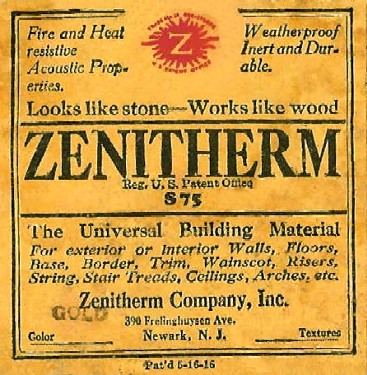
Gold Floor Tile Label, 1920s-30s, FTL Design
leading to its creation began as early as 1903, when German chemist Dr. Roser B. Sutter began experimenting “to produce a building product having all the advantages of wood and stone, but none of the disadvantages.” (Zenitherm Company, Inc., “Zenitherm: The Universal Building Material”, not dated or paginated). By 1908, he produced the first slabs of material. The first building constructed using Zenitherm panels was in 1913.
A patent was filed for Zenitherm in December of 1914 and granted in May of 1916. The filers explained that the filers reserved the right to expand materials “because the invention may be embodied in a multiplicity of forms, each being a species of our said invention.” (Alfred G. Cameron and Charles D. Higgens, “Wallboard”, Patent No. 1183165, Granted May 16, 1916)
It is interesting that the patent was not filed by Dr. Sutter; at the time he was the president of the Zenitherm Company with offices in Newark and a factory in Kearny, New Jersey. This likely occurred sometime around 1910 although I found no records to identify the precise date. Cameron and Higgens, the filers of the patent, apparently worked as researchers for Sutter’s company in 1914.
By the 1920s, Zenitherm was manufactured commercially, primarily in the northeastern United States. It was initially produced by the Zenitherm Company in Kearny. At some point, the product was manufactured by Structural Gypsum Corporation in New York City, likely before the Kearny manufacturing site was set up, although this isn’t verified. The material gained popularity throughout the 1920s and 1930s, particularly in New Jersey and surrounding regions, being used in a wide range of building types.
Composition
An article in Safety Engineering magazine provided a detailed look at the composition and manufacture of the material in 1914:

Zenitherm Wall Installation, 1931, Zenitherm For Walls And Floors, p. 19
Zenitherm consists chiefly of finely ground and screened cork. In the process of manufacture various chemicals and a liquid binder are added, the whole thoroughly mixed, placed into molds and subjected to moderate pressure in hydraulic press. From here the molds are conveyed into drying rooms, where they remain for a number of hours, after which the slabs go to the stock rooms. No baking or high heat is required. Since no glue, oil or vegetable matter of any kind is used in the binding composition, no decay is possible, or is the material ever attacked by vermin. It is odorless, and can be molded in any size or shape, but usually it is supplied in large slabs, 18 by 48 inches, in any thickness from 2 to 4 inches. The weight runs between 20 and 25 pounds per cubic foot, but this can be varied from 10 to 50 pounds per cubic foot, to suit special requirements. (“Fire and Heat Resistant Compositions”, Safety Engineering, Vol. 28, No. 1, July, 1914, p. 22)
The article goes on to highlight the use of a ‘facing’ on the front of some panels which was the decorative element resulting in its use in many commercial applications.

Zenitherm Wood Floor Installation, 1931, Zenitherm For Walls And Floors, p. 18
This facing (patent applied for) consists of a thin layer of very fine granular material, giving a smooth surface which may be likened in effect to the oatmeal wall papers now so popular for interior decoration. The faced surface can be made perfectly smooth by applying thereto a wood filler, then paint and finally varnish or enamel in any desired shade. It can also be stained and grained to imitate the most artistic grades of wood. (“Fire and Heat Resistant Compositions”, p. 23)
The 1916 patent explains that the product is explained to be a sheet of fibrous material (the cork), waterproofed with asphaltum, coated with an adhesive onto which was placed a crushed mineral such as sand, masonry or marble. Yet the makeup of Zenitherm seems to have changed throughout its life. Although the above descriptions explain the material, some Zenitherm products were known to contain asbestos. Other materials used included wood fiber, magnesium oxide and zinc (Sean Flynn, “Attention to detail”, The Newport Daily News website, gathered 3-29-26) as well as terra-cotta.(“Viriginia House - National Register of Historic Places Registration Form”, United States Department of the interior National Park Service, No. 127-255, p. 7) It is interesting that while the article in Safety Engineering trumpeted the fire resistance of the material, it does not mention asbestos.
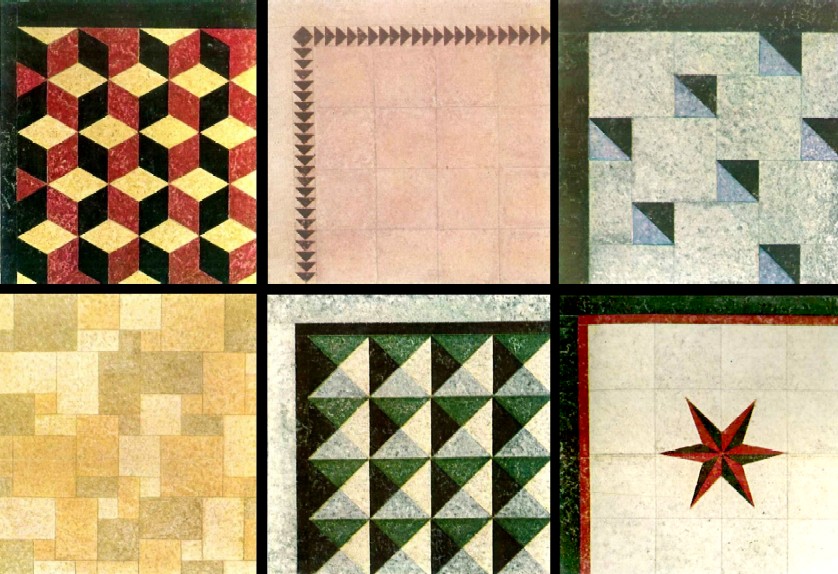 Zenitherm Floor Patterns, From Zenitherm - Floors of Character, 1930: <Top> Pattern F-28 - Cubes in Red, Gold & Black; Pattern F-70 - Brown Triangles on Coral Pink Background; Pattern F-205 - Stone Grey, Blue and Black
<Bottom> Pattern Random 'T' - Gold Tones; Pattern F-41 - Lichen Green, natural and Stone Grey Pyramids; Pattern F-60, Red and Black Star on Light Grey Field
Properties and Uses
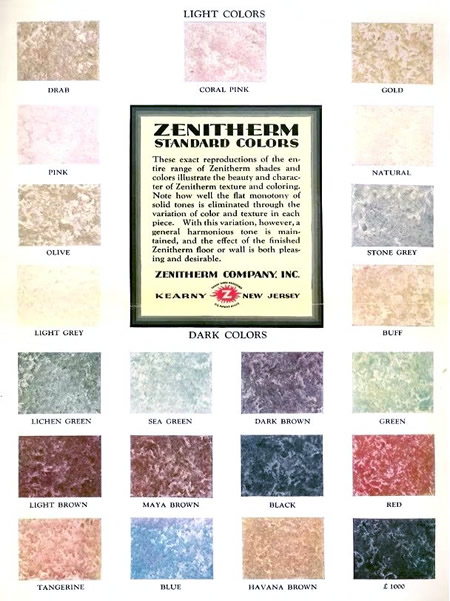
Zenitherm, Standard Colors, 1930, From Zenitherm - Floors of Character
Zenitherm had several distinctive properties:
- Durability: The mineral surface made it resistant to wear and aging. The Zenitherm literature actually indicaes that it became harder over time.
- Workability: Unlike stone, it was easily cut and shaped using standard woodworking tools. Most Zenitherm advertisements point to the ability to drive nails into it.
- Aesthetic flexibility: By using different colored minerals, manufacturers could produce a wide range of finishes and patterns.
- Moisture resistance: Coatings such as asphalt helped protect the material from water damage.
- Fire resistance: Heat and fire tests conducted in the testing laboratory of Columbia University in New York as well as by the Imperial Bureau of Standards in Berlin showed its fire resistance.
Uses of Zenitherm included:
- Wall Panels
Zenitherm was used as both an interior and exterior wall covering. It was produced in sheet or panel form and attached directly to building frames using nails or fasteners. Because of its textured surface, it could mimic plaster or stone walls without the need for labor-intensive masonry work. The panels were especially known for their resistance to cracking, a common problem with traditional plaster walls. This made them a practical choice for both residential and commercial construction.
- Flooring
Zenitherm was also widely employed as a flooring material. Tiles were typically thicker than wall panels, providing strength and durability under heavy foot traffic. Floors made from Zenitherm remained in good condition even after decades of use, demonstrating the material’s longevity. Being able to imitate marble or stone, Zenitherm flooring was found in entry halls, public buildings, and institutional spaces where both appearance and durability were important.
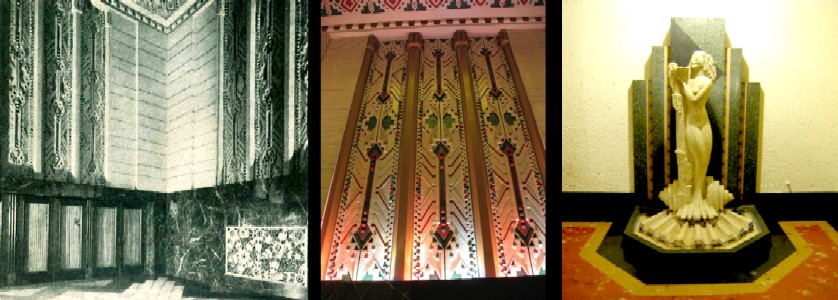 Zenitherm Panels at the Pickwick Theater, Park Ridge, Il, 1928: The Zenitherm panels are the flat pieces on the walls anf floors, not the Mayan decoration nor the statue. I believe the black marble pedestal of the statue which is housed in an alcove near the men's restroom is also Zenitherm.
Images: Zeitherm for Walls and Floors, 1931, p. 13; Atlas Obscura and Flickr User DWChicago
- Decorative Architectural Elements
Another application of Zenitherm was in architectural ornamentation. Because the material could be molded or pressed into detailed shapes, it was used for decorative features including:
- Moldings and panels
- Fireplace surrounds
- Columns and capitals
- Arches and soffits
Unlike carved stone, Zenitherm elements could be mass-produced, reducing cost while maintaining visual complexity. Its ability to replicate intricate designs made it particularly appealing for buildings that required ornate detailing. - Moldings and panels
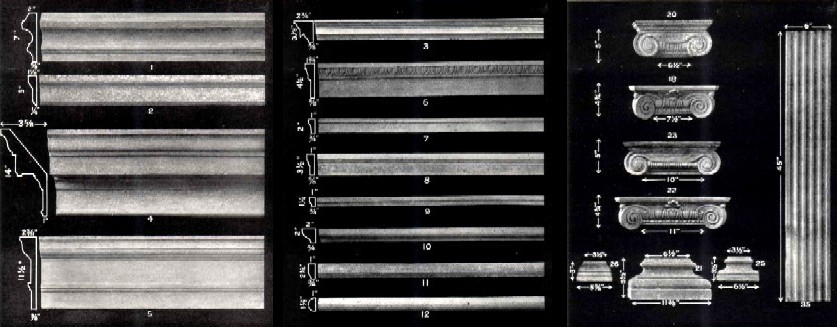 Zenitherm Moldings snf Columns, A Folder of Architectural and Decorative Ornaments Achive with Zenitherm, 1920s, FTL Design
Zenitherm was marketed as a “universal building material,” emphasizing its adaptability and cost-effectiveness. Its resistance to moisture allowed it to be mounted on building exteriors with the nail holes sealed with Zenitherm Compound and the material edges ‘buttered’ with Zenitherm Pointing Compound and fit tightly together. Advertisements highlighted its ability to replicate the look of marble or stone while being easier to handle and install. It could be cut, nailed, drilled, or shaped similarly to wood, making it attractive to builders and architects.
DeclineDespite its popularity, the production of Zenitherm appears to have ceased in the early 1940s. One reason was the emergence of newer materials such as drywall and improved concrete products. As the United States turned its production capabilities from consumer goods to war production in early 1942 the production of Zenitherm must have ceased. Company literature from the 1920s points to “hundreds of installations supervised by the most prominent architects and installed in many of the finest buildings throughout the United States.” (Zenitherm Company, Inc., “Zenitherm: The Universal Building Material”, not dated or paginated) However, production of Zenitherm doesn’t appear to have restarted after the war. Despite this, Sutter continued researching, filing other, unrelated patents as late as 1952. Today, Zenitherm is primarily encountered in historic preservation projects. It represents a transitional phase in building technology, bridging traditional materials and modern composites.
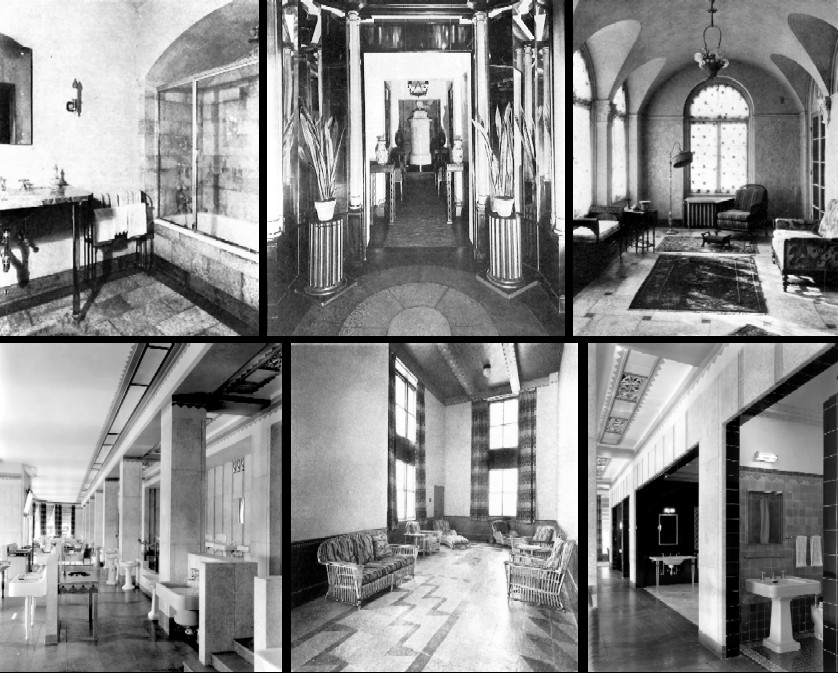
Rooms with Zenitherm Floors and Walls: <Top> Bathroom with Zenitherm Floor and Alcove Walls, From Zenitherm for Walls and Floors, 1931, p. 10; Zenitherm Floor, Jones and Erwin Interior Decorators Office, New York, From Zenitherm for Walls and Floors, 1931, p. 12; Zenitherm Floor, E. G. Klipstein House, From Zenitherm Floors, 1927, p. 4
<Bottom> (First and Last Images) Zenitherm Walls, Crane's Deluxe Plumbing Fixtures Store, Hollywood, CA, 1930, Before the 101 website; (Middle Image) Zenitherm, Haddon Hall, Atlantic City New Jersey, Rankin and Kellogg Architects, Zenitherm for Walls and Floors, 1931, p. 15
Sources Not Mentioned Above:
“Zenitherm Architectural Wall & Floor Material”, FTL Design website, gathered 3-29-26
Mike Jackson, “Understanding Asbestos Use in 20th Century Materials”, Architect Magazine website, gathered 3-29-26
Zenitherm Company, Inc., “Zenitherm for Walls and Floors”, 1930
Zenitherm Company, Inc., “Zenitherm for Walls”, 1927
Zenitherm Company, Inc., “Zenitherm for Floors”, 1927