Material - Nickel and Select Nickel Alloys
During the interwar era, the use of silvery metals became popular, exuding a luxurious quality, something at which polished metals shine. (Pun intended.) The 1925 Exposition Internationale des Arts Décoratifs et Industriels Modernes brought with it a philosophical shift from the flowery,
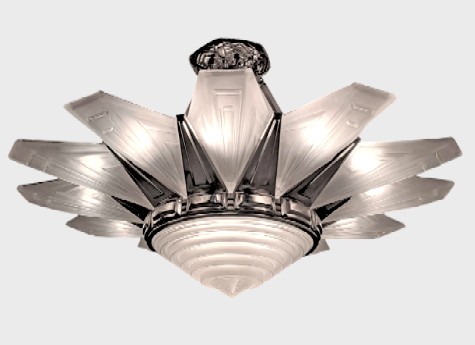
Starburst Slip Shade Chandelier, Nickeled Bronze with Frosted Art Glass,
Maison Leleau, Chairish
naturalistic Art Nouveau style to more geometric and mechanically sympathetic one. This was in line with Modernism's declaration that form should follow function and decoration should be minimized.
"Dominated by a machine aesthetic, Art Deco played into the hands of the commercial metal suppliers and expanded sales exponentially for white metals [such as silver and nickel]. ...Embracing simplicity through rationalised fabrication techniques and the mechanical strength of new alloys, the Bauhaus [movement] reinterpreted classic objects into entirely new forms. The strength, workability and neutral colour palette of white metals became synonymous with the new-fangled modernity, while high gloss finishes evoked the rarity found in gold and glass for a fraction of the cost." (James E. Churchill, "Decorative Monel: Historical Intent, Weathering and Analysis", Columbia University, 2020, p. 21-2)
Nickel was an important metal in Art Deco design, particularly in the 1920s before chrome began to be more widely used in furniture and furnishings. As another commenter explains, "[Nickel's] versatility makes it a popular choice for adding a touch of sophistication with a hint of industrial edge. This metal is aesthetically pleasing and captures a nostalgic atmosphere, and it... also masks fingerprints for easy upkeep."("Mastering the Art of Metal Finishes in Interior Design", Biro and Sons, gathered 10-28-25)
Nickel is an elemental metal. Its 'accidental use' is ancient, even though it wasn't specifically
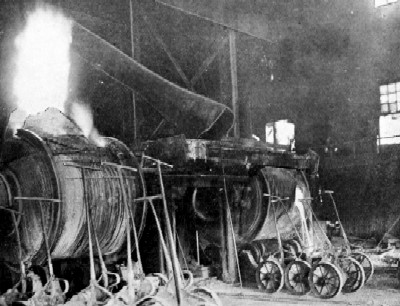
Victoria Mines, Nickel Smelter Converters, Sudbury, Ontario, 1913,
Wikimedia
identified as a specific metal until Swedish chemist Axel Cronstedt tried to extract copper from the ore nickeline - a nickel arsenide - in 1851. The Germans believed this yellow nickeline contained copper, referring to it as 'Kupfernickel' (literally 'copper-nickel') where 'nickel' referred to "a mischievous sprite of German mythology, Nickel (similar to Old Nick), [who was] besetting the copper." ("Nickel", Wikipedia, gathered 9-25-25) Not being able to produce copper, Cronstedt named the white metal he managed to extract 'nickel' after the latter half of Kupfernickel. Until 1824, rare Kupfernickel was the only way known to produce the new element. During the 19th century, other sources and processes were discovered which produced nickel. Large nickel deposits were discovered in Sudbury Basin, Canada in 1883, in Norilsk-Talnakh, Russia in 1920, and in the South African Merensky Reef in 1924 making large-scale nickel production possible.
A key process instrumental in the use of nickel in home products developed in parallel with the nickel production: nickel plating. The first practical method for nickel plating relied on an aqueous solution of nickel and ammonium sulfates invented by Rudolf Christian Böttger in 1843, being used for the next 70 years. Dr. Isaac Adams patented a bath plating process using nickel ammonium sulfate with a neutral pH in 1869 that became the cornerstone for modern nickel plating. In 1915, building upon Adams work, Oliver P. Watts created the Watts bath which used an aqueous electrolyte solution to deposit nickel on other metals to produce both a bright and semi-bright finish.
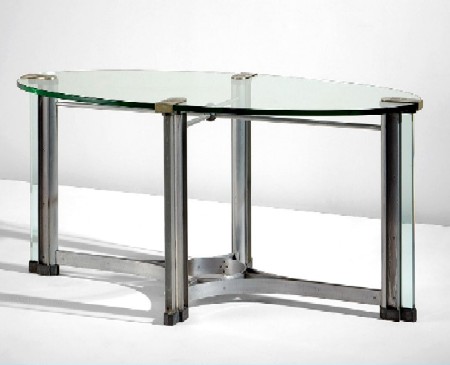
Table, Nickel, Metal and Glass, From RKO Roxy Theater, Ladies' Lounge,
Eugene Schoen,
c. 1932, Phillips
The Watts' type baths for nickel coating were used throughout the Art Deco and Streamline Moderne eras.
These baths yield soft, ductile deposits that are easily buffed to an appealing bright finish. If deposited over a bright surface to a thickness not exceeding 1 mil, the coatings usually exhibit a degree of brightness without buffing. But to achieve the luster demanded by a discriminating buyer, the object being coated must be polished and the coating must be buffed. Both are costly." (W. Wallace Sellers, "The Fascinating Story of Nickel Plating is Characterized by Resourceful Individuals and Companies Responding to Industry Needs", Effectrode website, gathered 9-25-25)
The bright finish would have been what was typically used on the sort of decorative items which might be found in interior design. The extra expense was likely not as much of a concern during the 1920s when luxurious materials were frequently used on Art Moderne products. This would have added to the appeal of an object in the minds of the target audience.
The 1930s would have been a slightly different story. Lumbered with the financial

Tea Set, Polished Nickel & Thermoset Plastic, 1920-30s, Roughan Home
problems caused the by Great Recession, the blasé attitude towards material cost would have become more important to some buyers. Max Schloetter developed and patented the first practical bright nickel bath, a process not requiring expensive polishing. During the remainder of the interwar years, various researchers began experimenting with variations on the process, leading to several patents for the process in addition to the development of new alloys. One of the problems with this process was pitting, something that didn't really begin to be effectively addressed until the 1940s.
Chromium coating challenged the use of nickel coating in some applications as it became more accessible in the late 1920s. The resulting finish was much brighter and more reflective, making it the standard coating for most metal tube furniture. Some designers attempted to use nickel coating on tubular steel furniture in the mid-1920s, but a few mention dissatisfaction with the results, turning to chromed metal when it became more available. This isn't to say that nickel was no longer used in home decor in the 1930s. It was still found in a variety of items, being popular as plating in many lighting designs as well as on cabinet handles and drawer pulls and some furniture. In addition, nickel was alloyed with steel resulting in several materials popular in home furnishings during the interwar period. Among these alloys were nickel silver and Monel. (Nickel is also an important element in Stainless Steel, but that is not discussed here, deserving its own article.)
Despite the popularity of chrome in Art Deco furniture, many designers still used nickel plating. It was often found in the hardware and accent pieces of furniture during the interwar period. The metal's resistance to corrosion and damage would have been appealing to furniture manufacturers, particularly given it's lower cost compared with more precious metals. Because nickel could be satin, polished or brushed, it provided furniture designers with a variety of possible finishes, depending on the intent. The silver tone also provided an interesting contrast to the warm woods found in a lot of furniture. A variety of well-known Art Deco and Modernist designers used it in this way as did manufacturers of unsigned furniture.
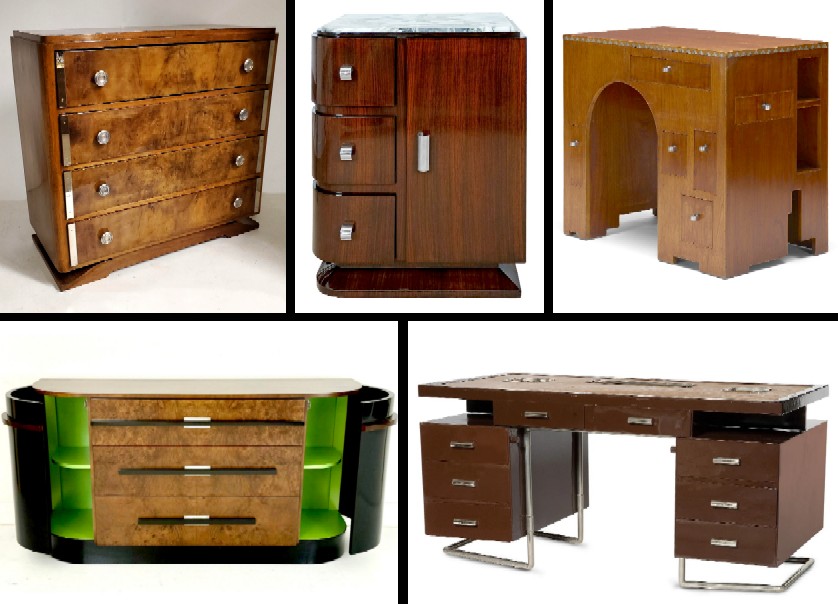 Furniture with Nickel Hardware, <Top> Chest of Drawers, Burl Wood with Polished Nickel Pulls and Edge Protectors, French, 1930s, 1st Dibs; Night Stand, Rosewood Veneer, Marble Top, Nickel Plated Brass Handles, French, 1930s, Fins de Siecles; Puzzle Desk, Walnut, Nickel Plated Brass, Bakelite, Paul Frankl, 1926-7, Wright Auctions
<Bottom> Cabinet/Sideboard, Burl Wood, Ebonized Drawer Pulls with Nickel Escutcheons, Donald Deskey for Hamilton Manufacturing, 1935, 1st Dibs; Desk, Lacquered Stamped Sheet Metal, Nickel-Plated Tubes, Leather Top, Robert Mallet-Stevens, c. 1927, Musee des Arts Decoratifs
Nickel also appeared in a variety of lighting products including those by Jean Perzel, Claude Lumière/Claude-Paz et Silva, Atelier Petitot, Max Le Verrier, Degué, La Maison Desny and others. Its elegant, modern appearance agreed with the fascination by some with the Modernist 'machine age' style as well as increasing interest in new, innovative materials. When unpolished, the metal provided the Modernist, industrial aspect, focusing attention on the clean lines of a light. When polished, it gave a lamp or chandelier a touch of the dramatic, reflecting the light in arresting and interesting patterns.
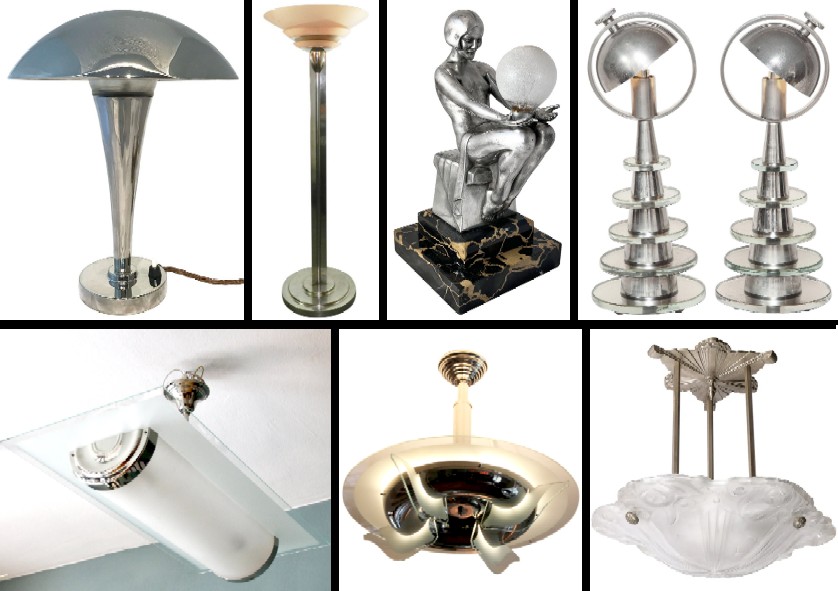 Nickel Plated Lighting Examples, <Top> Table Lamp, Nickel Plating and Glass, Claude-Paz et Silva, French, 1930s, Morgan Strickland Decorative Arts; Torchiere, Nickel Plated Bronze with Pink Crystal Glass, Jean Perzel, French, c. 1932, Antikeo; Seated Nude with Globe Lamp, Nickel Plate Figured, Marble Base, Frosted Glass, Max le Verrier, Morgan Strickland Decorative Arts; Table Lamps, Nickel Plated Brass, Maison Desny, French, 1927-33, 1st Dibs; <Bottom> Ceiling Light, Nickel Plated Bronze, Partially Etched Glass, Atelier Petitot, 1930s, Pamono; Ceiling Pendant Light, Nickel Plated Brass, Etched Glass, Unsigned, 1930s, Chairish; Chandelier, Nickel and Frosted Glass, Cubist Style, Degue, French, c. 1930, High Style Deco
As indicated by the Perzel figural lamp in the previous photo group, nickel plating was sometimes used in sculptures during the interwar period.Here it was primarily the aesthetic appeal of the material which was sought, projecting a sleek, modern luster. The strength and corrosion resistance of the nickel would also have helped keep the statues from being damaged and tarnished. A nickeled statue's "neutral tone complements a wide range of color palettes and design styles, allowing them to effortlessly integrate into various rooms." ("Nickel Statues: Elegant Home Decor", Lighting New York website, gathered 11-4-25)
 Nickel Plated Statues From the Interwar Period: <Top> Sculpture of Woman, Nickel Plated Bronze, Cold Painted, By M. Secondo, 1925, Art Deco Collection; Woman in Evening Dress, Nickel and Ebonised Wood, Austrian, c. 1930, Easy Live Auction; Woman Holding Bird with Ball Lamp, Nickel Plated Bronze on Yellow Marble Plinth, Joan Salvado, c. 1925, Sapphire Prime Collectibles
<Bottom> Panther, Nickel Plated Bronze on Marble Base, French, 1930, Deconamic
Nickel plating wasn't limited to furniture hardware, lights and statues. A wide variety of items featured nickel including some post-Interwar era things executed in Art Deco style.
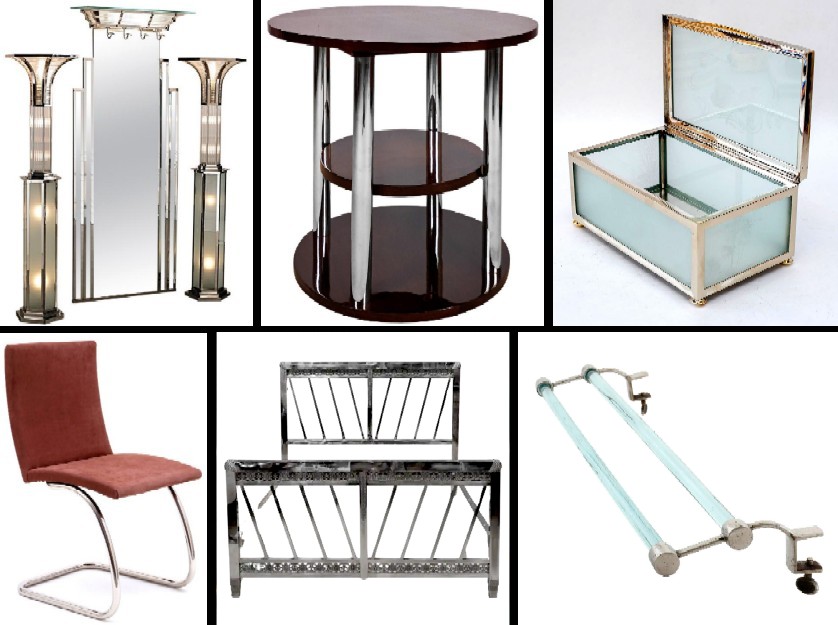 Nickel-Plated Art Deco Items, [Top] Lamp on Columns with Full Length Mirror, Nickel Finish and Glass, Sofar, Modern, 1st Dibs; Side Table, Nickel-Plated Steel Legs with Rosewood Surfaces, French, 1930s, 1st Dibs; Jewelry Box, Nickel Plated Metal and Glass, Austrian, 1920s, 1st Dibs
[Bottom] LR120 Cantilevered Armless Chair, Nickel-Plated Steel Tubing and Leather, Lilly Reich, c. 1931, MoMA; Bed Head and Footboard, Nickel with Steel Support Bars, 1930s, 1st Dibs; Towel Holder, Nickel Plated Brass and Glass, c. 1930, 1st Dibs
Nickel Silver
Nickel silver "became popular in the United States in the 1920s as a less expensive
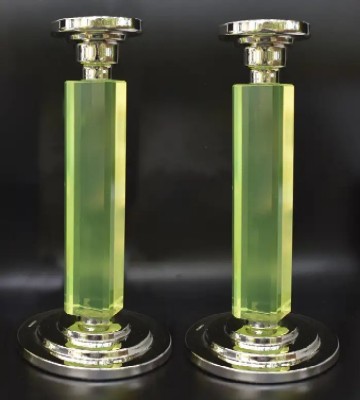
Nickel Silver Plated Metal and Uranium Glass Candlesticks,
Stepped Graduated Circle Design, c. 1930s, 1st Dibs
alternative to silver for decorative grilles and panels, railings, and elevator doors. Nickel silver's resistance to corrosion and elegant silvery-white appearance were among the desirable attributes that made it so sought-after for architectural applications." (Kathleen Murphy Skolnik, "Shimmer and Shine: Cutting-Edge Materials with Art Deco Pizzazz", Art Deco Society of New York, gathered 4-7-24)
In addition to it's corrosion resistance, nickel silver was extremely hard and resistant to abrasion. This makes it a good plating for door knobs, handrails and door plates as well as being used for tableware. While more corrosion resistant than many other metals, it is not entirely impervious to corrosion. This is due to the zinc in the alloy which can cause tarnishing when the metal is exposed to acid and sulfur pollutants.
Nickel silver is an alloy of copper (45-70%), nickel (5-30%) and zinc (8-45%). It was first smelted from unprocessed ore in China where it was called paktung (literally 'white copper'). It had found its way to Europe by the late 16th century, despite Chinese attempts to stop exports of it. By 1750, Germany managed to alloy raw materials so that they could manufacture a metal similar to paktung. The Germans began to experiment with the makeup of nickel silver culminating in an German competition in 1823 with the goal of making it look as much like silver as possible. The Henniger brothers in Berlin and Ernst Geitner in Schneeburg each managed to create the desired result. The Schneeburg metal was sold under the name Argentan while the Hennniger metal was sold as Alpacca. The metal was referred to as German silver in England up until World War I after which it was called nickel silver. It is also sometimes referred to as Alpacca, Alpacca Silver and Maillechort in France..
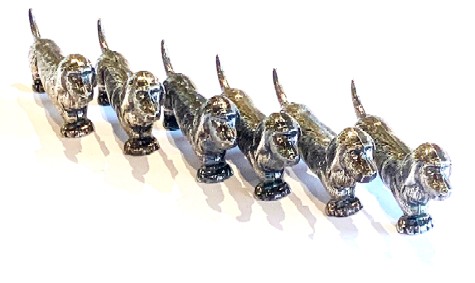
Nickel Silver Daschund Dog Knife Rests, French, c. 1930, Arte Deco
The popularity of nickel silver use increased after a method for commercial application using electroplating occurred. This began with surgeon John Wright who invented a method for electroplating using a solution of cyanide of silver in potassium cyanide after reading an article by Carl Wilhelm Scheele on how cyanides reacted with gold and silver in a potassium cyanide solution. He contacted the Elkington's plating firm in Birmingham, England about his invention and was paid £300 for the rights to patent the procedure plus another £500 when the patent was approved in 1840. The Elkingtons acquired rights to other processes for gold and silver plating which led to their opening an electroplating facility in Birmingham in 1841. "Nickel silver first became popular as a base metal for silver-plated cutlery and other silverware, notably the electroplated wares called EPNS (electro-plated nickel silver)." ("Silverplating", Annika Patterson website, gathered 10-29-25) The commercialization of the Elkingtons' electroplating process allowed for other metals such as nickel, brass and tin to be applied to cheaper metals in the 1850s.
The 1920s saw an increase in use in decoration using nickel silver. It was found in decorative panels, doors, grilles, railings, plumbing fixtures, plaques, trim and divider strips in terrazzo floors. It was likely chosen for such applications because of its bright elegant silvery appearance while still having good corrosion and abrasion resistance which could prevent damage to the type of public use it would experience in such places. Nickel silver is occasionally found in decorative lighting, likely as a cost-saving measure while still presenting the bright silver appearance which gave nickel the aura of luxury and modernity. Most of the lights which use nickel plating are today said to be nickel. Like regular nickel, nickel silver resisted corrosion as well as being strong and resistant to abrasion. Most of the period lighting found for sale in auctions today indicates that the plating is nickel rather than nickel silver, but there are some examples of the latter.
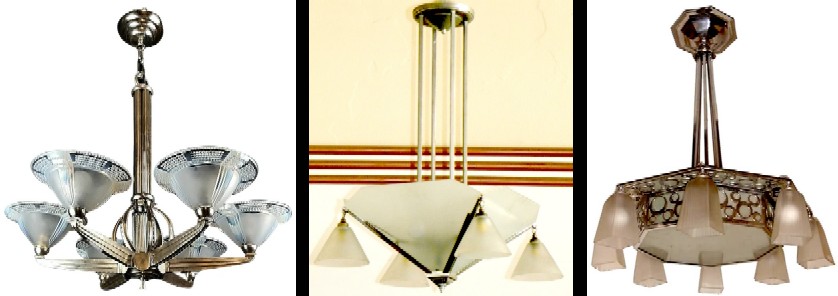 Nickel Silver Chandeliers, From Left: Chandelier, Opalescent Glass Shades, Nickel Silver, Bronze and Brass, Atelier Petitot, France, 1930s, Ruby Lane; Chandelier, Nickel Silver and Glass, French, 1930s, Art Deco Collection; Nickel Silver Chandelier with Eight Frosted Glass Globes, Bubble Design Metal Work, France c. 1930., Three Centuries Shop
Some Interwar Era decorators used nickel silver in their pieces. Jean Dunand employed it for its decorative properties. Dunand was fascinated by different materials and processes. He used nickel silver as part of his exploration of the use of non-precious metals in dinanderie (a type of intricate, ornamental metalwork). He also used nickel silver for decorative effect, combining it with various metals, inlays, patinas and his signature lacquering.
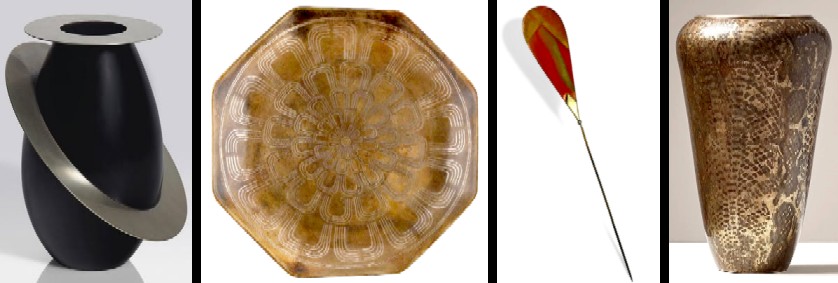 Nickel Silver Items by Jean Dunand, From Left: Winged Vase, Black Lacquer and Nickel Silver, c. 1928, Christie's; Dinanderie Charger, Patinated Copper and Nickel Silver, c. 1925, 1st Dibs; Brass and Nickel Silver Hatpin, Red Lacquer with Gold Accents, Aurelien Lechertier; Vase, Nickel Silver, Hammered Pattern with Brown Patina Shaded with Bronze, c. 1920, Instagram
Hungarian born naturalized American designer Ilonka Karasz also created a number of kitchen items for the Paye & Baker Company in 1928 which were nickel silver electroplated. Regarding one of their Karasz objects the Brooklyn Museum explains, "The material--electro-plated nickel silver--was affordable. Karasz and other designers were interested in making good design available to everyone." ("Sugar Bowl", Brooklyn Museum website, gathered 10-29-25)
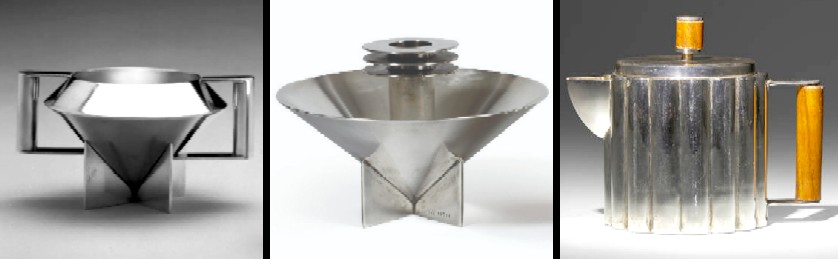 Nickel Silver Kitchen Items by Ilonka Karasz for Paye and Baker (1928 Designs), From Left: Sugar Bowl, Brooklyn Museum; Candlestick Base, The Magazine Antiques; Teapot, Los Angeles Modern
It is still in use today in various products including flatware, musical instruments and doors as one of the entries below attests.
Monel
Monel was found in architecture, furniture and interior design during the late 1920s and early 30s. It is an alloy which is primarily nickel (52-68%), with most of the balance being copper, added to which are small amounts of iron, manganese, carbon, and silicon. It is highly corrosion resistant and stronger than pure nickel. Monel was developed in 1905 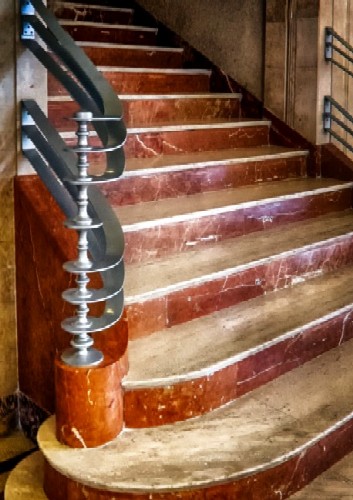
Monel Stair Railing and Newel, Marble Staircase,
Lakefront
Airport, New Orleans, flickr
by three chemists who were trying to find a cost-effective alternative to nickel silver using the nickel and copper ores found in Sudbury, Ontario. The first ingot was refined by Robert C. Stanley using nickel and copper. He named it Monel after International Nickel Corporation (INCO) chairman Ambrose Monell, with the second 'l' removed because trademark law didn't allow the use of people's names in official trademarks. ( Kathleen Murphy Skolnik, "Shimmer and Shine: Cutting-Edge", gathered 10-24-25ArtDeco.org)
Stanley eventually became the First Vice President of INCO, championing the metal after demand fell off upon completion of the first World War. In an advertising brochure from 1919, Monel was proclaimed to be "an alloy which will withstand acids, High temperature and the erosive action of hot gases and superheated steam." (The Bayonne Casting Company, Monel Metal, 1919, p. 5) While the metal was smelted in Ontario, Canada by the INCO, it had to be refined for distribution by companies. INCO engaged three companies to produce Monel is usable forms including the Bayonne Casting Company. They provided it as rods, castings, forgings, tubes, wire, strip stock and sheets among other forms. They explained that it could cast in "very intricate patterns" and could be "worked with equal facility either hot or cold." (Bayonne Casting, p. 7) They show a variety of castings in their brochure, most of which are industrial in nature. However, they also show them being used for golf club heads, promoting the fact that Monel didn't rust as the main selling point. (Bayonne Casting, p. 32)
Beyond the simple advertising of the metal to trade publications, INCO started marketing it to those making home products. The promotional material appears to have worked. "By the 1920s, Monel was used in 23 different industries, with uses ranging from naval battleship parts to specialized ice-cream cabinetry. Advertising touted Monel as a white metal that was corrosion proof, stronger than steel and of silvery appearance, brighter than nickel. This wonder metal alloy saw its decorative use exploded during the heady expansion of the art-deco age, while acid and seawater resistance and low coefficiency of expansion, among other properties, saw utilitarian use for industry methodically rise even through the Great Depression." ("Historic Monel: the alloy that time forgot", Nickel Institute website, gathered 10-28-25) Early uses of Monel were primarily industrial in nature. For example, 264,000 pounds of sheet for the Pennsylvania Railroad Station roof in 1908.
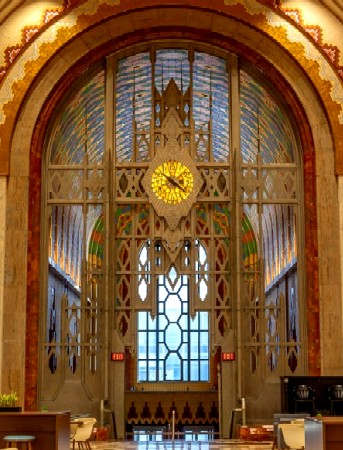
Monel Screen and Clock, Guardian Building, Detroit, MI,
Completed in 1929,
Photo by
Jeff Bondono
One of the more notable examples of the use of Monel in architecture was in the design of the Union Trust Building, renamed the Union Guardian Building in 1929 when Union Trust fell victim to the stock market crash, eventually just being called the Guardian Building. It was a bold Art Deco style skyscraper designed by Wirt C. Rowland of Smith, Hinchman & Gyllis and completed in downtown Detroit, Michigan in 1929. Rowland specified Monel for all the exposed metalwork in the building including a large metal screen with a Tiffany clock inside the lobby. (The clock and part of the screen can be seen at right.) INCO took out a full page ad highlighting Monel's "platinum-like beauty for modern design". (Michigan Manufacturer and Financial Record, volume 43, 1929, p. 69)
Rowland's use of materials provided a departure from the traditional surfaces of office towers. ...Multicolored Rookwood tiles sheathe the lobby ceiling, accompanied by exotic marble accenting the walls and floor with platinum-colored Monel Metal elevator doors, gates, and handrails. Dominating the lobby is the great Monel Metal screen that once guarded the entrance to what was the main banking room of the Union Commerce National Bank. ...Monel required a very low amount of maintenance, though its properties did not allow for casting, and it could only be rolled and cut. The physical limitations of Monel's properties did not limit Rowland's concept for the building's metalwork; surprisingly, they worked to accentuate his angular, machine-inspired motifs. (James W. Tottis, The Guardian Building: Cathedral of Finance, 2008, p. 2-3)
By 1931, trains, autos and radios were making use of the metal. "Even mundane household items such as the kitchen sink had fresh life breathed into them through fabrication in Monel." (James E. Churchill, "Decorative Monel: Historical Intent, Weathering and Analysis", Columbia University Thesis, 2020, p. 19)
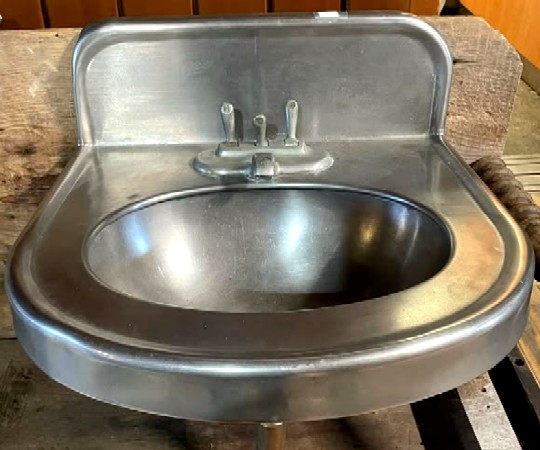
Monel, Bathroom Sink and Water Levers, Portland Architectural Salvage, Instagram
Monel's extensive use in the domestic market was rather short-lived, however. As with the output of the designers themselves, the stock market crash of 1929 saw a dramatic reduction in the use of Monel in consumer items. Chromed steel Stainless steel began to gain popularity and by the 1930s being used for a variety of industrial purposes. By 1935, stainless steel sinks had became popular while sales of Monel sinks began to decline. (See Churchill, p. 26)
Unfortunately, unlike stainless steel, Monel didn't retain its silver appearance when exposed to the elements. Stainless was also cheaper and proved to be better for outdoor use. "Monel can in fact turn black, gray, brown, yellow and green, and is subsequently painted, waxed and lacquered." (Nickel Institute) In fact, Monel is often misidentified as bronze or brass because it turns green when corroding. Even when kept indoors and kept clean so that it maintains its silvery appearance, it is often misidentified as stainless, nickel silver or aluminum.
(Note: This section adapted from the Monel also found on this website.)
Original Monel Facebook Group Posting
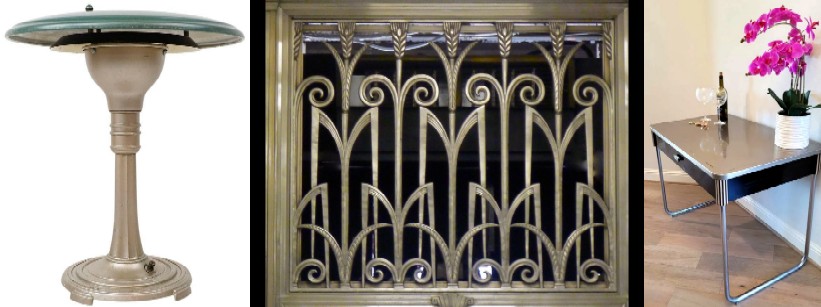 Monel Pieces, from left - Monel Saucer Lamp, Sight Light Corporation, c. 1940, 1st Dibs; Monel Metal, Transom Window - Above Door, The Chicago Board of Trade Building, flickr; Monel Top Smartline Table, Black Enamel Sheetmetal Body with Chromed Legs, International Nickel Company, Raymond Patten, 1930s, Etsy
Conclusion
While nickel was not a truly new product during the unterwar era, its recognized use in decorative home items was relatively new compared to some other metals. With the advent of nickel electroplating, its use became much easier and more affordable on decorative items. While found in some of the Art Nouveau products, it really came into its own during the Art Deco era with the rise of machine age focus of Modernism and the Art Moderne (Deco) emphasis on glamorous, shiny metals.Original Nickel Facebook Group Posting
Sources Not Referenced Above:
"Nickel Silver", Boker Bolingen website, gathered 4-7-24
"Nickel Silver", Wikipedia, gathered 4-7-24
"History of Nickel", Nickel Institute website, gathered 9-25-25
Kathleen Murphy Skolnik, "Shimmer and Shine: Cutting-Edge", New York Art Deco website, gathered 10-24-25
"Monel", Wikipedia, gathered 10-27-25
"Nickel Electroplating", Wikipedia, gathered 8-26-25
"Art Deco Silver and Metal - Pleasures to Treasure", Primavera Gallery, gathered 10-28-25 -
"Nickel Silver: Characteristics, Uses and Problems", U.S. General Services Administration website, gathered 10-29-25
"John Wright (inventor)", Wikipedia, gathered 10-29-25
"George Richards Elkington", Wikipedia, gathered 10-29-25
"The leafy modernism of Ilonka Karasz", The Magazine Antiques, gathered 10-30-25 -
Maribel Vega, "The Art of Metal Finishes: Exploring Art Deco Style and Outdoor Lighting", Coohom website, gathered 11-4-25