Material - Masonite
Masonite is a type of hardboard made from compressed wood
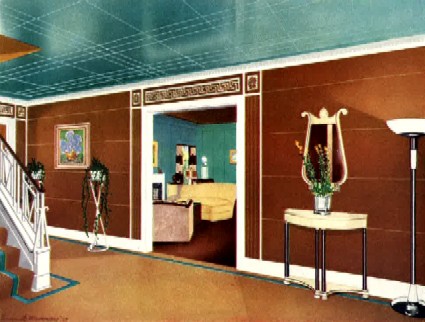
Masonite, Entrance Hall, Tempered Presdwood Walls with Beveling, Grooved
Tempered Presdwood Ceiling, 1933, Masonite Company, Masonite in Home
Design, Construction, Decoration, p. 2
fibers which was one of the many innovative building materials to emerge in the early 20th century. Its development coincided with a period of rapid industrial growth, urban expansion, and evolving architectural practices in the United States. During the 1920s and 1930s, Masonite was widely adopted in building due to its affordability, versatility, and suitability for mass production.
History of Development
Masonite was invented by William H. Mason in 1924. While visiting one of Wausau-Southern Lumber Company’s sawmills in Laurel, Mississippi, he was amazed by the amount of waste produced, including sawdust, wood chips and resin. He moved to Laurel in 1920 to start a plant to extract turpentine and pine oil from the yellow pine being processed there. After the First World War the amount of pine in the area decreased. Combined with decreased demand, his plant became unprofitable.
Mason became interested in finding a way to use the waste products created by wood processing, leading to his experimenting
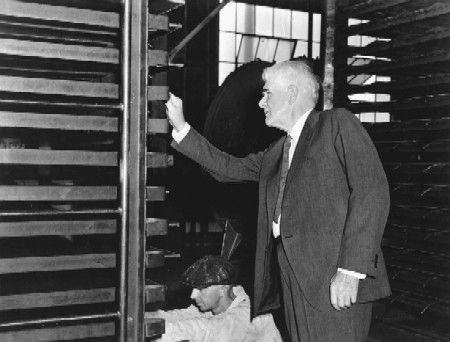
William H. Macy Inspecting Machinery, Pinterest
with methods to explode wood with high pressure steam. He created a large gun, filling the barrel with wood chips and a small amount of water, sealing it with a tapered steel plug. The gun was heated, building the pressure to about 1000 pounds per square inch. The plug was then struck causing an explosion in the chamber ejecting the plug and fibers. (The plug was never found.) The fibers were formed into a board, washed in a wringer and dried. Because the structure of the wood wasn't destroyed in the process, the material was held together by a natural bond.
Believing the fiber could be mass produced to make insulation board, Mason convinced investors to finance a small plant. During continued experimentation, he went to lunch without remembering to release a press, causing the fibers to be exposed to heat and moisture for an extended period. On returning, he found the material had been pressed into a thin, dense sheet.
Mason patented his process in 1924 and formed the Mason Fibre Company the next year. He began producing hardboard for sale in 1926. As sales grew, he changed the company name to the Masonite Corporation in 1929, moving to Chicago with product development in Laural. As demand grew, the company needed more wood waste than the lumber company produced and began to purchase wood specifically cut for them.
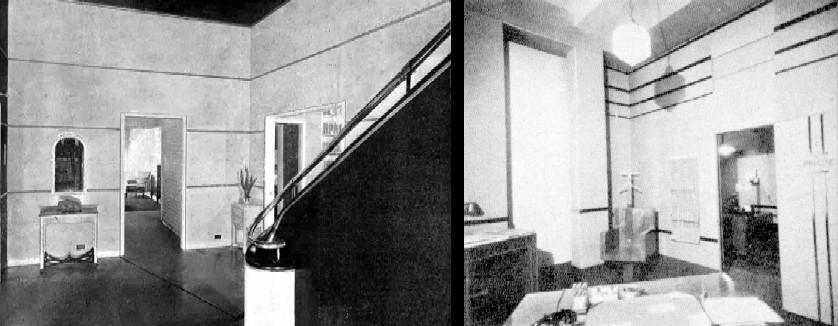 Streamlined Masonite Rooms: Entrance Hall, Masonite with Metal Strips, 1933, Masonite Company, Masonite in Home Design, Construction, Decoration, p. 12-3; Office Walls with Streamline Details, Masonite Corporation, 1936, Home Owner's Catalogs - Masonite, p. 19
Masonite Commercial Use in the Interwar Era
In the 1920s, Masonite thrived as a symbol of industrial progress and modern living. In the 1930s, it proved its resilience by meeting the demands of a struggling economy. These decades established Masonite not just as a product, but as a contributor to the evolution of twentieth-century construction and design.
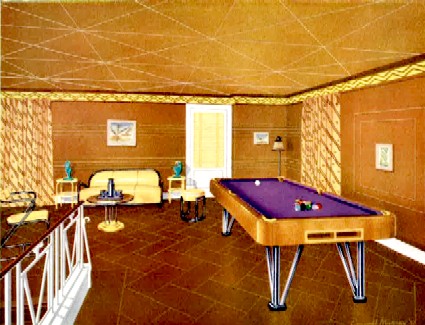
Masonite Recreation Room, QuartRboard Walls, Insulation Ceiling and Century
of Progress Flooring, 1933, Masonite Company, Masonite in Home Design,
Construction, Decoration, p. 8
Architects and designers discovered that Masonite offered several benefits. These included:
- Consistency: Unlike natural wood, Masonite provided predictable performance.
- Adaptability: It could be cut, drilled, and finished in numerous ways.
- Modern aesthetic: Its smooth, flat surfaces aligned with the clean lines of emerging design trends.
To generate demand, the Masonite Company created a variety of new products. Among them were Roof Insulation, Quartrboard wall boards (see in the first image below), Cushioned Flooring, Presdwood, Tempered Presdwood and Temprtile (seen below in two images below). Tempered Presdwood was treated with oil and baked at high temperatures to increase its strength and ability to resist moisture. Temprtile was created by cutting score lines in Temprd Presdwood to produce a tile-like look.
By lowering material costs and expanding their offerings, Masonite made styles and features more accessible. Middle-class families could now afford elements that had previously been reserved for wealthier households.
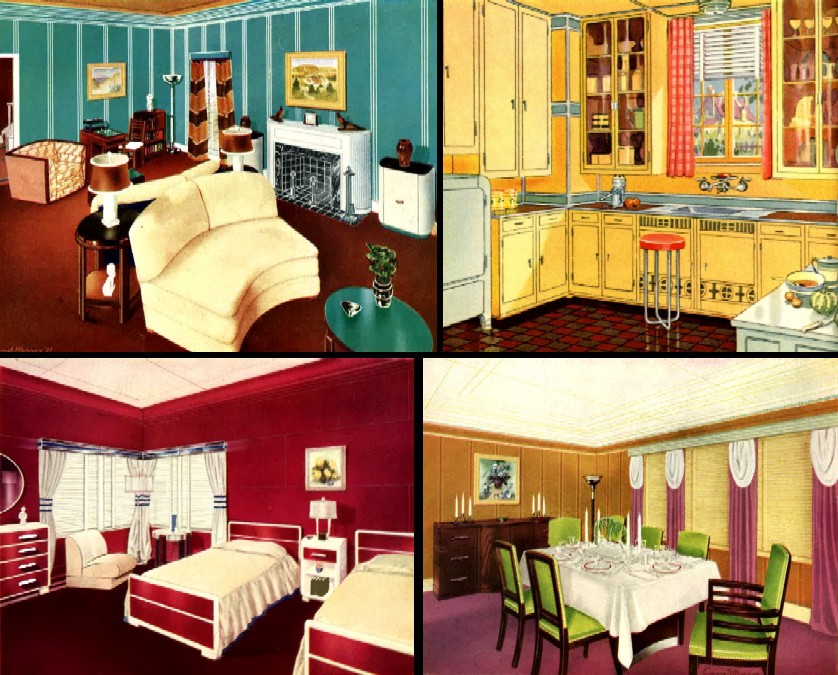 Streamlined Masonite Rooms: <Top> Livingroom, Grooved Presdwood Walls, QaurtRboard Ceiling, 1933, Masonite in Home Design, Construction, Decoration, p. 4; Kitchen, Tempered Presdwood, Cabinets, Ceiling, 1936, Home Owner's Catalogs - Masonite, p. 8
<Bottom> Bedroom, Quartrboad and Insulation Ceiling and Quartrboard Walls, 1933, Masonite in Home Design, Construction, Decoration, p. 6; Dining Room, Quartrboard Ceiling, Deluxe Quartrboard Walls, 1933, Masonite in Home Design, Construction, Decoration, p. 4
Masonite was widely used and highly visible at the Chicago Century of Progress World's Fair of 1933-4. One of the fourteen display houses built specifically for the Fair was the Masonite House. The exterior of the house was quarter inch tempered Presdboard over 7/16 inch Masonite structural insulation. The inside walls and ceilings were either Quartrboard or Presdboard with different finishes - paint or wallpaper. The bathroom was lined with Tempered Presdboard and the floors were Masonite Cushioned Flooring. Masonite was also used for walls and floors of other buildings at the 1933-4 World's Fair as well. These included the Science and Electrical building, the Time and Fortune building, the Schlitz Garden, and the Mueller Pabst restaurants, among others. Two and a half miles of Tempered Presdwood were used to line the Lake Michigan shoreline.
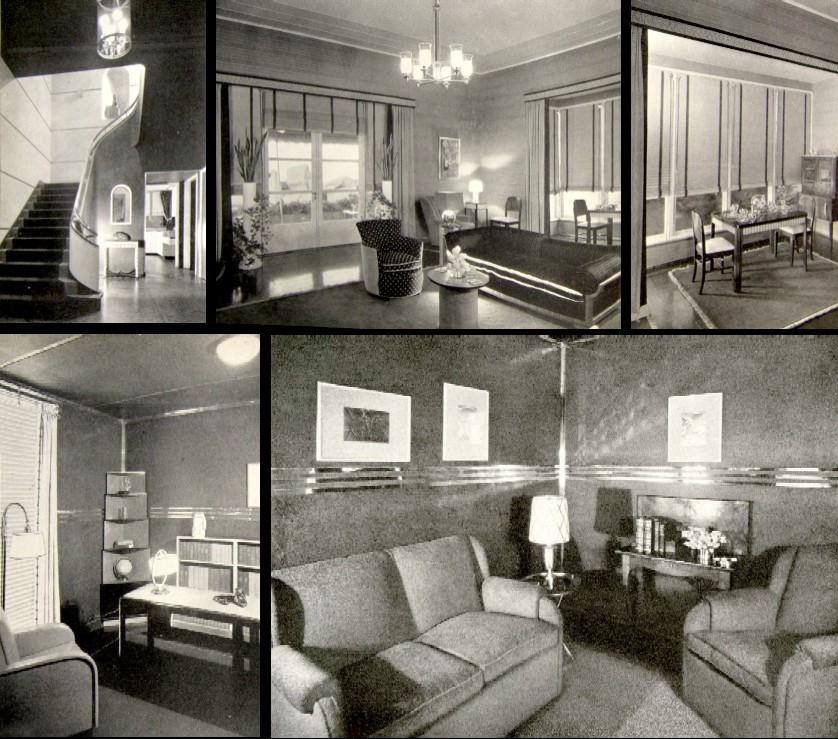 Masonite House Room at the 1933 Century of Progress World's Fair in Chicago: <top> Foyer, Living Room and Dinette <Biottom>
Office
Masonite House Room at the 1933 Century of Progress World's Fair in Chicago: <top> Foyer, Living Room and Dinette <Biottom>
Office
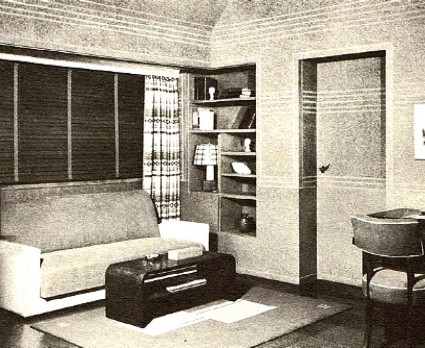
Bevelled and Grooved Structural Masonite, Living Room Ad, 1930s
In 1936, Masonite published a brochure which proclaimed their full embrace of modern streamlining.
What appeared hopelessly ugly is made beautiful simply by removing useless ornamentation... Banished forever are the heavy, oak woodwork and the air of stodgy dullness... Once the woodwork was removed, it was a simple matter to cover the walls with smooth, durable boards of Masonite Structural Insulation and finish them with paint or enamel. The vertical joints are beveled and cleverly made a part of the decorative scheme, while the broken horizontal courses are simply shallow grooves tooled into the surface of the boards. (Masonite Corporation, "Masonite", 1936, pp. 2 & 5)
Masonite boards even found a market among artists even though the company didn't pursue them. Masonite worked as a better rigid support material than wood because it had no grain, didn't warp, crack or split and was not sensitive to changes in temperature. In addition, it was cheaper than many other artist's materials. So it should not be surprising that it was used in painted room screens during the period.
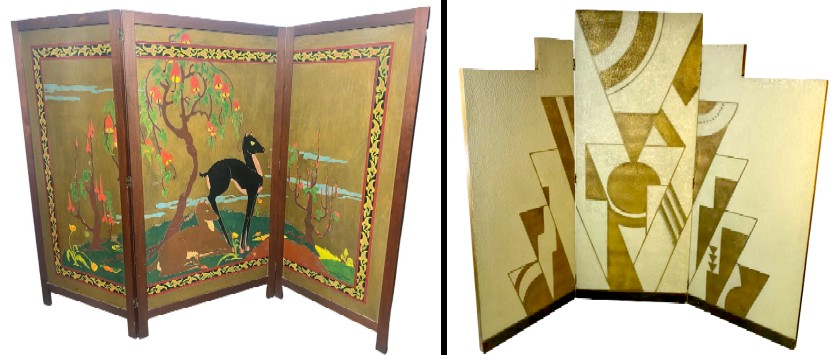 Painted Room Screens Using Masonite: Three Panel Screen with Painted Deer Motif, Masonite and Wood, Marian Jamieson, c. 1928, 1st Dibs; Three Panel Empire Style Screen, Carved Masonite on Wood with Black Bottom Trim, Early 20thc, Chairish
Conclusion
Masonite’s rise demonstrated the growing importance of engineered materials. Rather than relying solely on natural resources in their raw form, manufacturers began to develop products with enhanced properties tailored to specific uses. This shift would lead to the development of other such interwar manufactured materials like plywood and particleboard.
Following the Second World War, Masonite became a ubiquitous, inexpensive building material used heavily for residential siding, interior paneling, furniture, and cabinetry during the 1950s–1980s housing boom. Its smooth, durable, and versatile nature caused it to be adopted by manufacturers for toys and electronics backing as well as by designers like Charles Eames for modern furniture.
Sources Not Mentioned Above:
"The Sawmill", Guild and Gentry website, gathered 7/21/24
"Masonite International", Wikipedia, gathered 7/21/24
"Masonite History", Zippia Website, gathered 7/21/24
Dorothy Raley, ed., A Century of Progress Homes and Furnishings, 1934
Home & Field presents The Masonite House at A Century of Progress, 1933
Original Facebook Group Posting
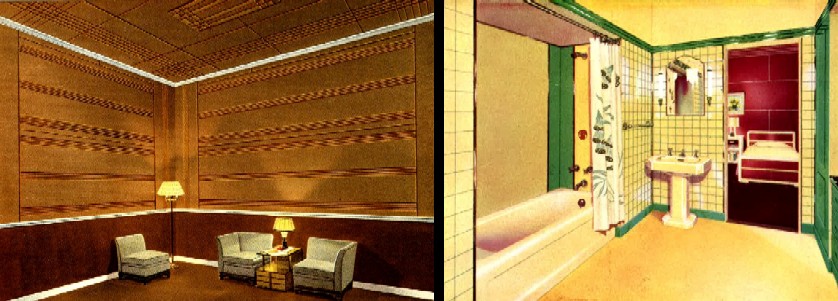 Masonite Color Advertisements, From Left - Grooved and Beveled Masonite Panels, 1936, Home Owner's Catalogs - Masonite, p. 16; Bathroom, Grooved Presdwood Temprtile Wall, 1933, Masonite in Home Design, Construction, Decoration, p. 7