Grecian Influence in Art Deco and Streamline Moderne
Art Deco and Streamline Moderne styles both borrowed motifs from a variety of other cultures including Greece. Just as the interest in Egyptian decor was inspired by Howard Carter's excavation of Pharaoh Tutankhamen's tomb in 1922, so Sir Arthur Evans'
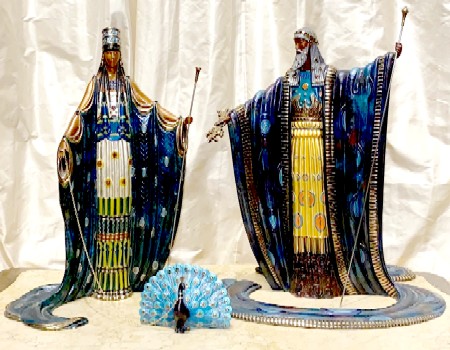
Hera and Zeus with Peacock, Cold Painted Bronze, Erte, 1989, Leviton Fine Art
excavation of the Cretan site at Knossos between 1900 and 1932 kept Greek discoveries in the news. Curiously, in addition to discovering the Minoan buildings and associated culture, Evans was also creating it. He referred to this process as 'reconstituting' the Minoan culture. David Tereshchuk opines that "in 'reconstituted' pieces of the palace itself, we see the inescapable influence of modish aesthetics from Evans' own time." (David Tereschuk, "Discovering a Society. Or rather ... Imagining It?", Huffpost website, gathered 4-9-24)
In the process of his 'reconstitution', Evans hired Swiss father and son decorative artists Émile Gilliéron to create friezes based on fragments of frescoes found during his excavation of Knossos. (See the first image in the series for an example of their work.) "Encouraged by Evans, the father and son formed a thriving business selling original watercolors after the frescoes and other reproductions of three-dimensional artworks, which they made directly from the originals, in many cases reworking the mold to recreate the object in its original, undamaged form." ("Metropolitan Museum of Art Presents Historic Images of the Greek Bronze Age The Reproductions of E. Gillieron & Son", Museum Publicity website, gathered 4-9-24) So while they were likely influenced by the Deco style, their sales of Deco inspired artworks would have reaffirmed and influenced the popular style going forward. "Although much of the re-creation was soundly based on the ancient evidence, elements of it were fanciful, leading some to consider the palace at Knossos the best-preserved Art Deco structure in Greece." (Tereshchuk, huffpost)
The restoration of the “Ladies in Blue”
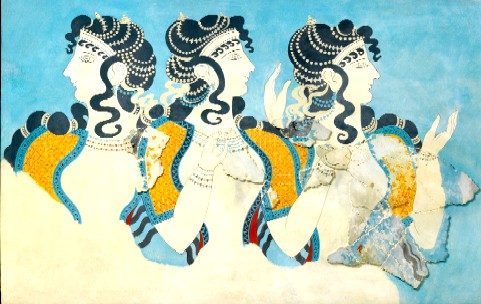
Reproduction of the Ladies in Blue Fresco, Painted Plaster, Emile Gilliéron - son,
MET Art Museum, 1927, Wikimedia
by Gilliéron is often cited as an example of how their work was inspired by the Art Deco movement. Emily Sorgini explains,
Silvia Loreti [“The Gilliérons and the Greek Bronze Age: New York.” The Burlington Magazine, vol. 153, no. 1304, 2011, pp. 764–765] states that the restored fresco bears more of a resemblance to Art Deco than it does to ancient art because 'the painting’s bright colours and well-defined lines are in dazzling contrast to the muted designs of the vases in the adjacent Greek and Roman room.' Regarding the restored “Ladies in Blue” fresco, Loreti states that writer Evelyn Waugh “remarked that the fresco was more a product of the influence of Vogue covers than of any zeal for accurate reconstruction.”(Sorgini, "Minoan Art or Art Deco?", Elisa's Trip to Greece Wordpress, gathered 4-9-24).
While Evans' work in Crete may have helped keep Greece in the minds of artists and designers during 20s and early 30s, it is actually not the style most usually found in Deco pieces. Sorginin points out, "There is a conspicuous connection between Art Deco and Greek art, but the Greek influence is from Archaic Greece (610 B.C.-480 B.C.), not from Bronze Age Crete". (Sorgini, "Minoan Art or Art Deco?) Indeed, such ancient Grecian influences can be found in a variety of of period Art Deco designs as seen below.
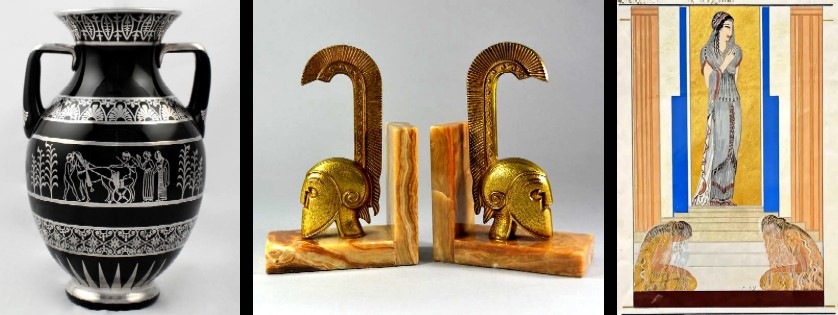
Grecian Inspired Decorative Art Deco Period Items, from left - Greek Revival Black Glass Vase with Silver Overlay, Rockwell Silver Company, Early 20th C, 1st Dibs; Bronze Greek Warrior Bookends on Onyx Base, c1930, Probably French, 1930.fr; Greek Goddess, Painting for L'Odyssee, François-Louis Schmied, 1928, 1st Dibs
A simple element which is found in a variety of Art Deco designs from the 1920s and 30s is the Greek key, appearing as a border,

Two Types of Greek Key Patterns
in furniture designs, in tile and as decoration. Greek key is just one of the names by which the design is called, likely because it appears in many ancient Greek objects with the design looking something like a simple, ancient key. (You can see a visual example of the key imposed on the design here.) Before the term 'Greek key' was applied to it, it was called the Meander, likely in reference to the winding path of the Maeander River in Asia Minor (now Turkey).
The history of the Greek key is fascinating, appearing in disconnected places and cultures. deserving a brief digression to examine its journey through cultural history.
An early example found in Mezine [modern Ukraine] on a decorative object dating to around 10,000 BCE. (You can see a sketch of that here.) Other, less definitive examples date even further back in the Paleolithic era. It found its way into in a variety of other disparate civilizations throughout history including the ancient Roman, Etruscan, Byzantine, Mayan, Chinese and Egyptian empires. It appears in Egypt around 2600-2500 BCE, carved into Egyptian stonework. Around 2000 BCE, it and similar designs are found in bronze vessels carved by Chinese artisans who referred to it as 'rolling thunder'. The Zapotec Mitla ruins in Mexico contain the pattern, being carved around 900 BCE.
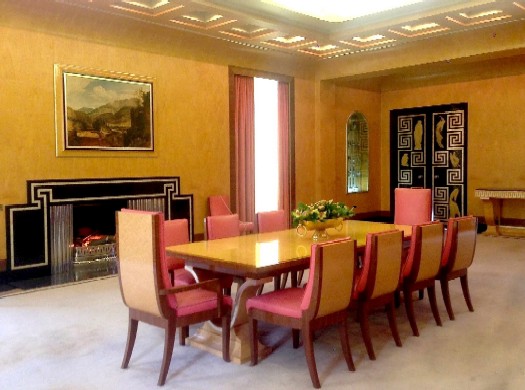
Dining Room at Eltham Palace, Ebonized Door and Fireplace Borders with Mica Greek Keys, 1933,
So Much More to See
[T]the Greeks go crazy with their prolific use of the Meander pattern, they insert it into everything: mosaic floors, plaster murals, art, architecture, ceramics, jewelry. As relics from this time have been documented, we can finally see the motif begin to travel intentionally. In the 1500s, it moves from artists in Greece to nearby artists in Rome. Romans incorporate the pattern in marble altars, frescoes, paintings, temples (including a Raphael painting in the Vatican). It grows in popularity via Roman architecture, all the way through the 1700s. Carved stones hold the pattern, as do wooden church doors, metal shields, jeweled tiaras, robe edges, upholstery, even dinner plates." (Kiera Coffee, "The Meaning and History of the Ancient Greek Key Pattern", Shutterstock website, gathered 3-4-25)
The simple, flowing yet rigid geometric shape of the Greek key is a natural fit with the Art Deco period when decoration was simplified while still favoring geometric shapes. While some of the decorators of the period used the infinite pattern of the Greek key, others stripped it down to a single instance of the shape, even incorporating it into the structure of certain furniture pieces.
Grecian style was influential in still another area of late Art Deco design, although it is primarily seen in public and government building exteriors. Smithsonian historian James Goode coined the term 'Greco Deco' to describe building exteriors featuring Grecian and Roman elements which had been modified to fit the Art Deco style. Such buildings were designed in this style as part of Roosevelt's New Deal in America as part of the Public Works Administration (PWA). In the strictest meaning, Greco-Roman buildings should fall under the umbrella of the 'PWA Moderne' style. PWA Moderne was designed to project progress, permanence, stability and authority, things sought during the despair created by the Great Depression. However, not all PWA Moderne buildings have Greco-Roman elements.
Other Sources Not Cited Above:
"Art Deco Origins & Influences", Art Deco Society of New York website, gathered 4-9-24
"Art Deco", The Art Story website, gathered 4-9-24
Dan Klein, "What is Art Deco?", Art Deco Society of New York website, gathered 4-9-24
"Symbolism, The Greek Keys", Art of Mourning website, gathered 4-9-25
"Mezine", Wikipedia, gathered 3-4-25
"Meander (art)", Wikipedia, gathered 3-3-25
Calder Loth, "The Complex Greek Meander", Institute of Classical Architecture & Art website, gathered 3-4-25
"The History and meaning Behind the Greek Key Pattern", In Good Taste, Invaluable website, gathered 3-4-25
"Minoan civilization", Wikipedia, gathered 4-9-24
"History", The Noble website, gathered 3-3-25
"PWA Moderne", Wikipedia, gathered 3-3-25
"PWA Moderne", Designing Buildings website, gathered 3-3-25
Neely Tucker, "The Adams Building Turns 85!", Library of Congress Blogs, gathered 3-3-25
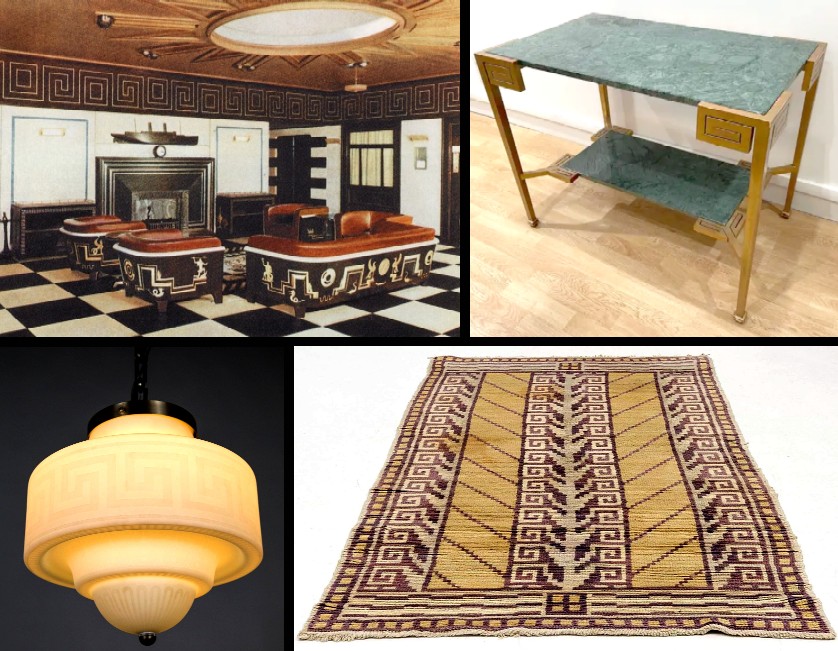
MS Kungshome Ocean Liner First Class Fireplace, 1928; Console Table, Gilt Iron with Greek Keys and Marble, Marcel Coard, French, 1930s, 1st Dibs; Stepped Pendant Light with Etched Greek Key, Glass and Brass, 1920s, 1st Dibs; Rug with Greek Key Pattern, Swedish, 1930s, Antiques Boutique