Material - Gold Leaf
On any given website
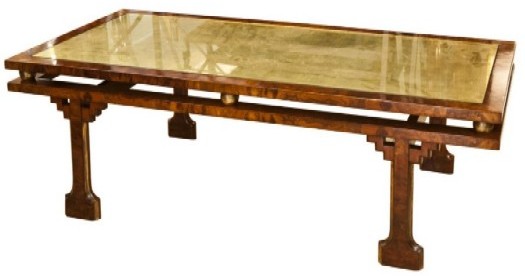
Coffee Table, Wood, Glass and Gold Leaf, 1920, Salvo
which discusses the colors of Art Deco you will find mention of the use of precious metals, particularly gold. Interior design objects may not seem the most likely place to find gold used but it was... in a way. Some Art Deco era furniture designers used gold leaf on their furniture. The process of applying gold leaf involves beating the gold to a very thin layer and carefully adhering it to another, non-gold surface. Such surfaces typically include metal, wood, glass, porcelain and stone. It can be attached to any surface which is smooth enough. Gold leaf is so thin that it cannot support its own weight so it must be attached to the non-gold surface with an adhesive, so the surface must also be able to bond with such.
To adhere gold leaf to a surface, it must be clean and smooth. It is then primed in a color which will best enhance the gold leaf once it is applied. Warm reds or yellows have traditionally been used to give the leaf a rich, luminous appearance. The surface is then 'sized' with the application of adhesive - either water- or oil-based, depending on the application. A water-based adhesive create the best overall appearance, but it involves several extra steps and can be damaged when exposed to moisture. The thin gold leaf is then applied to the adhesive when it is tacky.

'Duchesse Brisee' Reupholstered and Refinished, Paul Follot, 1920s - 30s, 1st Dibs.
This must be done carefully because the leaf is very fragile. Once applied, any excess or overlapping leaves are removed using a soft brush.
Gold varies in gold content and weight. The lower content golds are mixed with either silver or bronze with silver resulting in a 'cooler' tone and bronze a 'warmer' one. Gold leaf content varies between 6 karats (25% gold content) and 24 karats (100% gold content). Gold leaf with less than 96% (23 karat) gold content is not as durable as 23-24 karat and, as a result, is less likely to last than 23 or 24 karat gold leaf. The weight of gold leaf refers to the number of grams per 1000 sheets of leaf. You would think this would be directly related to thickness but it is not always so. Curiously, the industry standard for 'double' gold weight is only about 20% thicker than single gold weight. Of course, the heavier the gold leaf is, the better quality it is and more corrosion resistance it has.
In addition to genuine gold leaf there are other,
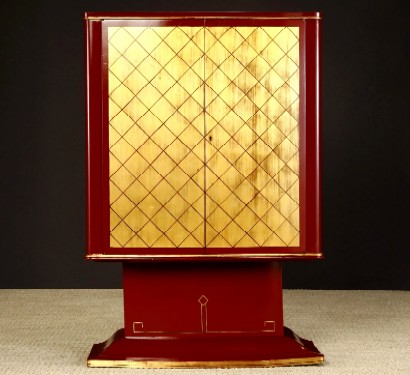
Dry Bar Cabinet, Red Lacquered Wood and Gold Leaf, c. 1930s, 1st Dibs
less expensive ways to create what appears to be gold leaf. The first is called Dutch leaf or composition leaf which is a form of brass, being composed of copper and either zinc or tin. It is applied in the same way as genuine gold leaf, but, unlike gold leaf, it is usually sealed with a varnish or sealer. The other, less expensive method to create a gold leaf effect uses gold paint which is made with bronze and mica. Neither of these alternative methods result in the same sort of bright finish as genuine gold leaf and they can even tarnish over time.
Gold leaf gilding is ancient, with the true gold leaf gilding (as opposed to just wrapping an object in thin gold) dating to about 2300 BC when the Egyptians used it on wood and metal, particularly coffins and other objects found in the Egyptian tombs. The process of thinning gold is still largely done by hand in the same way that Egyptian paintings show it, although it can be made much thinner today than it was then. Gold leaf was likewise used by the ancient Greeks about a century and a half later to represent clothes, crowns, hair and similar elements. The Romans gilded their palace and temple ceilings as did the church in the middle ages. The Renaissance saw extensive use of gilding in art, sculptures, furniture and architecture. Works of art and some of the extravagant architecture from the Baroque period were gilt. During Louis the XIV reign as well as the 'Gilded age' of the 19th century, the decorative arts - furniture, pottery and other interior design objects - were sometimes gilt.
Gilt gold furniture certainly had a place during the Art Deco period, particularly among certain designers. Perhaps foremost among them was Paul Follot, who designed a few offices with a gold theme. A number of pieces of his furniture designs feature gilded wood, as seen below.
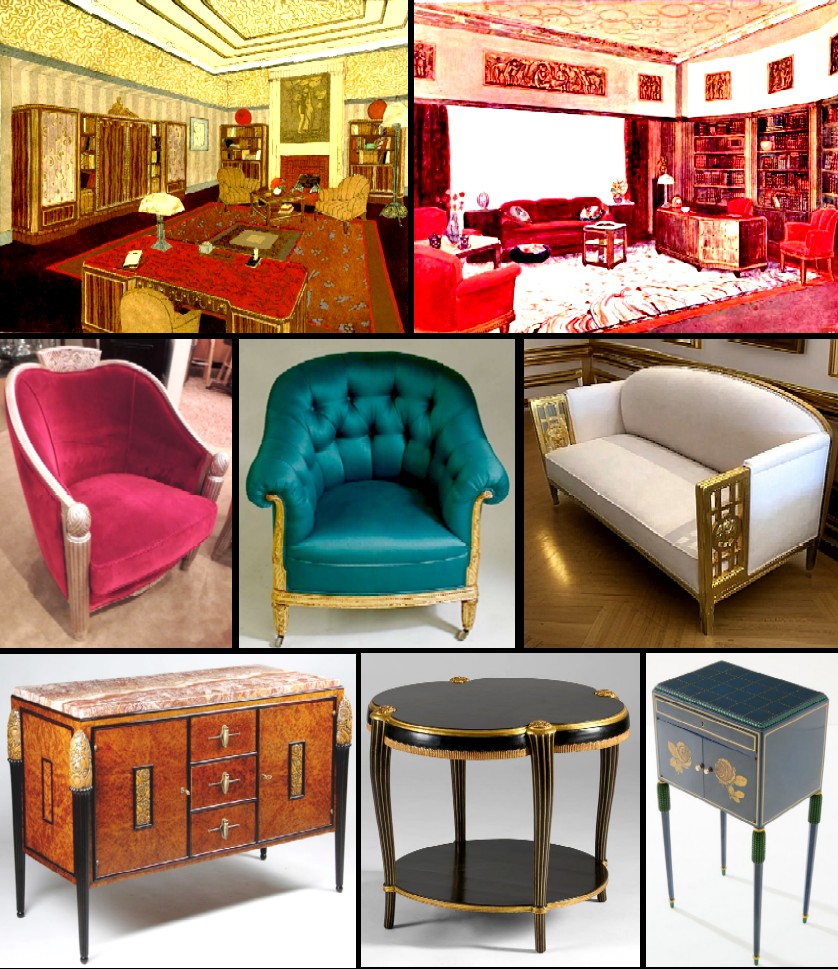 Use of Gold Leaf by Paul Follot. [Top Row] Office, Paul Follot for Bon Marche, 1924, Leon Moussinac, Interieurs IV, 1924, Plate 7; Office, From Albert Levy, Interieurs and Colours, 1926, Plate 19;
 [Center Row] Armchair, Carved, Gold Leaf Wood, Reupholstered in Red, Art Deco Collection; Armchair, Sculpted Wood and Green Upholstery, 1920, 1st Dibs; Sofa with Carved Gilded Wood and White Upholstery,1922, Martell Gallery
[Bottom Row] Commode with Palissander Legs, White Cedar Burl Wood with Onyx Marble Top, Carved and Guilded Fruitwood, Second Half of 1920s, Iliad Design; Table, Ebonized with Gilt Details, Follot for Bon Marche, 1920s, Maison Gerard; Cabinet, Blue and Green Lacquered Beechwood, Gilded Gold Accents, Early 1920s, Pamono
Designer Jean Dunand sometimes combined gold leaf with black lacquer to create striking designs. Dunand used gold leaf frequently on his screens and wall art during his career. His various wall panels for the opulent French ship Normandie all featured gold leaf.
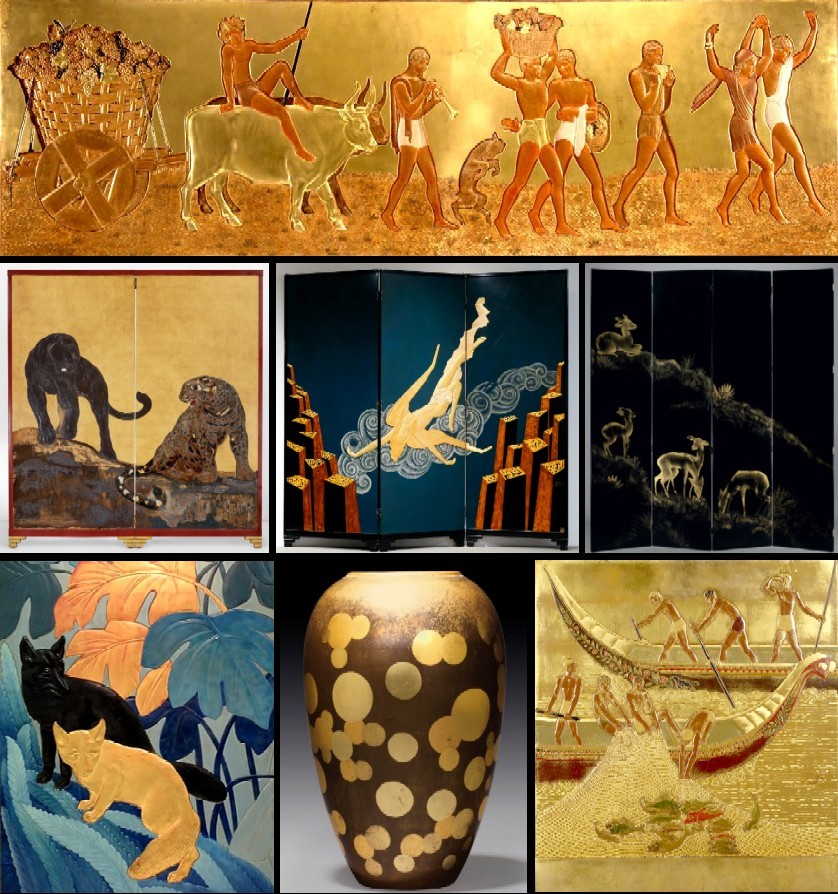 Use of Gold Leaf by Jean Dunand. [Top Row] The Grape Harvest, Smoking Room of the Normandie, Jean Dupas Designer, Jean Dunand Lacquerer, Plaster with Gold Leaf and Pigment, 1934
[Center Row - Screens] Blsck Panther and Jaguar, Lacquered and Gilt Wood, Eggshell and Ivorine, c. 1921, Sothebys; Pianissimo, Music Room, Lacquered Wood, Eggshell, Mother-of-Pearl, Gold, Séraphin Soudbinine,Sculptor, Jean Dunand, Lacquerer, 1925-6, The MET; The Does, Gold Leaf and Black Lacquer, 1930s, Christies
[Bottom Row] The Hunt Wall Panel, From the Smoking Room, Normandie, Jean Dupas Designer, Dunand Lacquerer, Plaster with Gold Leaf and Pigment, Reproduced in 1935, Wikimedia; Vase, Lacquered Metal and Gold Leaf, c. 1925, Christie's; Fishing, Reproduced Scaled Panel of Normandie, Stucco, Gold Leaf and Lacquer on Wood, c. 1935, Rago Arts
While gold leaf was certainly used during the Art Deco
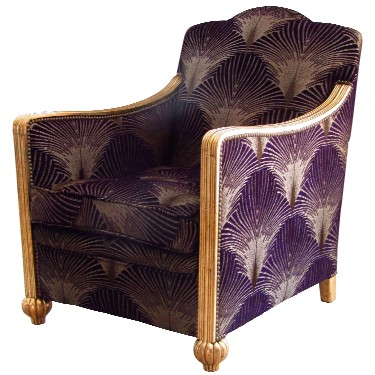
Armchair, Reupholstered, French, 1935, 1st Dibs
era it was probably not quite as prevalent as one might think given the era's reputation for employing precious metals. This may have been due to the expense, although it seems more likely that it would have been due to how difficult it was to work with. Gold itself may also have been used in some decorative objects. Small items such as drawer pulls, cabinet handles, desk sets, clocks, lighters, statues and similar pieces seem may have been gold. However, many of these items that appear to be gold coloring are actually bronze, a metal that was widely used during this time.
Sources Not Mentioned Above:
Bernecki and Associates, "The Art of Gilding", Conservation & Design website, gathered 8-11-25
"Dutch metal", Wikipedia, gathered 8-10-25
"Gilding", Wikipedia, gathered 8-10-25
"Gold Leaf Gilding in Architecture: When, Where, & Why It Was Used", John Canning Company website, gathered 8-11-25
"The Art and Process of Gilding", John Canning Company website, gathered 8-11-25
Andrew Oddy, "A history of gilding with particular reference to statuary", American Institute for Conservation of Historic and Artistic Works, gathered 8-11-25
"Gilding History", Watergild website, gathered 8-11-25