KEM Weber (1889-1963)
Karl Emanuel Martin (KEM) Weber was born into a family with ambitious expectations for their children. Weber’s parents enrolled him in an elite gymnasium [school], hoping he would excel academically. Despite efforts to improve his performance, Weber chafed against the strict discipline and rote learning of the Prussian educational system. By the end of 1904, the school’s administrators insisted that his parents remove him. He was ill-suited for such teaching. From a young age, Weber enjoyed working with his hands, spending hours hammering, sawing, and assembling toys, boats, wagons and such. His parents decided that apprenticeship might be a better fit for him, so they placed him in a cabinetmaker’s shop in Potsdam under Eduard Schulz.
Weber thrived in the cabinet shop, finding satisfaction and pride in craftsmanship. The work offered the sort of hands-on work missing in the classroom. Surrounded by tools and machines, Weber spent three years working diligently and learning the trade, receiving his journeyman’s diploma from the Cabinetmakers’
 Weber, c. 1917, The Magaziune Antiques.jpg)
Karl Emanuel Martin (KEM) Weber, c. 1915
Standing in Front of the Planned German
Exhibits for the Panama-Pacific International
Exposition in San Francisco
Guild of Potsdam in April 1907. Being interested in design, he decided not to pursue cabinetmaking as a career, instead enrolling in the Unterrichts-Anstalt des königlichen Kunstgewerbemuseums (Teaching institution of the Museum of Decorative Arts) to study design in the fall of 1907.
Fortunately for Weber, recently installed Unterrichts-Anstalt school director Bruno Paul began shifting the school away from classroom-based toward workshop‑centered instruction that year. Under Paul’s guidance, he received training in interior architecture, a discipline combining interior design and architecture. During the next six years, he absorbed Paul’s stripped‑down classicism which focused on order, practicality, and restraint. Paul also provided Weber with exposure to professional practice in his atelier, gradually entrusting him with increasing responsibility for design of furniture and interior spaces.
By 1913, Weber was a capable designer. That year, he opened his own small studio in Charlottenburg while he was completing his studies. He traveled throughout Europe, studying architecture, design, and theatrical production. Involvement in stage design with theater director Max Reinhardt broadened his understanding of space, lighting, and atmosphere. Upon graduating, Paul invited Weber to remain as an assistant instructor, a testament to his mastery of both design principles and professional discipline.
In 1914, Paul recommended Weber to supervise the installation of the German exhibits at the Panama-Pacific International Exposition in San Francisco. However, shortly after arriving, the outbreak of World War I made it impossible for Weber to return to Germany. Stranded but resourceful, he started redesigning exhibits before the Germans cancelled their participation. In early 1915, Weber began looking for commercial opportunities, establishing a small studio with Otto Schufftan to make Modernist flowerpots, baskets, screens, and similar items. Finding success, he expanded into furniture, lighting, toys, and decorative objects. When the US declared war on Germany in 1917, his business declined, eventually failing as German immigrants faced inevitable American prejudice. To make ends meet, he painted billboards, designing sets for a small movie studio and managing a farm while looking for design work.
After the end of the war,
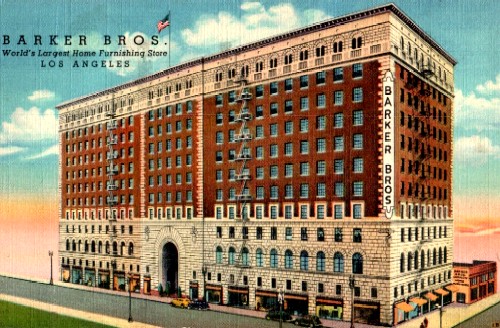
The New Barker Brothers Store In Los Angeles, 1942 Postcard, Ebay
Weber formed a partnership with interior decorator Donna Youmans in Santa Barbara. Together, they produced revivalist furniture and interiors for affluent clients. Although viable, Weber still wanted to bring modernist style to America. Large furniture vendor Barker Brothers offered him a designer position in 1921 giving him hope that he would be able to design Modernist furniture for them. Within months of hiring, Barker promoted him. He now ran the design studio, overseeing furniture design, custom interiors, and store displays. Modernism did not interest the Barker management during the early 1920s, preferring the popular Spanish revivalist interiors and furniture.
As Barker Brothers outgrew their locations in 1924, they leased a city block where they built a twelve-story store. Weber oversaw the new store’s interior design which he completed by the fall of that year. He asked Barker management to send him on a buying trip to Europe, which he was granted. During the trip, he witnessed European modernism, particularly in Paris, which rekindled his desire to develop a Modernist line for Barker. Upon return to California, he proposed the creation of a dedicated space within their new store focused on modern design. Unlike previous proposals for Modernist furniture and designs, Barker management agreed in light of the success of the 1925 Paris Exposition.
Weber named his Modernist store-within-a-store Modes and Manners.
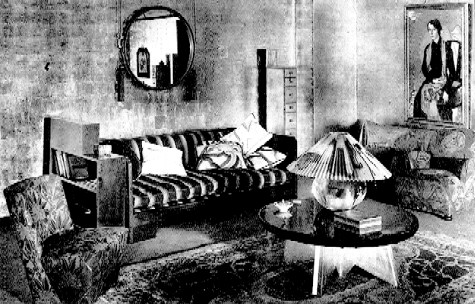
A Display in Modes and Manners at Barker Brothers, 1926, The Magazine Antiques
The name indicated that the shop included objects as well as overall style. Weber had intended to include pieces by several American modernist designers. Unfortunately, the few that existed were mostly on the other side of the country and those were overwhelmed by demand following interest in the Paris Exposition. Being mostly handcrafted pieces, their production was also slow and unreliable. Because of this, the August 1926 store opening was furnished primarily with Weber’s own designs.
Modes and Manners quickly generated strong sales and a lot of publicity. In addition to sales in the store, Barker Brothers were commissioned to design rooms and interiors. To add to the success of the store, Weber received critical praise for a design for the Mayfair Hotel in Los Angeles and a top prize for modern American furniture by the Art Alliance of America. Barker Brothers capitalized on this momentum, opening a new Art Moderne Room. He was becoming a leading modern designer on the West Coast. Barker announced plans for a new Hollywood branch which Weber designed in the summer and fall of 1927 which opened in October.
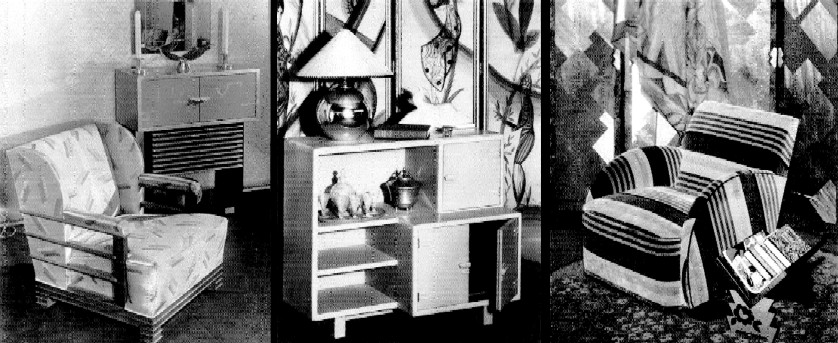 Three Modes and Nanners Displays at Barker Brothers, 1926, The Magazine Antiques
With his new-found popularity, Weber looked at opening his own studio, leading him to resign from Barker in November of 1927. He kept his ties with Barker by contracting to consult with them. His first big project as an independent designer was the Macy’s 1928 exhibition, An International Exposition of Art in Industry. He had the largest and most prominent space in the exhibition. creating a furnished, compact three‑room apartment. Critics praised the project for its efficiency and elegance. Everything could be mass-produced making the design affordable for small apartment dwellers. This national attention brought him a flood of commissions for furniture, lighting, interiors and retail displays. He began embracing streamlining, a style symbolizing speed and efficiency which was inspired by the airplane. During this creative period, he produced interiors for several private homes, high-profile retail spaces, and even designed some aircraft seating.
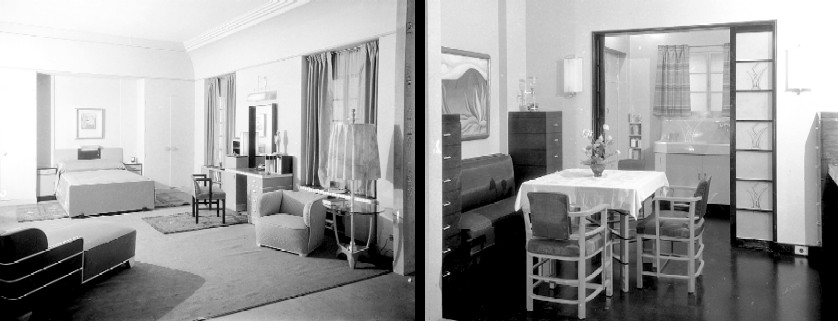 Apartment Display for Macy’s 1928 exhibition, An International Exposition of Art in Industry, Images from loc.gov
The onset of the Great Depression completely derailed Weber’s success.
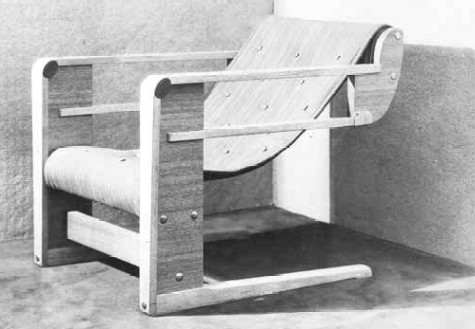
Air Line Chair Prototype, Bentlock Line, 1931, Furniture History Newsletter, Nov. 21, p. 5
Freelance commissions disappeared, and financial pressures loomed. His freelance practice proved to be a double-edged sword as the economy slowed and eventually stopped his commissions. By 1930, he was forced to dismiss his staff, move his family into a smaller home, confronting financial hardship.
Weber adapted, spending the early 1930s engaged in teaching, consulting, and experimenting with new designs. Among his experimental designs were a line of affordable, practical furnishings created for middle-class Americans culminating in the Bentlock furniture line which was unveiled at the AUDAC (American Union od Decorative Artists and Craftsmen) exhibition in the Brooklyn Museum in 1931. The simple, streamlined wooden pieces were designed to ship flat and assembled by the end consumer. Though widely praised by critics, the line failed commercially — a problem he would face repeatedly when his designs were so far ahead of their time. One bright spot in the line was a cantilevered frame chair. The uniquely dynamic lines of the chair echoed rounded aircraft surfaces, so Weber called the design an ‘Air Line chair’. He would revisit this chair and the cantilever design several times.
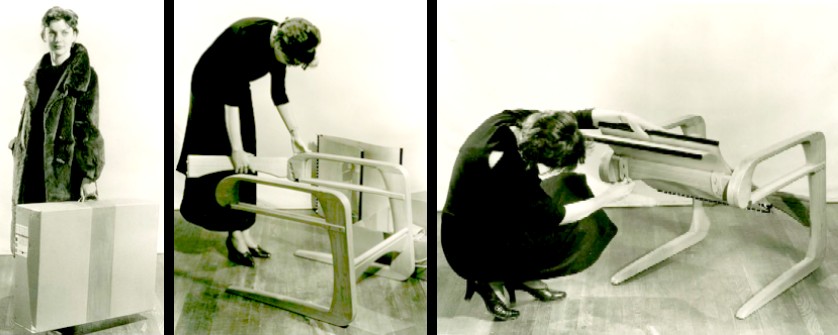 Promotional Photos of Bentlock Airline Chair Assembly...in Heels!, Photos by Will Connell, 1935, Collections Weekly & Dezeen
By
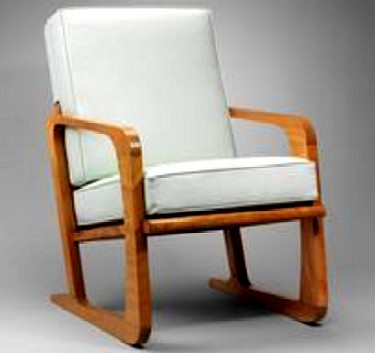
Fleetwood Armchair, Maple and Upholstery,
Mueller Company,
1936, MFA Boston
the mid-1930s, Weber’s fortunes improved. He secured new contracts, expanded his studio, and took on ambitious projects, including interiors for private residences and commercial spaces. He began making trips to Grand Rapids, Michigan, the furniture industry center during the late 19th and early 20th century. In addition to supplying furniture to Barkley, he began to design pieces for several midwestern furniture manufacturers including Chicago-based Karpen Furniture, and Michigan manufacturers like Baker Furniture, Berkley and Gay, and Haskelite Manufacturing. He designed a streamlined Fleetwood line with for Mueller furniture. Yet his best-known mass produced furniture is probably the chromed tube designs created for Lloyd Furniture. As Christopher Long explains, Weber's
most arresting pieces from this period [mid 1930s] were ...those for Lloyd. Almost all of them relied on continuous, sinuous lines, in some instances doubled or even tripled. The notion of using "stacked" legs and arms probably came from his friend [Paul] Frankl.... Weber's designs, however, showed an individual interpretation of the idea, in large measure because he insisted on using simpler, more regular geometries." (Long, Kem Weber: Designer and Architect, 2014, p. 162)
Weber's relationship with Lloyd not produced interesting designs which continue to appeal to collectors, it was a profitable one allowing him to work with them working with the company to create furniture designs for them. for several years.
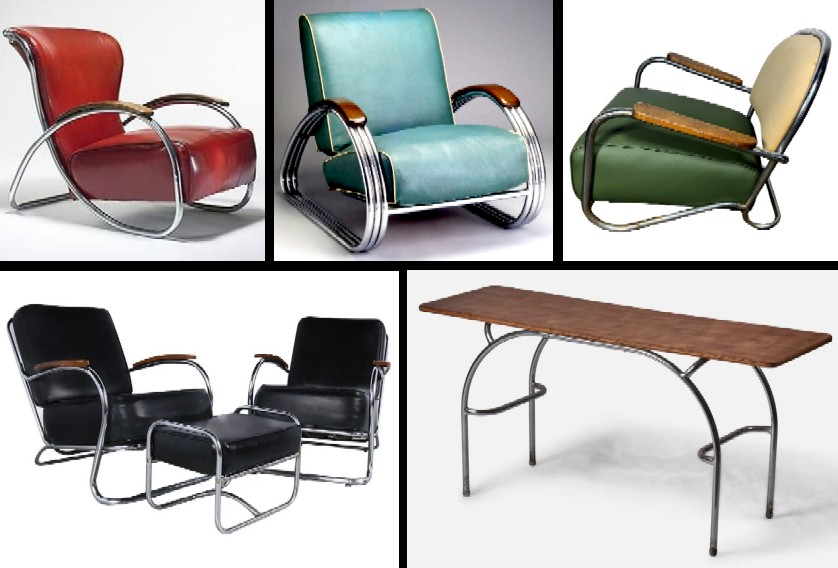 Chrome Tube Furniture by Weber for Lloyd Manufacturing: <Top> Lounge Chair LC-52, Chromed Steel and Naugahyde, c. 1934, Sotheby's; Lounge Chair C-19-C, Chromed Steel and Naugahyde, c. 1936-7, High Museum of Art; Lounge Chair C-19-C, Chromed Steel and Fabri, c. 1934, 1st Dibs
<Bottom>
Lounge Chairs and Ottoman, Chromed Steel and Naugahyde, 1940s, Mary Kay's Furniture; Table, Wood and Chromed Tubing, 1930s, PRB Collection
A Display in Modes and Manners at Barker Brothers, 1926, The Magazine Antiques
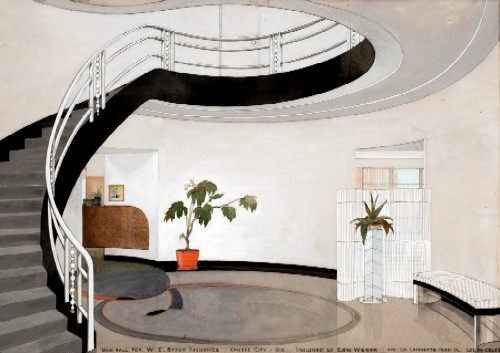
Among the private commissions Weber undertook during this period was the Bixby House. He had been contacted by Kansas architect Edward W. Tanner in 1936. Tanner wanted advice on how to execute the interior decor for insurance executive Walter E. Bixby’s house. Bixby had requested an elaborate, Modernist house. Weber designed a single room for the Bixby house as requested.
Upon seeing the design for the room, Tanner (likely at the request of Bixby) asked Weber to design twelve more, including the foyer, living and dining rooms, breakfast room, bedrooms and the ‘rumpus room’ in the basement. The resulting rooms had contoured edges and a colorful palette. “To underscore the modern appearance of the house, he made use of a full array of new materials, including aluminum, linoleum, Masonite, glass block, veneered plywood, and cork paneling. He took pains to mitigate the impact of Tanner's sharply orthogonal rooms.” (Long, p. 167)
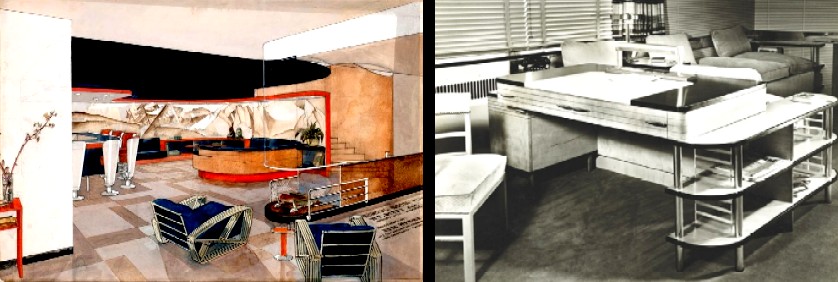 Bixby House Rooms: Concept Sketch of Basement 'Rumpus Room', 1935; Restoring Ross; Room with Custom Yellow Desk, Photo by R. B. Churchill, 1937, The Magazine Antiques via Archive.org
Weber became increasingly busy in 1937. Among other commissions, Walt Disney approached him to assist in the new Disney Studios after Walt realized that the project needed a guiding hand to provide coherence. Disney’s design concerns were primarily functional although he asked Weber to devise a bright, cheerful color scheme. The result was a series of graduated desert-inspired pastels in both the exteriors and interiors, with muted carpets and curtains to avoid distracting the studio’s artists. Disney frequently visited the construction site, sometimes overruling Weber’s decisions so that Weber had to modify Disney’s instructions.
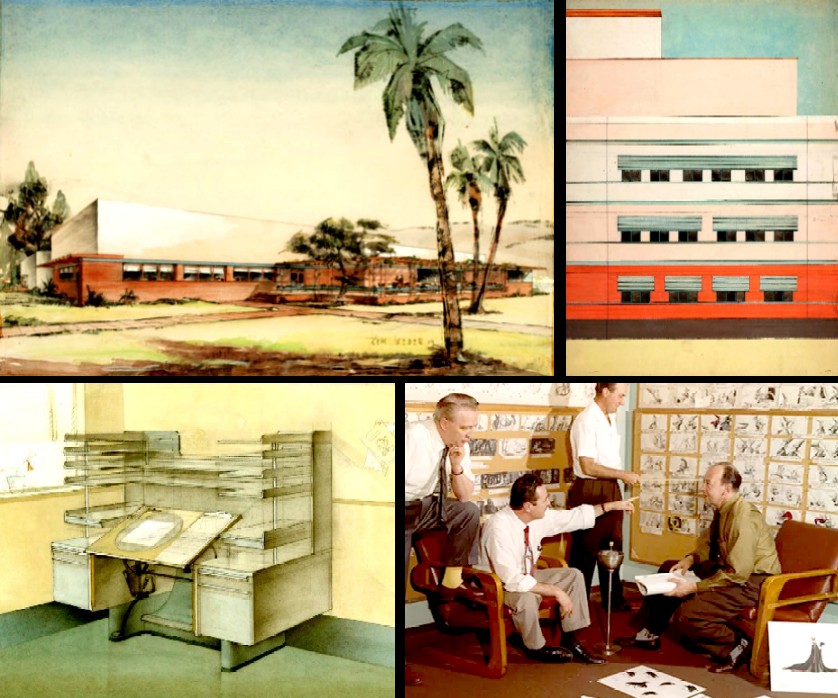 Designs for Disney Studios: <Top> Commissary for Walt Disney Studios, Concept Sketch, 1939. Cartoon Research, Color Scheme for Disney Studios Administration Building, 1939, Culture Zohn
<Bottom> Disney Animator's Desk Concept Sketch, 1939, Metropolis; Animators Using Air Line Chairs While Working on Sleeping Beauty, 1950s, Resource Design Lab
This led to another period of prolific work in the early 1940s.
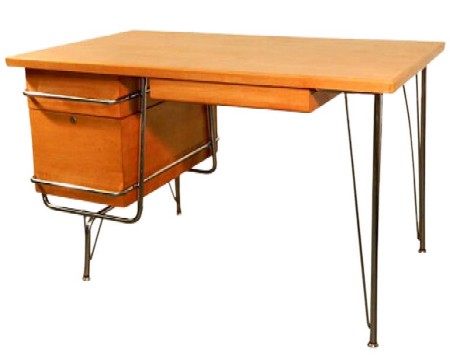
Trimline Desk, Msple and Chrome Tubing, Heywood Wakefield, 1950s, 1st Dibs
Projects ranged from furniture design to major commercial interiors. Weber’s designs during this time were cleaner, more angular, and forward-looking. These experiments culminated in a personal architectural style that defined his postwar work and secured his place as a restless innovator within American modernism.
After the war, Weber decided to slow down professionally, choosing his projects with greater deliberation and care. By the mid-late 1950s he became less interested in design work and more interested in recreational pastimes such as painting and sailing.
Weber’s path to becoming one of the most influential industrial designers in the United States during the interwar years was neither direct nor conventional. Through resilience, adaptability, and a steadfast commitment to practical modern design, he helped shape the course of American industrial design, bridging craftsmanship and mass production, European modernism and American culture. Even amid financial struggle and shifting tastes, Weber remained committed to progress—believing good design belonged not only in luxury interiors, but in the everyday spaces of modern American life.
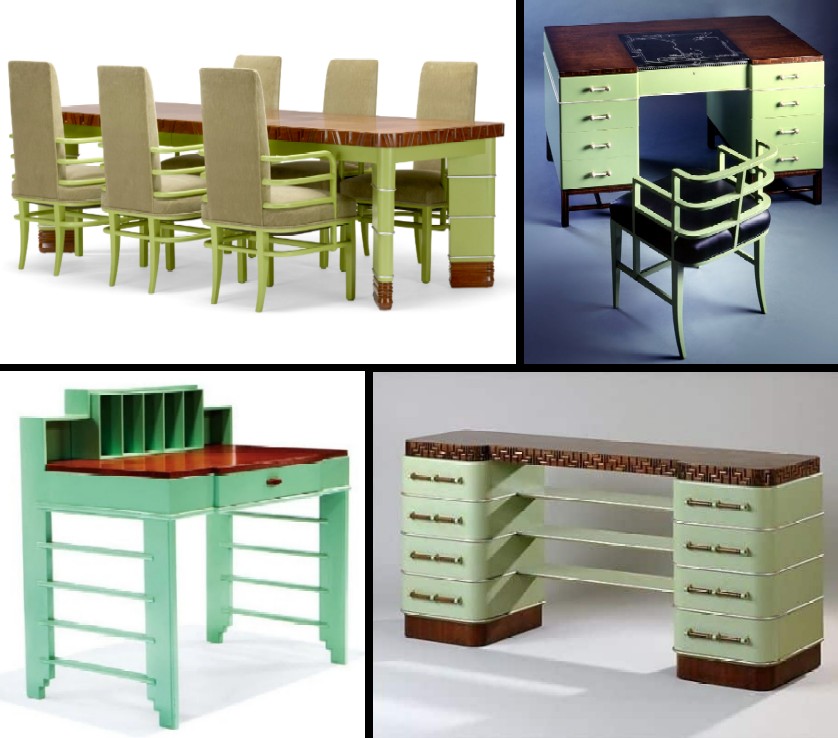 Green Furniture by KEM Weber: <Top> Dining Room Table, Lacquered Walnut, Fabric Upholstery, Grand Rapids Chair Company, c. 1928, Wright Auctions; Desk and Chair, Lacquer, Wood, Silver Leaf and Leather, J. W. Bissinger Company, Wolfsonian, 1928-9, Partons
<Bottom> Desk, Walt Disney Company, Metal and Wood, c. 1939, Dwell; Desk, Wood wth Metal Banding, Grand Rapids Chair Company, 1930s, Cleveland Musum of Art
I usually have more images on this webpage than on my Facebook group postings, but I decided to devote an entire week of posts on Facebook to Weber when I put this together. So there are actually more images of his work in the Facebook group than there are here. For those interested in seeing some of them, click on the links below:
- KEM Weber Profile
- Bixby House
- Lloyd Manufacturing Chairs
- The Air Line Chair
- Silver-Plated and Pewter Table Top Items
- Desks and Tables
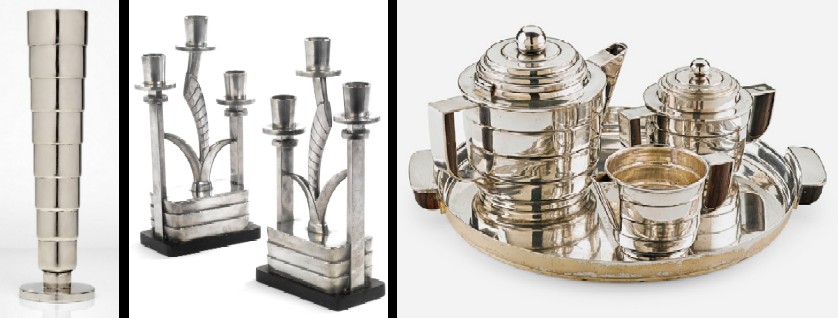 Silver Colored Table Top Items: Today Vase, Silver Plated, Friedman Silver Company, c. 1928, Sotheby's; Candleabras, Pewter and Ebony, Porter Blanchard, 1928, Sotheby's; Machine Age Tea Set, Silver Plated, Friedman Silver Company, 1920s, Rago Auctions