Baptistin Spade (1891-1969)
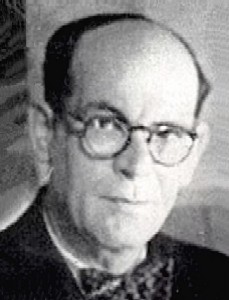
Baptistin Spade
Baptistin Spade was born in Marseille in 1891 to a father who upholstered furniture and designed tapestries. He worked in his father's shop learning these arts before enrolling in the Marseille Ecole de Beaux-Arts (School of Fine Arts) where he studied drawing and sculpture. His sculpture 'Indian Bacchus' won him first prize at a school competition in 1908. He enjoyed sculpting and continued to sculpt throughout his lifetime even after becoming known as a decorator and furniture designer. Baptistin moved to Paris in 1908 where he reportedly continued studying drawing and sculpture as well as painting, although where he did this is not mentioned. It is possible that these 'studies' were not formal education, rather being what he learned casually through the instruction of his fellow artists.
Bapstistin set up a small antique business at Place Possoz with his younger brother Honoré in the Latin Quarter of Paris in 1910, gradually introducing his own contemporary creations into the store. In 1912, Baptistin appears to have enlisted in the French Army, participating in the French colonial conquest of Morocco. Wikipedia says he enlisted for four years, leaving his brother Honoré to run the business in Paris. One source indicates that Honoré was conscripted in 1914, suggesting that the shop was not open for several years. This makes sense because during the war, materials needed to built furniture were devoted to the war effort.
Another source states, "By 1914 business was so good the brothers were able to move to the wealthier 16th arrondissement. The move catapulted Batistin [ibid] to the top of the industry, giving him an entre to the Paris elite." ("Batistin Spade", Maison Gerard, gathered 9-2-25) This appears to have been a single room shop which "was very busy but small, focused around one main room, which served as a workshop and a shop." ("Biography", Baptistin Spade website, gathered 8-28-25) Yet, "despite the rough nature of this arrangement, Spade's furnishings became wildly popular. He quickly developed a reliable clientele —patrons hungry for a bridge between modern and classic 19th & 18th century aesthetics." ("Batistin Spade")
 Baptistin Spade Designs, From left - Office Arm Chair, Cherry Wood and Leather, c. 1935, Conjeaud and Chappy; Couch, Wood and Floral Fabric, Reupholstered, Osenat
It is not possible for all of the above to be true. The brothers couldn't have moved their shop in 1914 and both been in the military. It is possible that Honoré moved the shop before he was conscripted in 1914, provided some of the above is correct. To further confuse matters, one source indicates that the single room shop was their first location rather than their second. This seems unusual if their first location was an antique shop. Setting the dates and physical dwelling aside, it is apparent that the business did well enough to be moved to a better location at some time in the 1910s. "This move was the main reason for the growth of the Spade brothers' business, clearly visible at the beginning of the 1920s." ("Biography") Some sources suggest that Baptistin also began working as a decorator around this time.
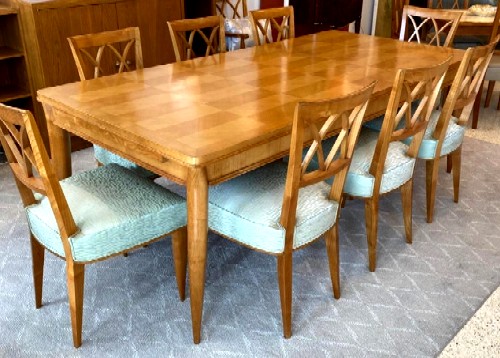
Dining Room Set with 12 Chairs, Oak and Fabric, c. 1940, Incollect
After the end of the first world war, Baptistin and Honoré opened several workshops which specialized in diverse products including cabinet-making, interior design, marquetry and tapestry. His drawing office was located in a workshop at 8 rue des Réservoirs where about thirty employees and craftsmen worked. Their company had a variety of clients many of whom were in Paris and the French provinces although there was also some in Belgium, Switzerland and even North and South America. Among his many projects were apartments, villas and palaces. His commercial projects included offices for maritime and aviation companies, banks and insurance companies. Mobilier National ordered large sets of his furniture collections for ministries and French foreign delegations including the Ministries of Labor and Finance, the Merchant Navy and the Postes, Télégraphes et Téléphones, as well as for embassies in Ottawa and Warsaw.
Unlike many of the other French decorators of the 1930s who suffered serious declines in custom as the Depression hit, the Spades flourished. In 1930, they opened a new 'stylish' decoration shop with a large shop window where he could display his furniture designs at 80 de l'Avenue de la Muette. Two years later, the brothers moved all their production and design into a single large warehouse built for that purpose, located on rue des Réservoirs near Trocadéro square in Paris. Baptistin was made the head of the Chambre Syndicale des Tapissiers-Décorateurs (the Upholsterer-Decorators' Trade Union) by his fellow decorators around this time. "As Baptistin Spade remained a craftsman, applying his art and skill, he hardly ever took part in exhibitions. During his lifetime he did not give any interviews to the press, trade journals or otherwise." ("Biography")
 Baptistin Spade Chrome Metal Furniture Designed in the 1930s, From left - Armchair, Chromed Steel and Black Vinyl, 1930s, Mutual Art; Armchair, Chromed Steel, Light Brown Vinyl Upholstery, 1958, Dorotheum; Armchair and Swivel Stool, Chromed Steel, White and Blue Vinyl Upholstery, 1950s, Dorotheum. These are all the same design, apparently built by Spade's company in the 30s - 50s.
In 1935, Baptistin was hired as a craftsman for the Normandie ship, creating about 50 armchairs used in the first class main hall, smoking room, grill room and main lounge. These were designed by designer Jean-Maurice Rothschild. This was the beginning of Baptistin's career as a designer for cruise ships in
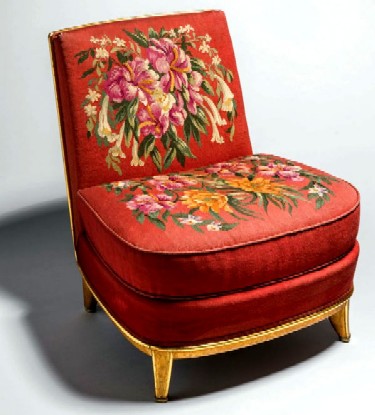
Normandy Grand Salon Side Chair, With Jean-Maruice Roghtschild
and Emile Gaudissart, Gilded Wood, Metal, Silk Tapestry and Wool,
Photo - Walter Silver, 1934, The Decorative Arts Trust
France. He worked for several of the major French cruise ship builders over the next 28 years including Compagnie Générale Transatlantique, Compagnie des Messageries Maritimes, Compagnie de Navigation Mixte, Compagnie des Chargeurs Réunis, Compagnie de Navigation Paquet and Société Générale de Transport Maritime.
...he participated in the decoration or re-decoration of around thirty cruise ships: London, City of Algiers , De Grasse , Liberté , El-Mansour, Floridor, Île-de-France, Félix-Roussel, Kairouan, Provence, Flanders, Antilles, City of Tunis, Maréchal-Joffre, Lyautey, El-Djezaïr, Cambodia, Fort-Desaix, Fort-Royal, France, Ancerville, Mykonos, M/S Avenir, etc. These were considerable contracts which required heavy logistics with secondary workshops in the main French shipyards. ("Baptistin Spade", French Wikipedia, gathered 8-28-25)
Baptistin continued working until 1958. His son and grandson followed in his footsteps, taking up the mantle of French cruise ship designer for 'B. Spade'.
Baptistin's furniture belongs to the French classical-inspired style of Art Deco (as opposed to the Modernist-inspired style). "His work shows his love for the eighteenth century and, to a lesser extent, the style of the turn of the nineteenth century. Baptistin Spade liked to 'recreate' furniture from this period. He was careful to give them quite a personal interpretation while expressing a contemporary feel in his work by using the most modern techniques. Only at the very end of his career did the decorator start to evolve stylistically by designing more pragmatic furniture." ("Biography") His designs favored the tapered legs of earlier French furniture as opposed to the stolid legs found in weightier Moderne furniture. This gave them a delicate air which was emphasized by the materials he chose. Such furniture lent itself well to the Midcentury Modern style of the 50s.
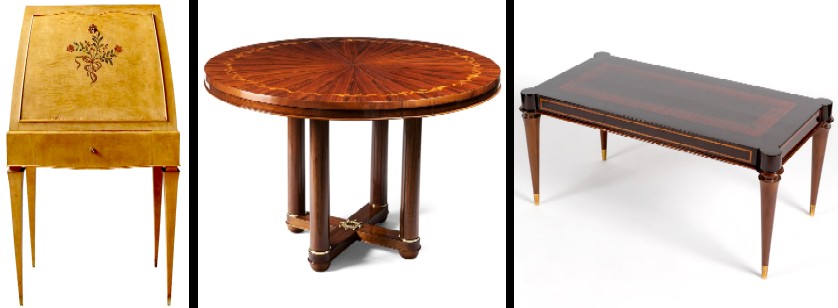
Baptistin Spade Wood-Based Furniture, From left - Secretary, Sycamore with Gilded Bronze Details and Floral Decoration, Brass Hardware, 1946, Conjeaud & Chappey; Dining Table, Rosewood Veneer with Fruitwood Inlays, Brass Details, c. 1940, Incollect; Coffee or DrinksTable, Mahogany with Lacquered Design and Gild Sabots, 1940s, Maison Gerard
The furniture he produced tended to be of lighter-colored woods like ash and sycamore, although he also employed some darker woods such as walnut, rosewood and mahogany. "Baptistin Spade loved color and rich materials. He designed furniture in addition to lamps and tapestries. He used draperies and tapestries to soften the gravity of his dark wood furniture designs. He used lacquer enhanced with gold smears as well as new materials. Like some other designers of rich objects, he also employed shagreen and parchment in particularly expensive items."("Biography")
Sources Not Mentioned Above:
"Morocco Campaign", French Wikipedia, gathered 9-2-25
"Batistin Spade", Docantic, gathered 9-17-25
Original Facebook Group Posting
 Baptistin Spade Chairs and Table, From left - Club Chair, Wood with Brass Sabers, Leather, Reupholstered, c. 1938, 1st Dibs; Table, Walnut, Leather and Bronze, 1940s, 1st Dibs; Armchair, Mahogany Fabric, 1930s, 1st Dibs