Édouard-Marcel Sandoz (1880-1971)
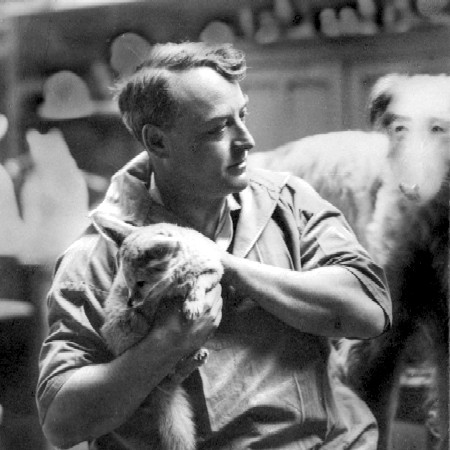
Édouard-Marcel Sandoz Holding a Fennec Fox
Fondation Edouard and Maurice Sandoz
Édouard-Marcel Sandoz was born in Basel, Switzerland. His father, Eduoard Sandoz, was a co-founder of the chemical company Sandoz AG. He went to school in in Château-d'Oex and Lausanne. He then spent some time in Rome. While visiting the 1900 Exposition Universelle in Paris at the age of 20, he decided to become an artist. That year, he enrolled at the Haute ecole d'arts appliqués de Genève where he studied ceramics. Upon graduation, he approached Émile Gallé about joining his family business in Nancy, France. Gallé did not hire Sandoz, with some sources suggesting that he advised Sandoz to study at the École des Beaux-Arts in Paris. Sandoz moved there in 1904 or 1905, attending the school from 1905 to 1908, being taught by sculptors Antonin Mercié and Jean-Antoine Injalbert.
Sandoz began by sculpting people, but his sculpting subject appears to have been influenced around 1908 by the work of Francois Pompon - a French artist known for his animal sculptures. Moving away from traditional human sculptures, he began to create animals an interest which began with the desire to create a small owl in gray marble. Over time, he began stylizing animal designs, using moving toward the use of stylized geometric shapes which were influenced by the Cubist movement popular during this period. He not only experimented with form, Sandoz also experimented with materials. Among those he used were porcelain, bronze, wood and cut stone including onyx and marble.
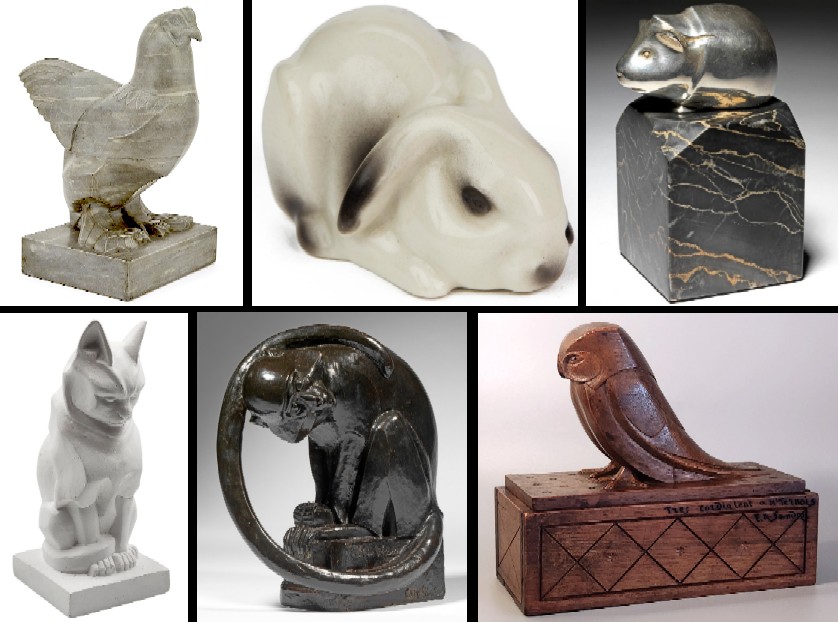 Sandoz Animal Sculptures in Different Materisls: <Top> Hen, Grey Marble, 1928, Invaluable; Rabbit, Glazed Porcelain, Langenthal Porcelain, 1948, 1st Dibs; Guinea Pig, Silvered Bronze on Marble Block, 1919, Artsy
<Bottom> Cubist Cat, Plaster, 20th c., 1st Dibs; Monkey Curled in Tail, Bronze, Claude Valsuani Foundry, 1922, Sladmore; Parakeet Pencil Box, Wood, Proantic Sandoz participated in a variety of annual exhibitions, beginning with the Société Nationale des Beaux-Arts in 1906 and the exhibitions put on by the Société des Artistes Décorateurs beginning in 1911. Sandoz married Adèle Passavant in 1909 and the couple moved to the artists' district of Montparnasse in 1910. Due to limitations of available materials during the First World War he began working in ceramics. He created over 200 porcelain models over his lifetime beginning around 1916-7 for Theodore Haviland in Limoges, France, a relationship which continued until 1952. He created an extensive series of highly stylized porcelain tea and coffee services in the form of birds, animals and children starting for Haviland. He went on to create such models for other companies in the 1920s including Manufacture de Sèvres and Porcelaine de Paris in France, Richard-Ginori in Italy and Langenthal in Switzerland.
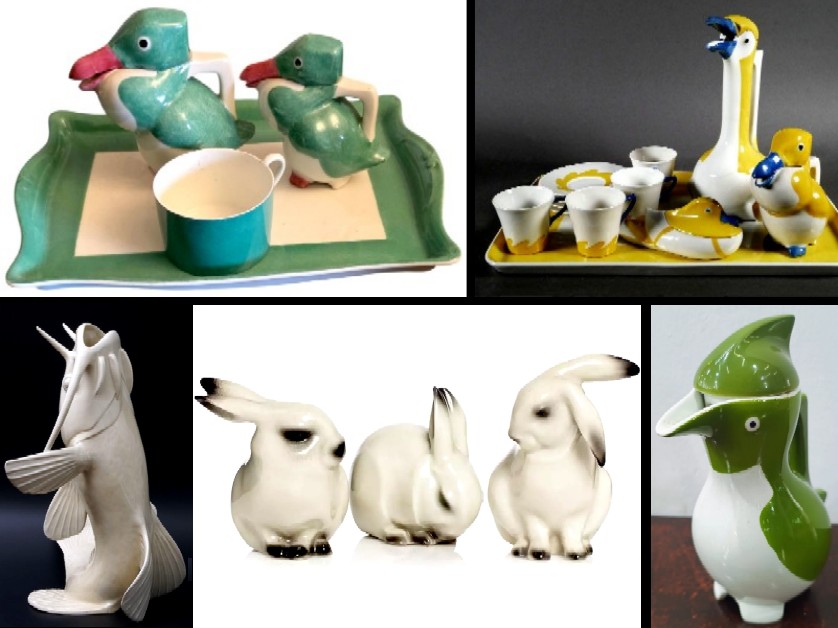 Sandoz Porcelain Sculptures and Tea Sets: <Top> Sandoz, Green Ducks, Enameled, Limoges by Theodore Haviland, 20th c., Proantic; Yellow Birds with Blue Bills, Enameled,. Limoges by Theodore Haviland, 1920s, Bidsquare
<Bottom> Catfish Vase, Porcelain de Paris, 1920s, Antic Store; Rabbit Set, Enameled, Langenthal, 1940s, Millon; Green Penguin Jug, Enameled, Ginori, 1920s-30s, Ebay
As his interest in animals grew, Sandoz began to surround himself with the objects of his studies.
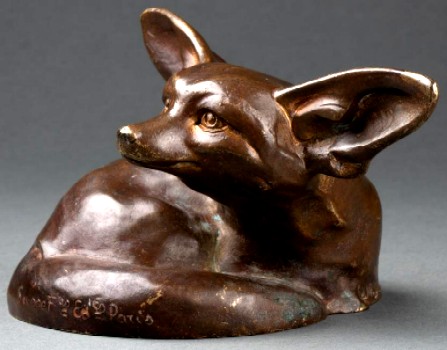
Fennec Fox, Patinated Bronze, 1920s, 1st Dibs
There was a period when he kept two monkeys as pets—Joseph and Madame Putiphaz—who shared his Paris studio with him. "There are photographs of him at work in his studio at Denantou in Lausanne surrounded by a panther, fennecs, monkeys, cubs, fish, frogs, turtles, dogs, cats, parrots, and even a cheetah." (Jane Librizzi, "The Polymathic Career of Edouard-Marcel Sandoz" , The Blue Lantern blog, gathered 1-12-26) Other websites add that he had cockatoos as well. It should come as no surprise that he founded the French Society of Animalists (referring to sculptors of animals) in 1933.
His love of animals was even used to entice Sandoz to accept a job. In 1920, the president of the Transatlantic General Company, Del Diaz, offered him a fennec fox if he would go North Africa to create artwork for them. In 1921, Sandoz painted watercolors for them while in North Africa. Upon his father's death in 1928, he inherited the Denantou property in Lausanne, Switzerland which he renovated and added a workshop. He created frescoes for the Nestlé pavilion at the 1937 Paris World's Fair, collaborating with Modernist architect Jean Tschumi. He worked with Tschumi again in 1949, designing frescoes for the new Sandoz laboratories.
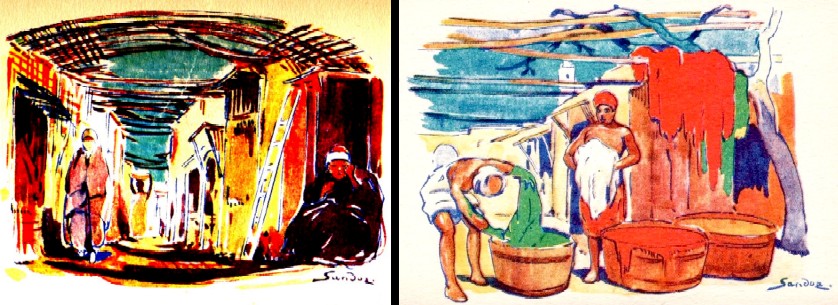 A Pair of North African Postcards by Sandoz, Watercolor, 1920s, Both from Ebay
Sandoz was multi-talented, not restricting his activities to art. He researched dyes and their applications and has been credited with inventing the black light. He was installed as a member of the board of directors of Sandoz SA in 1923. In the 1920s, he developed a process for light projections for theatrical sets. In 1935, he was one of the founding shareholders of the photographic paper company Tellko S.A. in Fribourg. He was made the president and CEO of Sandoz France in 1941.
Sandoz participated in a variety of charitable organizations, founding several of them himself. He became president of the Baron Taylor Association (today the Fondation Taylor Association des Artistes) in 1952, continuing in the role until his death in 1971. The purpose of the foundation is to help artists through exhibitions, financial assistance
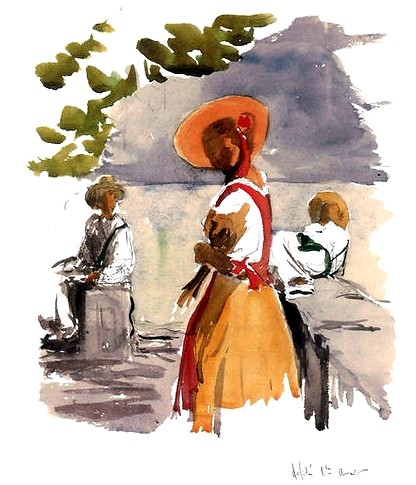
Sandoz, Wine Growers Festival, Watercolor, 1955, L'Estree
and award prizes for artwork. He contributed to the creation of the Cité des Arts in Paris, a foundation which manages an artist-in-residence building complex which fosters research and creative work by artists. He is widely credited with starting the Œuvre des enfants d'artiste (Charitable Society for Children of Artists) although there is no information about the organization online suggesting it was short-lived. It may have been folded into the Swiss Fondation de Famille Sandoz (Sandoz Family Foundation) which Édouard founded in 1964. The purpose of the foundation was originally to provide long term philanthropy using its strategic holdings in diverse sectors such as chemistry and industry. Today the foundation engages in charitable activities in a variety of fields including education and training, higher education and research, and cultural and social activities.
For his wide ranging activities, Sandoz was given a great deal of recognition. In 1947 he was elected a member of the Paris Académie des Beaux-Arts (Academy of Fine Arts). He was made a Commander both of the Legion of Honour and of the Ordre des Arts et des Lettres (Order of Arts and Letters). The University of Lausanne awarded him an honorary doctorate in geology and botany in 1959.
His animals, distinctly figurative, are characterized by a stylization influenced by Cubism. Gradually, this was abandoned in favor of a naturalistic representation of animal species – particularly fish and birds – based on a rigorous study of the subjects through watercolor and drawing. He not only casts his bronze sculptures but also explores the application of an identical model to various uses: lamps, trinket trays, bookends, paperweights, and radiator caps for automobiles. The fountains he designs are sometimes quite complex structures that integrate animals into a larger framework. The rejection of the autonomy of the work of art, with the animal sculptures responding either to a decorative concern, tinged with humor or morality, or to a desire for scientific representation, is Sandoz's most distinctive characteristic. ("Edouard Marcel Sandoz")
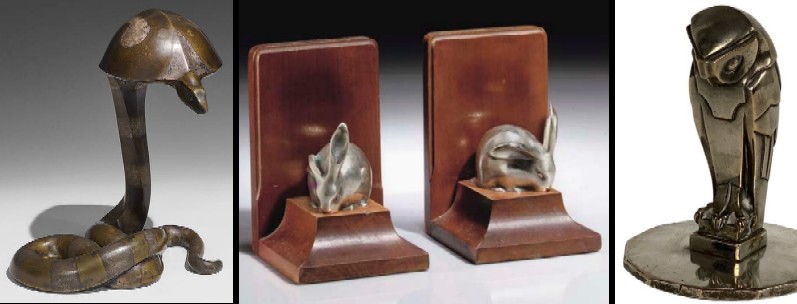
Sandoz Sculptures in Other Forms: Cobra Table Lamp, Bronze, A. Valsuani Foundry, Toomy and Co.; Grazing Rabbit Bookends, Silvered Bronze on Wood Bases, Susse Freres, Christie's; Owl Sculpture Auto Mascot, Cubist, Silver-Plated Bronze, 1925, Martell Gallery
Other Sources Not Mentioned Above:
"Édouard-Marcel Sandoz", Wikipedia, gathered 1-9-26
"Edouard Marcel Sandoz, Swiss, 1881–1971", Artsy website, gathered 1-9-26
"Edouard-Marcel Sandoz", Sladmore website, gathered 1-9-26
"Edouard-Marcel Sandoz (1881-1971)", Katten Kabinet website, gathered 1-9-26
"Edouard-Marcel Sandoz", 1st Dibs, gathered 1-9-26
"Marcel Edouard Sandoz", Passage Arts website, gathered 1-9-26 -
"Bronze Dachshund By Edouard-marcel Sandoz", Proantic website, gathered 1-10-26
"Association Presidents", Fondation Taylor website, gathered 1-14-26
"Sandoz Family Foundation", Grokopedia, gathered 1-15-26
"Sandoz Family Foundation", Wikipedia, gathered 1-15-26
"Cité internationale des arts", Wikipedia, gathered 1-15-26