Paul Philippe (1870-1930)
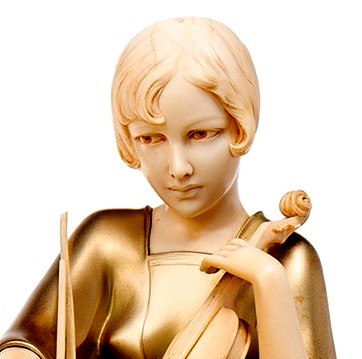
Girl with Violin, Cold Painted Bronze and Chryselephantine on
Onyx Plinth, for Rosenthal and Maeder, 1920s, McTear's
Painter and sculptor Paul Philippe may have been born in Thorn, Poland if the majority of the sources are to be believed. However, other sources suggest he was born in Berlin or France while some sources don't commit and just say he was Polish/German or French/German. The German Wikipedia explains, "From the available literature, neither Philippe's birthplace nor his nationality can be clearly determined." ("Paul Phillipe", German Wikipedia, gathered 7-1-24) It is curious that his surname is French, definitely not German or Polish. He may have been born to French parents outside of France. This confusion over his birthplace hints at just how little is known about the man. He left a wealth of beautiful statues, however, all of which appear to date to the 20th century.
Philippe studied at the Royal Academy of Arts (Königliche Akadamie) in Berlin before moving to France. There are a variety of paintings attributed to him, none of them dated and nearly all of which are of ships in port. Several art galleries list him as a painter in Brittany, France, probably because several of his painting are of a Breton harbor. He appears to have been there long enough to create at least twenty different seascape paintings. No source specifically states when he moved to France and his focus after 1902 appears to be on statuary. This may indicate that he moved to Brittany before going to Paris to study sculpture. (Note that it is possible that these paintings were by a different Paul Philippe. Artnet attributes them to the same man who created sculptures in the 20th century, however.)
 Paintings by Paul Philippe, from top left - Retour De Pêche à Concarneau au Crépuscule, Brittany, Proantic; Bringing in the Catch, Sundown, Mutual Art; Retour de pêche en Bretagne, Christophe Joron-Derem; Paul Philippe, Painting, Bateaux de Peche dan un Port Breton, Bid to Art
In Paris, Philippe lived in Les Fusains, an artists' colony at the foot of Montmartre and studied at the Ecole des Beaux-Arts in the studio of Antonin Larroux, a neoclassical sculptor who was awarded several prestigious awards at the Paris Salons. From 1902 to 1909 Philippe exhibited at the Salons of the Société des Artistes Français in Paris. His statue L'éveil (The Awakening) was particularly popular at the 1907 Salon. (See the first image below, top left) The sculpture was produced in various sizes and materials including bronze, marble, ivory and wood by the Friedrich Goldscheider company in Paris. The sculptor also began creating designs for the Preiss-Kassler foundries in Germany during this period. These designs were softer and more in line with the Art Nouveau style of that time.
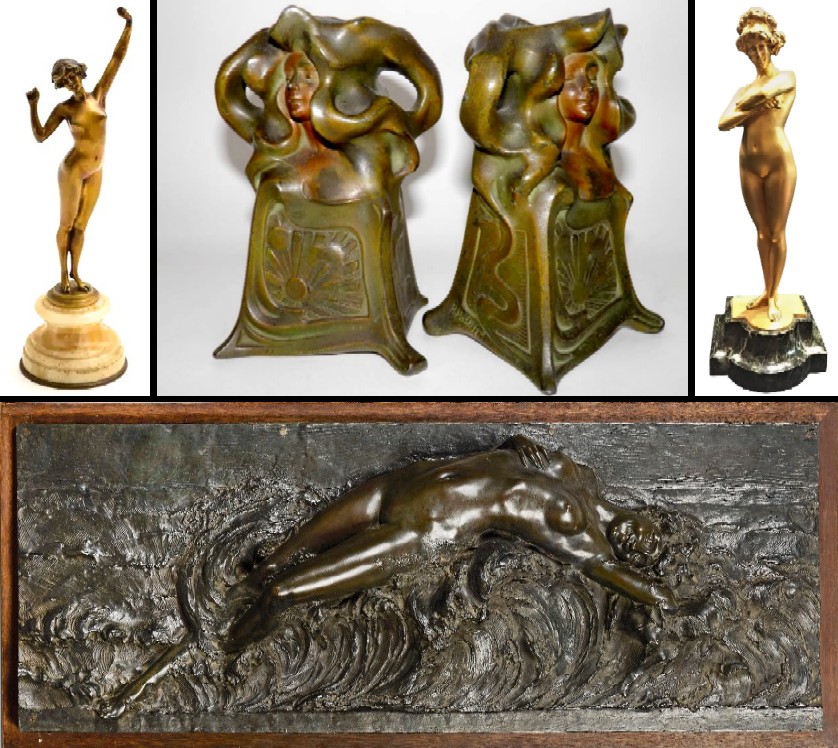 Art Nouveau Style Sculptures by Paul Philippe, from top left - The Awakening, Bronze on Beige Onyx Base, 1st Dibs; Flower Vases, Probably 1900s-10s, Abe Books; Irony, Gilt Bronze and Marble, Chairish; Water Nymph, Patinated Bronze Figural Relief Plaque, Signed, Bonham's.
Following World War I, Philippe moved to Weimar, Germany while still maintaining his ties to France. His sculptures became more stylized in the interwar years - streamlined, elongated and even willowy - likely because of the popularity of the 'Art Moderne' style. "[H]is young women [were] rendered now with wistful facial features (see the first image on this page) and clad in billowing, geometrically patterned skirts, tasselled belts and slippers with heart motifs." (Alastair Duncan, Art Deco Sculpture, 2016, p. 381) He began blending French and German techniques in his work. Even his popular Awakening sculpture received this treatment as the first image below shows.
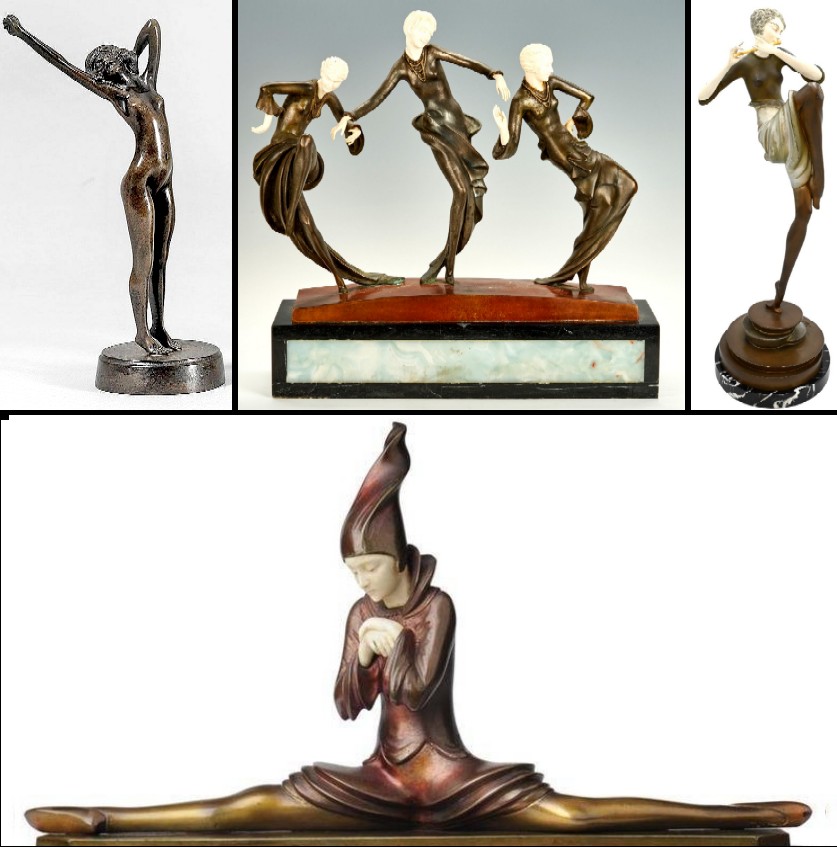 Stylized Female Sculptures by Paul Philippe, from top left - Awakening, Patinated Bronze, c. 1930, Invaluable; Three Dancers, Bronze and Ivory on Copper, Black Hardstone and Onyx Base, c1930, Case Antiques; Flute Player, Patinated Cold-Painted Bronze on Marble Base, Nadeau's Auction Gallery; Le Grand Ecart Respectueux, Cold-Painted Bronze and Ivory, c. 1925, Tennants
During this period, he provided designs to Les Neveux de Jules Lehmann in Paris and Rosenthal und Maeder in Berlin, continuing to produce pieces for them when they were taken over by Preiss-Kassler in 1929.
He exhibited extensively at all of the major French salons and developed his own voice in sculpture by focusing his ouevre around the movement of the female body, often depicting exotic models in highly theatrical poses with a loose adherence to realism in his idealized visions. He walked a fine line between Art Nouveau and Art Deco while his figures do tend towards the latter.. ("Paul Philippe, 'Irony', French Art Deco Gilt Bronze & Marble Sculpture, ca. 1925", Chairish website, gathered 6-4-25)
Much is said about the design and style of his sculptures. Phillippe worked in the usual sculpting media of clay, bronze and stone as well as wax. In the Art Deco style, he also created some sculptures in more exotic and unusual materials including ivory, marble, porcelain, wood and chryselephantine (created by attaching thin pieces of ivory to a frame to represent skin and sheets of metal leaf such as gold or bronze to represent clothing). He decorated some of his works with precious stones which gave such sculptures a rich feel. "Due to the expensive materials he used, Philippe's works were particularly popular with the French bourgeoisie." ("Philippe, Paul", Dobiaschofsky website, gathered 7-1-24)
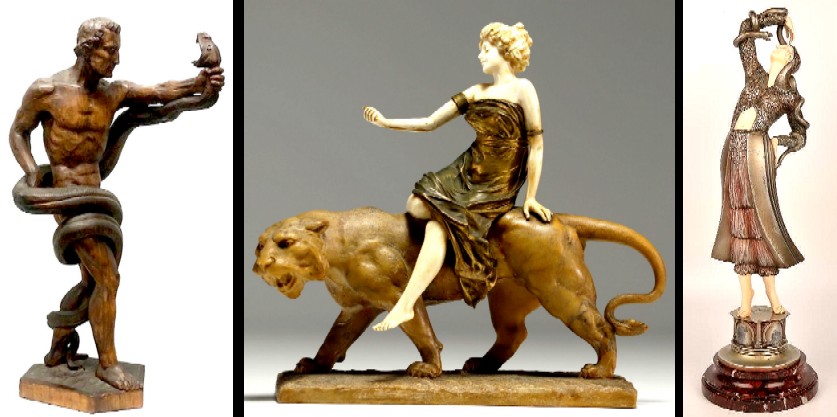 Sculptures with Animals by Paul Philippe, from left - Man with Serpent, Wood, c. 1920s, Ashville Gallery; Woman and Lioness, Chryselephantine - Ivory and Bronze on Beijge Marble Plinth, c. 1920, Invaluable; Radha, Woman with Snake, Bronze and Ivory, Veined Marble Base, Invaluable
The majority of Philippe's sculptures were of women, including nudes, pantomimes, dancers, women with animals and instruments, which were popular subjects for sculptors during this period. "All his models are distinguished by extreme refinement and delicacy of forms. The master paid special attention to the quality of the finish and the selection of spectacular patina. Thanks to shades of brown, gilded and silvered patinas, his sculptures looked unusually impressive and life-like." (Chairish) The German Wikipedia article suggests that many of his models were take from real-life, notably cabaret dancers, actors and demimondaine (women of questionable morality).
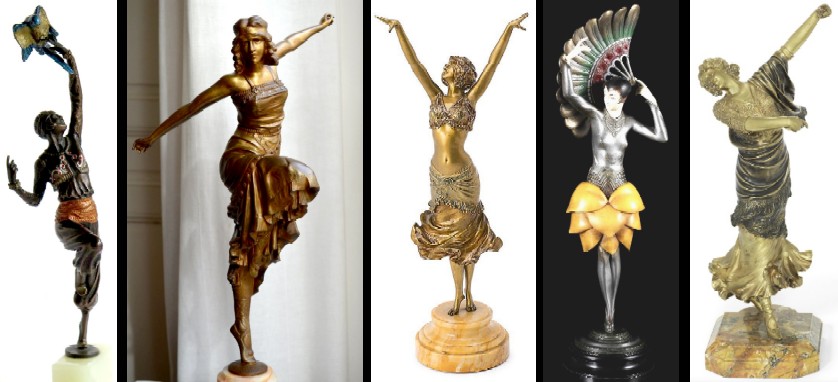 Dancer Sculptures by Paul Philippe, from left - Paul Philippe, La Danseur Perroquet - The Parrot Dancer in Turkish Outift, Bronze with Onyx Base, Cold-Painted, c1920, 1st Dibs; Russian Dancer, Bronze with Onyx and Guilded Brass Base Base, c 1925, Catawiki; Dancer, Gilded Bronze on Marble Base, c. 1920, Invaluable; Fan Dancer, Bronze and Ivory, Silvered and Cold Painted, Turned Marble Base, c. 1925, Bonhams; Spanish Dancer, Gilt Bronze on Marble Plinth, c. 1925, The Sale Room
Philippe died in 1930, just as the Art Deco period was ending and the Streamline Moderne period beginning. It would have been interesting to see how the streamlined styles popular in the 1930s would have affected the work of such an artist.
Sources Not Mentioned Above:
"Sculpture by Paul Philippe (France, 1870?1930)", Carter's Price Guide to Antiques, gathered 7-1-24
Alberto Shayo, Statuettes of the Art Deco Period, 2016, p. 190
"Feminine Figure by Philippe", McTear's website, gathered 6-4-25
"Artist Biography & Facts: Paul Philippe", askArt website, gathered 6-4-25
'Mischievous' | Paul Philippe", Silla Fine Antiques website, gathered 7-1-24
"Man with Serpent", Ashville Gallery, gathered 7-1-24
"Friedrich Goldscheider", Wikipedia, gathered 6-5-25
Original Facebook Group Profile
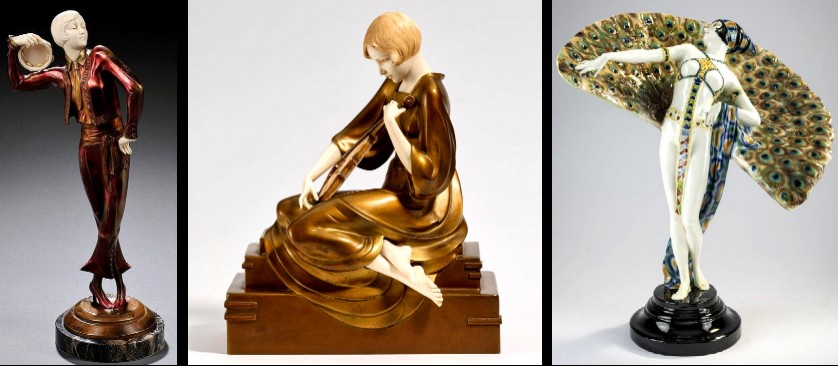 Paul Philippe Art Deco Sculptures, from left - Woman with Tambourine, Rosenthal und Maeder, Invaluable; Girl with Violin, Cold Painted Bronze and Chryselephantine on Onxy Plinth, for Rosenthal and Maeder, 1920s, Van Ham Auction; Paul Philippe, Dancer in Peacock Costume, Earthenware with Polychrome Glaze, For Freidrich Goldscheider, 1924-5