Jean Perzel (1892-1986)
Jean Perzel was born in Bavaria to a
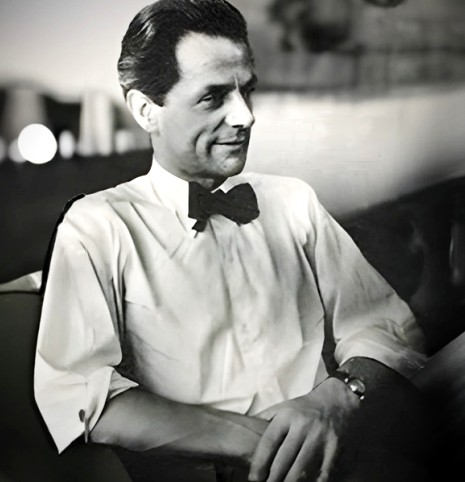
Jean Perzel (1938)
glassmaker (who was himself the son of a glassmaker). Perzel began an apprenticeship in 1905 in Munich, where he became proficient at glass painting - referring to painting an image one side of a piece of glass which is meant to be viewed on the non-painted side. "Throughout the 19th century painting on glass was widely popular as folk art in Austria, Bavaria, Moravia, Bohemia and Slovakia." ("Reverse glass painting", Wikipedia, gathered 6-14-25) He completed this part of his apprenticeship and, at age 16, set off on foot as a 'companion of duty', an extension of apprenticeship in which someone travels, spending six months to a year with different masters, learning their trade. For the next few years he visited Austria, Bohemia (Czechoslovakia), Switzerland, Northern Italy and France, deciding in 1910 to remain in France.
Perzel went to work for a French master glassmakers to continue to improve his skills. He was sent to Algiers in 1911 to mange a commission for stained glass windows for the Prefecture's dome. In 1914, he returned to France. He enlisted in the French Foreign Legion for the duration of World War 1. During his tenure in the legion, he was promoted to Corporal. At the end of the war, he was demobilized (released from service). His five years of voluntary service in the military allowed him to apply for French citizenship.
Returning to France in 1919, Perzel joined the studio of woodworker, stained glass designer and decorator Jacques Grüber. This gave him the opportunity to continue perfecting his skills. He was particularly interested in the best way to use glass to radiate light. Electricity was being installed in some homes in France during this period inspiring Perzel to consider the future potential of electric light design. Leaving Grüber's workshop in 1922, he began to pursue this new interest, establishing his own workshop - Jean Perzel Luminaires - in Paris in 1923.
From 1922 to 1924, Perzel created a variety of lights, giving each model a number, beginning with 1 (see the image at right for a modern reproduction of lamp 1), starting his imaginative designs from the base of his knowledge of stained glass. "His earliest lamp designs were
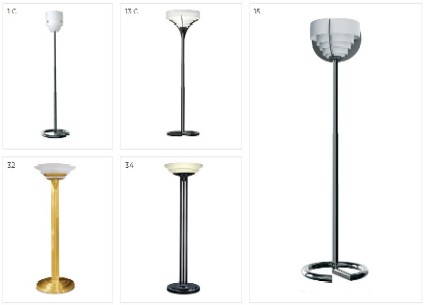
Floor Lamps, 1C, 13C, 15, 32, and 34, Metal and Frosted Glass, Jean Perzel,
Designed in 1924, Modern Reproductions, Perzel
inspired by Romanesque church windows, integrating the ethereal glow of stained glass with contemporary aesthetics." ("Jean Perzel (1892 – 1986) Austrian Lighting Designer", encyclopedia.design website, gathered 6-16-25) However, he saw that such designs failed to provide the light intended. As he explained, "It would be pretentious to say that I tried to treat electricity in the same way that the old stained glass artists treated the sun, but that is what I tried to do. I wanted to mask entirely the luminous source in using its rays; from which came my research into the relative opacity of nacreous [lustrous] and frosted glass." (Jean Perzel, Lux, August, 1928, p. 7)
Exclusively a designer and manufacturer of light fixtures, Perzel had a two-fold philosophy: first, to ensure that the light playing on the diffusing surfaces did so evenly, and, secondly, to achieve maximum utilization of the light source's rays. To ensure that the light was transmitted uniformly, Perzel developed a specially frosted, sandblasted sheet of glass for the inner surface of his lampshades, adding an enamelled layer on the exterior for decorative effect. By this means not only was the light equally filtered, but Perzel's preferred standards of opacity and milkiness were met. In later years, lightly tinted enamels were used to match the color schemes in certain room settings. (Alastair Duncan, "Art Deco Lighting", The Journal of Decorative and Propaganda Arts, Spring, 1986, p. 25)
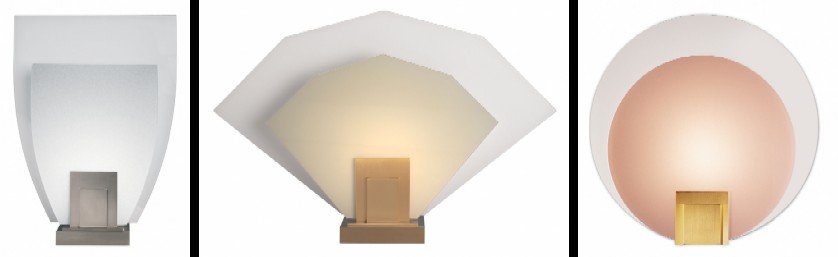 Jean Perzel Wall Sconce Designs, From left - 160K Plated Metal with Sandblasted Glass; 160FL Plated Metal with Sandblasted and Enameled Glass; 160J, Plated Metal with Sandblasted and Enameled Glass; Original Design 1926, Modern Reproductions, Perzel
Perzel exhibited four models at the 1924 Salon d'Automne in Paris, all of which were
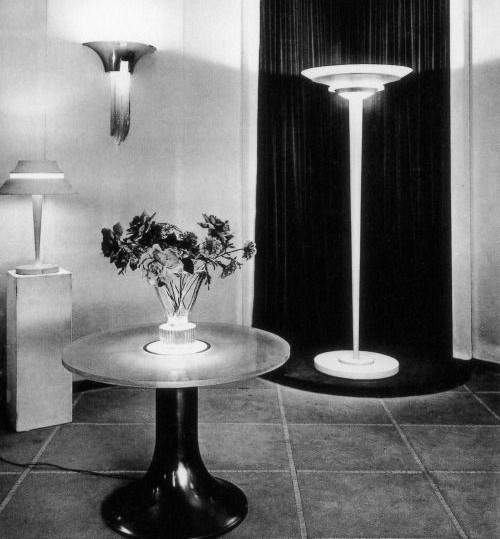
Collection of Lights '1925', Jean Perzel, Wikimedia.
purchased by the baron Robert de Rothschild. This was the beginning of a long and successful career zelin lighting design. Following this promising debut, his fixtures were displayed at the seminal 1925 Exposition Internationale des Arts Décoratifs et Industriels Modernes where he received a gold medal for his work. Following the 1925 Exposition, his work was displayed at the 1926–1939 Société des Artistes Décorateurs, the 1929–1939 Salon d'Automne, the Paris Salons of Light which took place in 1933, 1934, 1935, 1937 (as part of that year's International Exposition), and 1939, and the Société Nationale des Beaux-Arts Salons in the 1920s and 30s. He won first prize in the Lighting Competition at the Salon des Décorateurs in 1928, four first prizes in their 1936 Lighting Competition and a Grand Prix at the 1937 Universal Exhibition.
Paris Salons were one of the best ways for a designer to advertise their talent and attract clients, both individuals and other designers. Among the Art Deco era designers who saw Perzel's designs at the salons and expressed interest in working with him were Jacques-Émile Ruhlmann, Jules Leleu, Robert Mallet-Stevens, and Pierre Chareau. He was among the first lighting designers to to create interior electric lighting for large rooms and projects, both in France and internationally. Such projects included the League of Nations Palace in Geneva, Luxembourg Cathedral, the Mulhouse Train Station, the Samaritaine deparment store, the ocean liners Normandie and Queen Mary, the Manik Bagh Palace of the Maharaja of Indore, the King of Siam's Chitralada Palace in Bangkok, the Canadian Embassy in The Hague, the French Institute and the Savoy Hotel, both in London. His lights were (and still are) used by a variety of architects in their designs.
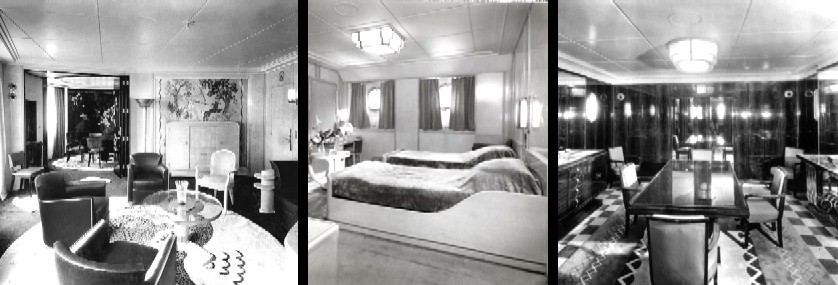 Jean Perzel Lighting on SS Normandie (1935) , From left - Grand Luxe Room 'Trouville', Salon and Salle de Manger, Photo #340; Ceiling and Sconce Lights,
Outer Cabin, 1st Class, Photo #363; Grande Luxe Room 'Caen', Dining Room, Photo #293 - All Image from Tessier-Sarrou website
Like most of the Art Deco artisans of the period, Perzel's sales were impacted by the stock market crash of 1929.
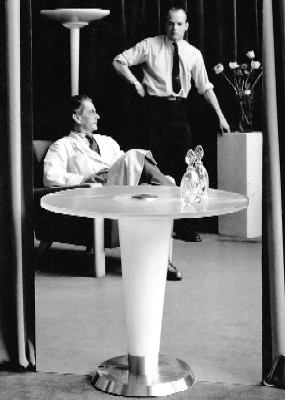
Jean Perzel and Nephew François Raidt (1954)
Yet he managed to procure enough work to keep the 10 workers he had before the crash employed. He was even able to move his workshop in 1931 to a building he commissioned from architect Michael Roux-Spitz located at 3, rue de la Cité-Universitaire where the company remains to this day. "He now had a beautiful exhibition room and basement studios large enough to give free rein to his creativity." ("Perzel: 100 Years of Luminous History", Perzel website, gathered 5-16-25)
In 1933, Perzel brought his nephew François Raidt into the business at the age of 14. Like Perzel, Raidt had learned the art of glassmaking as an apprentice, while also taking architecture classes in the evening. Perzel taught Raidt the engineering techniques he had discovered in creating his light designs. Four years after being brought into the business, Raidt found himself in charge of an order by Henry Ford which required the creation of several decorative objects made from Ford parts which were needed within 36 hours of their order. He proved equal to the task.
During World War II, both Perzel and Raidt were mobilized. The company was taken over by the government until 1948. Returning to the remains of a once prosperous business, Perzel embarked on what the Perzel website calls 'an artistic renaissance', meeting new, post-war tastes. In 1951, he became ill, resulting in his nephew and three other employees being place in charge of managing the company. Under Raidt's guidance the product line was expanded and Perzel's designs are updated. Many of the designs Perzel created in the 1930s are still available today through the company with updated wiring and lighting options. You can see the products they currently offer here.
Sources Not Mentioned Above:
"Jean Perzel", French Wikipedia, gathered 8-16-25
"The Atelier Jean Perzel", Perzel website, gathered 6-15-25
Yaël Nacache, "Ateliers Jean Perzel, 100 years of creation", Signatures Singulieres, gathered 6-16-25
"Jean Perzel - French, 1892", Incollect, gathered 5-16-25
"Jean Perzel", Galerie Marcilhac, gathered 6-14-25
"Compagnons du Devoir", Wikipedia, gathered 6-14-25
"Jacques Grüber", Wikipedia, gathered 6-16-25
Original Facebook Group Posting
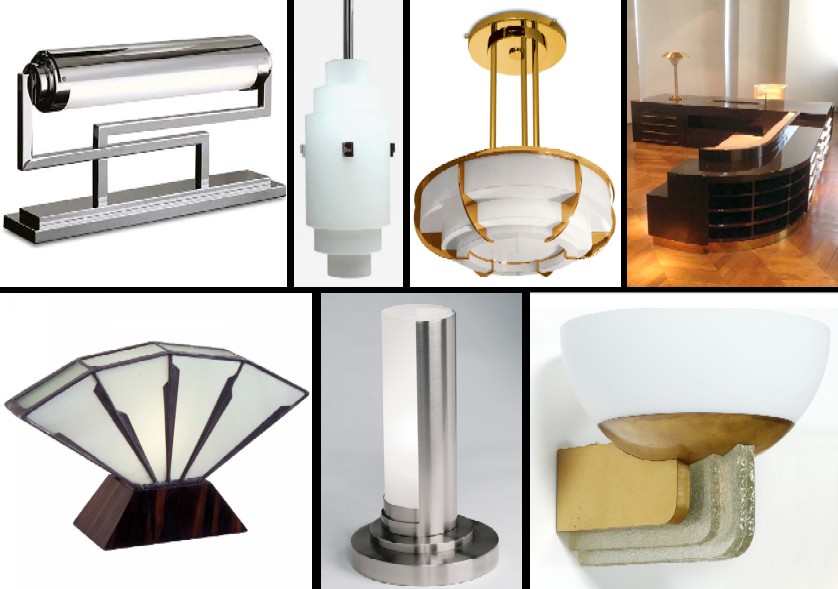 Jean Perzel Desk Lamps and Chandeliers, From top left - Desk Lamp 234, Metal and Frosted Glass, 1925 Signatures Singulieres; Pendant Chandelier 215, Frosted Glass and Metal, 1920s, IncollectChandelier, 354 BIS S, Plated Metal and Frosted Glass, 1920s, Perzel; Office of Michel Roux-Spitz, Lamp 162 by Perzel, Desk Designed by Roux-Spitz, 1931, Wikimedia; Table Lamp, Macassar Ebon eotj Frosted Glass, Mutual Art; Desk Lamp 313, Metal and Glass, 1928, Signature Singulieres; Sconce Light 342 B , Gilded Brass, Glass Slab and Frosted Glass, 1920s, Invaluable