
Warren McArthur, Jr. (1885 - 1961)
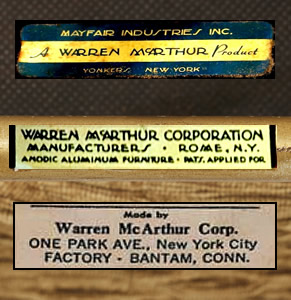
Various Warren McArthur Furniture Tags (1930s-40s)
Warren McArthur, Jr. is a bit unusual for an Art Deco designer in that he didn't come from the decorating or stage design fields like many other eventual industrial designers. He was an engineer, earning his mechanical engineering degree from Cornell University in 1908. His father, Warren McArthur, Sr. was the executive sales manager of the C. T. Ham Company of Rochester NY, the R. E. Deitz Company of Chicago as well as for other affiliated lamp-production companies. It is likely through his father that young Warren obtained a position with one of these lamp design companies in 911, remaining there in various positions for several years.
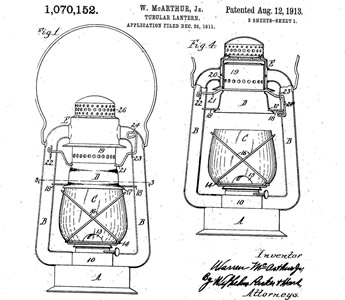
Warren McArthur's Tubular Lantern Patent, Google Patents
It is here that Warren Jr. was exposed to the patenting process, knowledge he would make good use of all through his life. He patented a globe or 'tube' lamp, the rights for which he sold to the Dietz Lantern Company for $2000.. This was one among ten patents he obtained for lamps. The basic design is still in production today.
Warren, Jr. moved to Phoenix to work with his brother Charles, setting up the McArthur Brothers Mercantile Company to sell Dodge vehicles in 1914. Their interest in cars was another gift from their father who had owned one of the first cars in Chicago. Once settled in to Arizona, the brothers began to expand into other businesses. The Dodge dealership was one of twelve dealerships the brothers eventually started, including one to sell Jordan autos. (See "Warren McArthur", Irwin Weiner website, gathered 10-22-25 & James H. Lackey, The Jordan Automobile: A History, p. 118) In 1922, they started the first radio station in Arizona. Warren, Jr. never forgot his engineering roots. He developed an adapter for vehicle radiators to prevent overheating in the desert. During the 1920s, the brothers converted one of their Dodge trucks into an RV which they called the 'Wonderbus', installing extra seats and including four beds, in which they took people on tours of Arizona Landmarks. In 1926, McArthur applied for a patent for his design, calling it a 'Touring and Camping Road Vehicle'.
Arthur, Sr. asked Warren and Charles to build him a vacation house in Phoenix in 1923. Their other brother Albert Chase McArthur, an architect came to help them design the house. While the house was built, the brothers almost ran out of cash completing it. To save money, Warren offered to design the furniture for the house and have it locally source, being made of tubular steel. This was at least two years before the European designers started making tubular metal furniture.
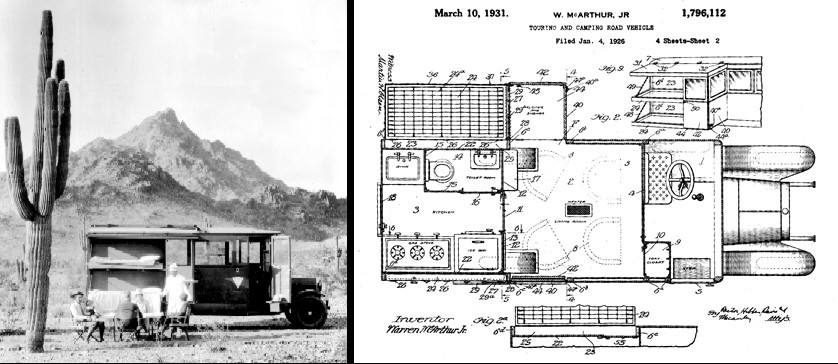 Warren McArthur's Wonderbus (From Left): Wonderbus in Arizona, ~ 1920s, Arizona Biltmore; Patent 1796112, 'Touring and Camping Road Vehicle', Google Patents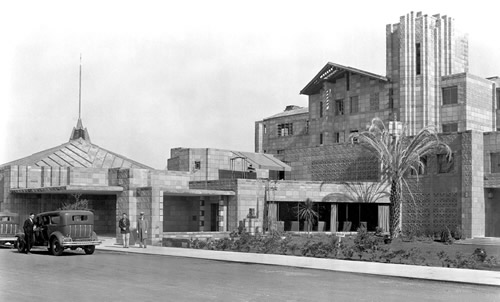
The Completed Arizona Biltmore Hotel by Albert , c. 1930, Arizona Biltmore
In the late 1920s, Warren and Charles became interested in the idea of promoting Arizona as a touriis destination. The idea started with tours in their 'Wonderbus', leading them to the idea that they might create a resort hotel for this purpose. They commissioned their older brother, architect Albert, to design such a hotel for them in Phoenix. Albert had been mentored by Frank Lloyd Wright, working for him between 1907 and 1909. He asked Wright if he could use his textile-block slab construction for the hotel. Wright agreed, working with Arthur on the project while still making it clear that it was Arthur's work, not his. This may have been in part because Albert modified the design, using rectangular blocks instead of Wright's square blocks.
The Arizona Biltmore hotel opened in February of 1929 hosting 3 days of celebration. Unfortunately, the stock market crash that year caused the McArthurs to sacrifice their financial interest in the Arizona hotel. Their rights were purchased by William Wrigley who had begun visiting Phoenix in the winter and had invested in the hotel company as well as purchasing a nearby lot. Wrigley purchased it in a foreclosure sale.
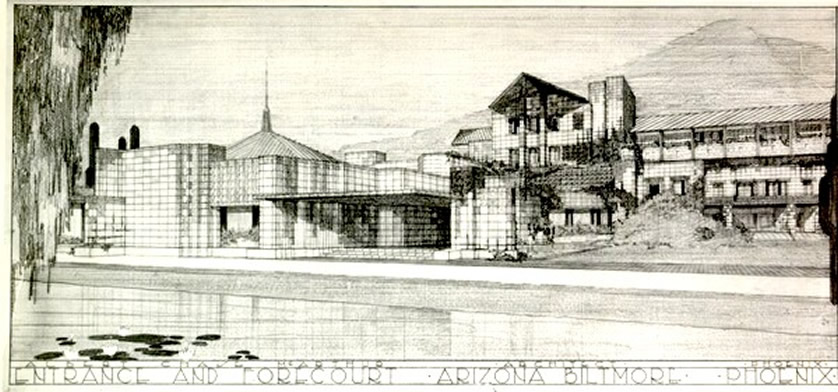 Architectural Rendering of the Arizona Biltmore Hotel by Albert Chase McArthur, c. 1927, Arizona State University Library
The experience was not entirely without merit. In creating the proper environment for a destination hotel, Charles and Warren had designed the furniture for the hotel. Although Warren had gaine furniture design experience while designing the furniture for his father, this was a bigger project. Several sources suggest Charles designed the furniture, although it seems more likely that the two would have worked together if Charles was involved, given Warren's previous experience. Following the loss of the hotel to Wrigley, the three brothers moved to Los Angeles with their father's financial backing.
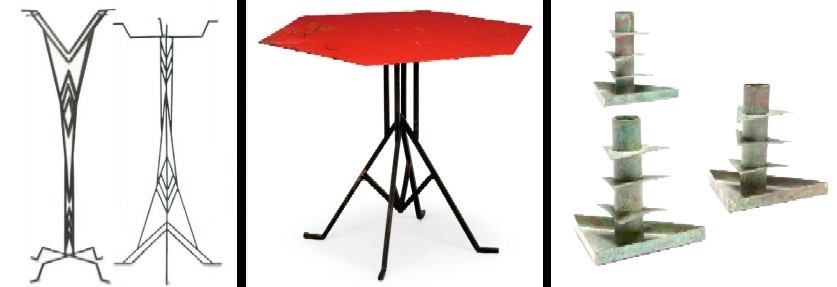 Furniture Examples by the McArthurs For the Biltmore in 1927 (From Left): Fern Stands. Wrought Iron, 1927s, From Judith Miller, Art Deco, 2014, p. 294; Table, Iron Frame with Lacquered Iron Top, Invaluable; Candle Holders, Wrought Iron, Invaluable
In California, Warren Jr. started the Warren McArthur Company in 1930. He began to design and produce
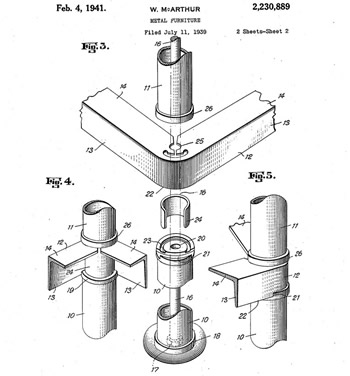
McArthur's Furniture Joint Patent 2230889, Google Patent
furniture using the design and manufacturing experiences gained in the building of tubular metal furniture for their father's house and the hotel. Between 1930 and 1933, the company produced furniture that was so well built it came with a lifetime guarantee. Warren, Jr. applied for his first patent for his aluminum furniture in 1932.
McArthur patented a technique to provide rigidity and strength to his aluminum tubular furniture, aluminum being a weak metal. McArthur had supporting steel rods placed inside the hollow aluminum tubes of his furniture. The tubes and inner rods were attached together with interchangeable joints and washers that were visible and sometimes capped with a smooth round button. The furniture was then polished and given a finish that resembled matte silver. ("Warren McArthur", Wikipedia, gathered 10-19-25)
He used anodization to keep the aluminum from tarnishing as well as providing a method for permanently coloring the metal in tones such as Grenadine, Alice lue, and Golf Green. The brightly colored metal combined with contrasting upholstery appealed to Los Angeles clientele, among whom were the Ambassador Hotel, Warner Brothers studios, the Los Angeles restaurant Sardi's, Marlene Dietrich, Rudolph Schindler, Paul Williams and Clark Gable. "Many movies made during the time featured McArthur's furniture, and are recognizable for their curved tubing design and rounded edges. His signature grid with overlaying bars in the framework, black 'puck' feet and 'tootsie roll' armrests used on lounges, sofas, chairs and end tables made for some of his most successful sellers." ("Warren McArthur", Decophobia website, gathered 10-20-25)
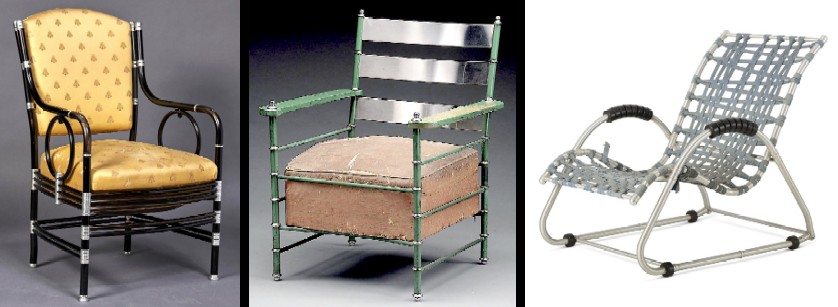 Examples of Early 1930s Chairs by McArthur Company (From Left): Armchair, Black Anodized Aluminum and Fabric, 1930s, Invaluable; Armchair, Golf Green Anodized Aluminum, 1930, Wisconsin State Farmer; Southampton Lounge, Aluminum with Webbing and Rubber, 1931-2, Vitra Design Museum
Making the interchangeable
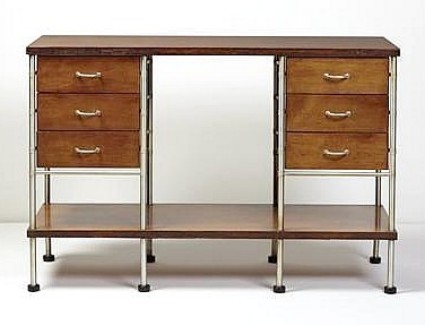
Sideboard, Oak, Aluminum and Rubber, c. 1935, Invaluable
external fittings a part of the design was a clever idea, producing a beautiful, weld-free frame. However, the expensive materials, time required for assembly and limited production runs hurt his bottom line. "Regardless of how chic his designs were, the company was not profitable, and McArthur was forced to rely on his father's fortune to keep the business afloat." (Peter C. Vemilyea, Hidden History of Litchfield County, 2014, not paginated)
In 1933, following his father's death, McArthur closed the Los Angeles facility. One website states that this was because the company had to declare bankruptcy. ("Warren McArthur", Collections Online. Design-Museum.de website, gathered 10-20-25) However, this is not corroborated elsewhere and most sources indicate that he simply moved. Whatever the reason, McArthur began manufacturing furniture in Rome, New York in 1933. He opened a showroom in New York city in the fall of that year. Fortuitously for the Warren McArthur Corporation, the 1933 Century of Progress Exhibition in Chicago brought metal tube furniture into the popular consciousness. McArthur continued to innovate, filing for numerous patents on his designs, printing the fact that they were patented on his furniture labels.
McArthur's stylish, inventive furniture was popular both domestically and commercially; the company produced over 600 individual designs ranging from bar stools to settees, desks to folding chairs, smoking tables to vanities. He received distinguished commissions to design furniture for the Union Pacific Railroad dining cars as well as for the Chrysler headquarters in Detroit in the 1930s. (Megan M. Mastrobattista, "Warren McArthur", Doyle website, gathered 10-20-25 )
 Examples of Mid 1930s Furniture by McArthur Company [Top}: Occasional Table 1516, Aluminum, Glass and Rubber, c. 1933, LA Modern; Desk and Chair, Aluminum Glass and Upholstery, 1930s, 1st Dibs; Adjustable Arm Chair, Aluminum and Lether or Faux Leather, After 1936, Vitra Design Museum
[Bottom] Adjustable Lounge Chair and Ottoman, Aluminum, Rubber and Upholstery, c. 1936, Ragi; Dining Room Table, Aluminum, Laminated and Lacquered Wood, c. 1935, Wright Auctions
The company continued operating in New York until 1938, when McArthur acquired the old Bantam Ball Bearing Company factory located in Bantam, Connecticut along with the 90-acre Scott Bowen farm. Why this move was made is not clear, although it seems probably that increased demand may have required the company to find a larger facility.
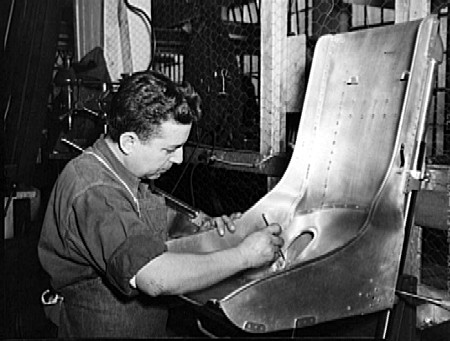
Wprler Ralph DePino Assembling a Bomber Seat at tje Warren McArthur Plant in
Bantem, Connecticut in June, 1941
The company continued to produce their signature aluminum furniture until the needs of the War prohibited all use of aluminum for private use. Because of McArthur's experience working with aluminum seating, the government contracted him to design and produce airplane seats.
Before the war, the company had employed approximately 28 people; by 1945 that number had grown to over 1,500. It was estimated that Warren McArthur produced between 75 and 85 percent of all seats used in American military aircraft. Aside from the sheer number of seats produced in Bantam, McArthur's most notable technological contribution was the design of seats made from a magnesium alloy tubing which saved precious war-needed materials. While light, the seats were strong, meeting structural tests for loads exceeding 2,400 pounds. General Douglas McArthur's command chair in Japan was built at the Bantam plant. ("Mill Record Litchfield, Warren McArthur Corp", Connecticut Mills website, gathered 10-20-25)
Following the end of the war, American tastes changed resulting in a decrease in interest in the tubular aluminum McArthur Company designs. The Warren McArthur company declared bankruptcy in 1948. Warren McArthur then started Mayfair Industries in Yonkers, New York to produce institutional furniture. The majority of the furniture from Mayfair that is found today are folding chairs, their best seller. Warren retired from Mayfair in 1961.
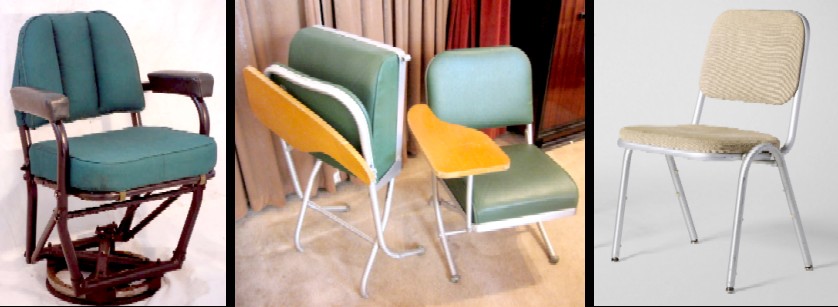 Examples of Post-War Mayfair Industries Chairs by McArthur Company (From Left): Aircraft Navigator's Seat Model 364, 1947, 1st Dibs; Folding Chairs with Removable Desk (Institutional Furniture), Aluminum, Upholstery, Wood, Mayfair, 1940s, Art Deco Collection; Stacking Chair (Institutional Furniture), Mayfair Industries, c. 1955, LA Modern
Sources Not Mentioned Above:
"Warren McArthur", Cooper Hewitt Website, gathered 10-20-25
"Warren McArthur", Modernism website, gathered 10-20-23
"Warren McArthur's return", Forbes website, gathered 10-20-25
"Albert Chase McArthur", Wikipedia, gathered 10-20-25
Stanley Turkel, Great American Hoteliers: Pioneers of the Hotel Industry, 2009, p. 9
Jamie Logan Abell, "Albert Chase McArthur's Arizona Biltmore: the Jewel of the Desert", Arizona Contractor & Community website, gathered 10-20-25
Micheal F. Logan, Desert Cities: The Environmental History of Tucson and Phoenix, 2012, p. 93
Harold Housley, "In the Shadow of Frank Lloyd Wright: The Albert Chase McArthur Collection", Arizona State University Library website, gathered 10-20-25
"Warren McArthur", Design2Share Blog, gathered 10-22-25
"The sad story of Warren McArthur", Observer-Reporter website, gathered 10-20-25
Judith Miller, Furniture: World Styles from Classical to Contemporary, 2005, p. 441
"1940s Warren MacArthur Art Deco/Modernist Folding Chairs with Removable Desktops", Art Deco Collection website, gathered 10-23-25
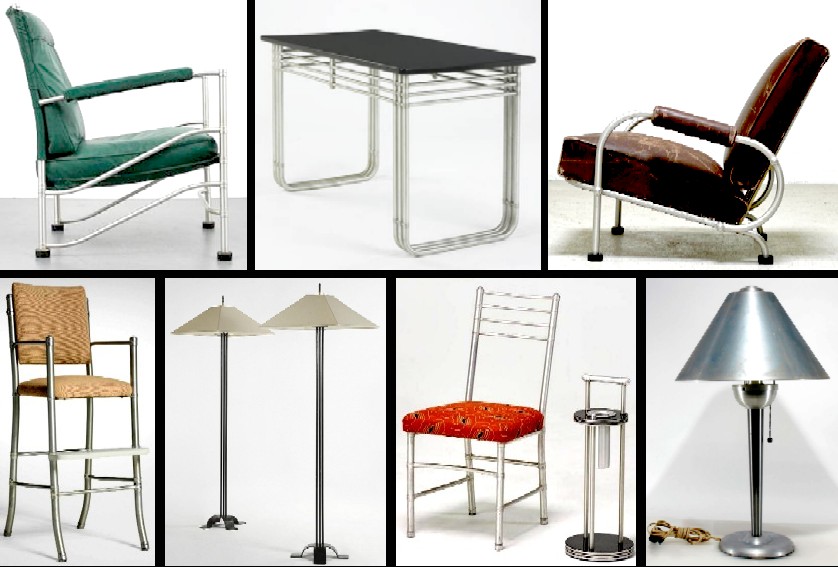 More Examples of 1930s Furniture by McArthur Company [Top}: Lounge Chair, Aluminum, Upholstery and Rubber, 1930s, Invaluable; Table, Model 1651, Lacquered Wood and Aluminum, c. 1935 Wright Auctions; Lounge Chair, Aluminum, Leather and Rubber, 1930s, 1st Dibs
[Bottom]High Chair, Aluminum, Upholstery, Painted Wood, c. 1933, Invaluable;Floor Lamps, Bronze with Paper Shades, Arizona Biltmore, 1927, Invaluable; Side Chair with Ashtray, Aluminum, Upholstery and Laminated Wood, Reupholstered, 1930s, Bidsquare; Lamp, Aluminum, 1930s, Invalable;