Sibylle May
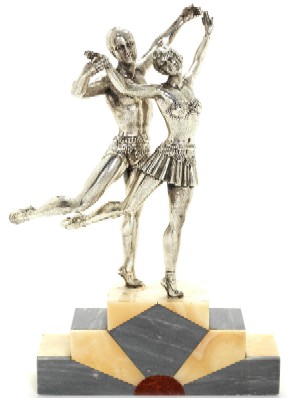
Dancers Sculpture, Silvered Spelter, Believed to be
Modelled on Vaslav Nijinsky and Sibylle May, By
Enrique Molins Balleste, c. 1925, Bonhams
Sibylle May's biography is somewhat mysterious. She appears on the German Wikipedia site, which simply states that her "life dates are not known in the literature. The sculptor worked in France during the interwar period (documented from 1925 to 1935), probably in Paris." ("Sibylle May", German Wikipedia, gathered 8-13-25) They indicate that she was an English sculptor without indicating a source, something that is widely repeated on the internet. An ad for her sculptures in The American Hebrew magazine in 1927 says, "One of those clever Americans made these, and her signature - Sibylle May- makes each a collector's pieces as well as a delightful decorative incident." (Advertisement by R. Altman & Co., The American Hebrew, May 27, 1927, p. 134)
However, she is listed in Société des Artistes Décorateurs catalog of 1923 as "MAY (Mme Sibylle) Nee a Neuilly. Demeurant 17, rue Quentin-Bauchart, a Paris." ("MAY (Mme Sibylle).", Société des artistes décorateurs, catalogue du XIVe salon, du 3 mai au 1er juillet 1923, Paris, Grand Palais des Champs-Elysées, rue Jean Goujon, not paginated) The Société description also states that was born in Neuilly-sur-Seine, France - a wealthy, residential suburb located just west of Paris. This seems more concrete than an unsubstantiated Wikipedia reference or an Ad in an American magazine. Somewhat in support of her French origin, the spelling of given name in America and England would typically not include the 'le' on the end, although that would be likely in France. It gives her shop or studio address as 17, rue Quentin-Bauchart which is located in the 'Golden Triangle', a center for luxury and fashion in the early 20th century. May was was still located there in 1926 according to another catalog. ("May, Mlle. Sibylle", Explication des ouvrages de peinture, sculpture, exposés dans les galeries de la Société des amis des arts de Bordeaux, 1926, p. 85)
Some auctions sites indicate that May was born in the 19th century, apparently assuming this
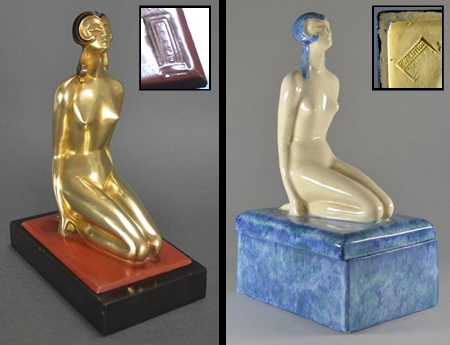
Sculpture of a Lady Comparison, Bronze for La Stele and Ceramic for l'Evolution
With Foundry Mark insets, c. 1930, 1930.fr: La Stele - Evolution
because she was an active sculptor in 1920s. However, the Bonham's auction site has a statue sculpted by Enrique Molins-Balleste which they state consists of "a male and female dancer, believed to be modelled on Vaslav Nijinsky and Sibylle May, mounted on a onyx base in a sunray design." ("Lot 259: Enrique Molins-Balleste", Bonhams website, gathered 1-27-25) If this is indeed a statue of May, she could easily have been in her early 20s when the sculpture was made and thus have been born in the early 20th century.
May is probably best known for her presence in the artist groups La Stèle and L'Évolution by Arthur Goldscheider. The son of an Austrian entrepreneur who manufactured ceramics and bronzes, Goldscheider established himself in Paris in 1900. He selected sculptures to produce by visiting various artists workshops and salons in France. Following the end of the First World War, Goldscheider began manufacturing Art Deco style sculptures, including Pierre le Faguays' Dans bachique in 1924. (Images of this sculpture can be found here.) May was known to have worked with le Faguay although it is not clear when the two met.
In 1925, Goldscheider established two groups of progressive artists:
 Seated Egyptian dancer, Evolution series, Proof in Polychrome Enameled Ceramic, Signed, c. 1925, Cote Basque En Cheres.jpg)
Egyptian Dancer Lamp, Sibylle MAY for Céramique de CAZAUX
(Édouard) Seated Egyptian dancer, Evolution series, Polychrome
Enameled Ceramic, c. 1925, Cote Basque En Cheres
"La Stele for sculptors and L'Évolution for creators of decorative works." (Arthur Goldscheider, French Wikipedia, gathered 1-27-25). The Goldscheider website gives a slightly different description of the two groups, based on the categories in which they were represented at the touchstone 1925 Exposition internationale des arts décoratifs et industriels modernes: "Modern sculptors are represented under 'La Stèle', while the decorative artists under 'Évolution' are represented under 'Arts and Crafts'." (Goldscheider, "Art Deco in Paris under Arthur Goldscheider", gathered 1-27-25). Both sources place Sibylle May's works in the Évolution display at the Exposition. Yet there are pieces by May which were created for of the two groups, suggesting the division between them may not have been straight-forward. (See the image above right.) Consider May's 'Sculpture of a Lady' seen in the image above right. The piece on the left was sold under Goldscheider's Stèle stamp (see the inset image) while the one of the right was sold in his Évolution group. These are clearly the same sculpture, although they are executed in different colors, media and on different types of bases. It seems likely that Goldscheider blurred the line between the two groups over time.
More might be understood about May as an artist if Goldscheider's motivation for selecting her for inclusion in his new lines was known. He most likely found her while searching the workshops and salons of Paris for suitable pieces in Paris, possibly solo or with another group. Since May worked with Pierre le Faguay and le Faguay worked with Goldscheider before the two new groups were created, it is possible that he suggested her to Goldscheider.
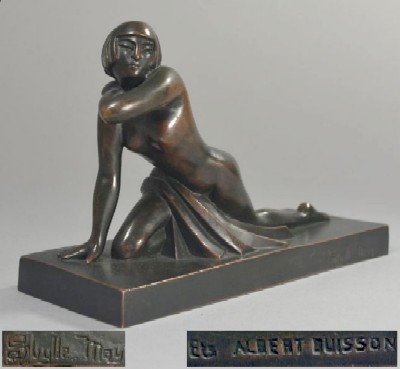
Sculpture with Marking Insets, Editor Francios Albert-Buisson, 1930.fr
While designing for Goldscheider, May worked with ceramicist Édouard Cazaux, whose sculptures were included in the Évolution display at the Exposition. Whether they knew each other before Goldscheider selected them for his new lines is not clear. Of their work together, auction site 1930.fr explains Cazaux, who was in the Goldscheider's Stèle group, decorated some of May's sculptures "in subtle monochromatic hues". . An example of this can be found above left bearing both May's signature and Cazaux's stamp.
Independent of Goldsheider, May created pieces for Éditeur d'art Francois Albert-Buisson of Hypodermie Laboratories of Paris. (An 'Éditeur d'art' is a person who select artwork for production.) Most websites incorrectly give his name as 'Albert Buisson', probably because that was what was engraved on the statue (seen at right). He was an 'entrepreneurial pharmacist' who also worked as an industrialist, politician, banker and writer. Based on an advertisement in Vendre, he was offering a limited edition bronze sculpture by May for as a gifts to people in the medical profession. (See the advertisement in Vendre - tout ce qui concerne la vente et la publicité, No. 29, 1926, p. 226)
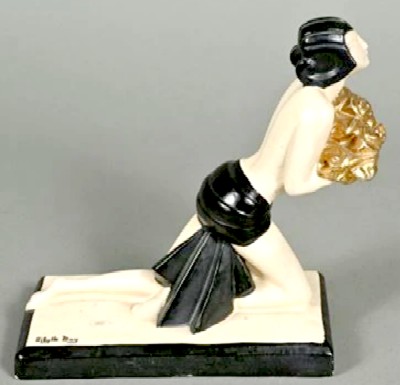
Adoration, Enameled Ceramic, 1925, Mutual Art
Of May herself, we can only guess what she was like since no contemporary sources describing her life have come to light. Although most online sources agree that she moved to France from another country, the evidence from the Société des Artistes Décorateurs catalogue indicates she was French, coming from a well-heeled neighborhood and having a shop in an exclusive part of Paris. If the statue in the first image is of her, its appearance suggests a fairly progressive woman with a finger wave haircut, perhaps indicating an independent, possibly free-spirited woman. It is curious that so little is said in the period press about a woman who appears to have been well known enough to be immortalized in statuary, who appears to have been well born and whose shop or studio was in the tony Golden Triangle of Paris.
One wonders if she was married and, if so, what her maiden name was. In an online discussion of May, one of the posters points out that she is addressed in an advertisement as madame ('Mme'), "so we can assume that May is her married name". (poster isme, "Boite art-déco Sybille May", Place de l'Ours forum, gathered 1-27-25) This is also how she was referred to in the Société des Artistes Décorateurs catalogue. Yet in 1926, the Galeries de la Société des amis des arts de Bordeaux entry identifies her as Mlle - 'miss'. Like nearly everything else about her life, little can be gleaned about her marital status from such published mixed titles.
 Seated Cubist Sculpures by May, 1920s, From Left: Figural Clock, Gilt, Paintated & Painted Bronze, Andrew Jones Auctions; Egyptian Table Lamp, Patinated Bronze and Glass, c. 1925, Sheryl's Art Deco; Statue of Nude Woman, Bronze on Wood Base, c. 1925, Artnet
Her sculpting style was decidedly Cubist, leaning more in that direction than many other Cubist-inspired artists as the above examples suggest. Various websites describe her sculptures as "straightforward", "limited to the essentials", "Modernist", "artfully realized" and "angular". In 1923, the journal La Francaise declared, "Mme. Sibylle May is a master of porcelain and earthenware decoration." (Mathilde Dons, "L'Art - Les femmes decorateurs et reliers", La Francaise, 30 Juin, 1923, p. 3) Her designs were produced in bronze and/or ceramic. Many of them were created in both mediums with different finishes as the examples below indicate.
 Seated Nude Sculpure by May for Goldschieder's Evolution Line in Different Mediums and Finishes, 1920s, From Left: Silver-Plated Bronze, 1930.fr; Painted Ceramic, Sheryl's Art Deco; Painted and Gilt Bronze, Toomey & Co.; Terracotta with Gloss Paint, Sheryl's Art Deco
The majority of her scultpures which appear on the internet are of nude or semi-nude women, typically having stylish short hair cuts as the above examples suggest. However, this may be because these are the sculptures which sell the best. Some of other examples of her sculptures are shown below.
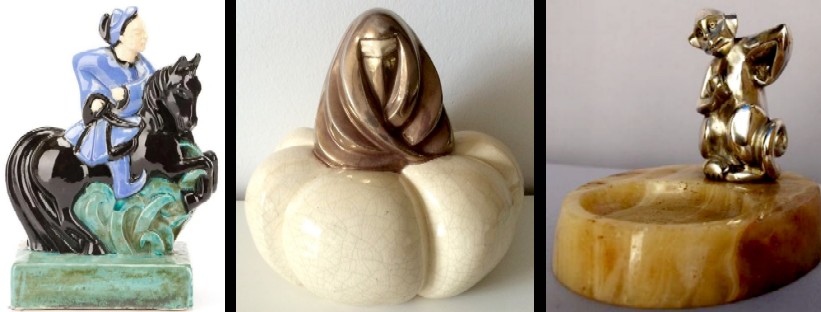 Non-Nude Sculpures by May, 1920s, From Left: Man on Horse, Edouard Cazaux Coloring, Painted Ceramic, c. 1925, Mutual Art; Arabic Woman, Painted Ceramic, Servimg; Monkey Holding Fruit Ashtray, Silvered Bronze, 1930s, 1930.fr
With regard to her death, the Dille Art website (no longer online) stated that May died in in 1935 although I found no corroboration for this. It seems more likely that they got this date from the end of her productive period as stated on a variety of other websites. As a result, her life begins and ends with a mystery.
Sources Not Cited Above:
"Art Deco Bronze Sculpture Figure of a Naked Woman by Sibylle May, France 1920", 1st Dibs website, gathered 1-27-25
Sheryl Ryen, "May, Sybille", Shery's Art Deco, gathered 1-27-25