Antonín Kybal (1901–1971)
Antonín Kybal was born in Czechoslovakia where
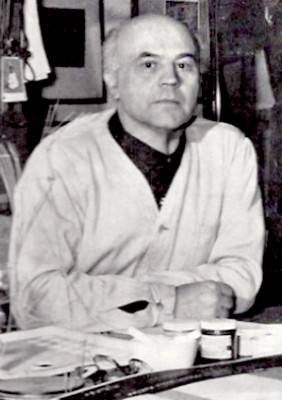
Antonin Kybal
his father was a partner in a mechanical weaving factory. This provided him with a background in rug making. He explained, "I come from a family where weaving was home, from Nové Město and Metují. At that time, almost every cottage had weaving handlooms. Weaving was always talked about at home, my childhood friends were mostly the sons of weavers..." (Vladimíra Halouzková, "Osobnost a dílo textilního výtvarníka Antonína Kybala", Bachelor's Degree thesis, Masrykova University, p. 21) He wanted to be a freelance artist, but his parents convinced him to pursue technological studies. They didn't consider an artistic career secure, so they made him study pedagogy at Karlově Univerzitě (Charles University) so that he was qualified to teach drawing and mathematics in secondary schools. Following a year of study at Charles University, he enrolled in the Uměleckoprůmyslovou školu (School of Applied Arts) without telling his parents.
After graduating in 1925, Kybal taught at a gymnasium in Solvakia. He then moved to Pilsen before being transferred to Subcarpathian Ukraine where he gave up teaching. He married one of his classmates from the School of Applied Arts, Ludmila Tolmanová, in 1926. Antonín decided to travel and paint what he saw once he had left teaching. Over time, he was drawn back to the textile industry he knew as a boy. He created his first tapestries in 1926.
In 1928, Antonín and Ludmila established a studio for textile research and design. As he explains, "I realized that the [textile design] artist, if his work is to be purposeful, must at least master weaving and dyeing in a laboratory, and this is exactly what the small textile workshop served me for." (Halouzková, p. 22) The couple worked together to produce tapestries, rugs and other products which used fabric such as pillows and chairs. Most of their products were sold through the Krásná Jizba stores. Some of his designs were among the most popular items sold there in the 1930s.
Like other Art Deco artists of the late 1920s, Kybal worked
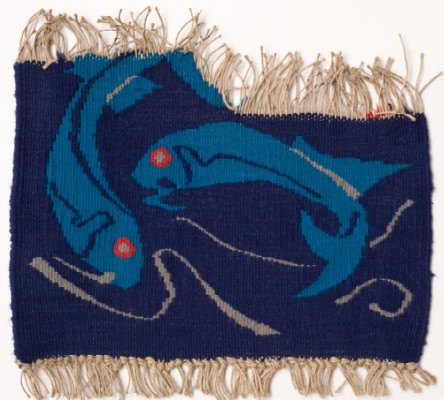
Antonin Kybal, Fish Tapestry, 1926, Maharam
on custom commissions, particularly large, hand-knotted tapestries. Among his private clients were the Czechoslovakian government who wanted tapestries for the presidential villa. He also designed projects for Czech architects including Josef Gočár, Ladislav Žák, Vladimír Grégr, and Karel Caivas.
Kybal's designs reflected the Modernist style popular in Czechoslovakia at the time. His training in textile production likely influenced his decision to pick a salable style as well as to create an environment suitable for mass manufacturing. "Kybal's workshop was one of the few that produced textiles adapted to efficient production techniques and tastes of the new style. Among his first mass-produced items were pillows composed of linear motifs, color fields, and nets that resembled contemporary abstract paintings and the severity of Functionalist architecture."(Adam Štěch, "Antonín Kybal: the Legacy of Czech Modernist Textile Design", maharam website, gathered 11-11-24)
When Nazi Germany occupied Czechoslovakia in 1938, Kybal closed his shop and turned to painting, spending his time at a cottage which he and his wife had built in Ptáčově. He created pastoral scenes focusing on landscapes, farmers, animals and children, using pencils with hints of pastel and watercolor paints. Some of these were the basis for textile designs he created after the war. He also sketched designs for carpets.
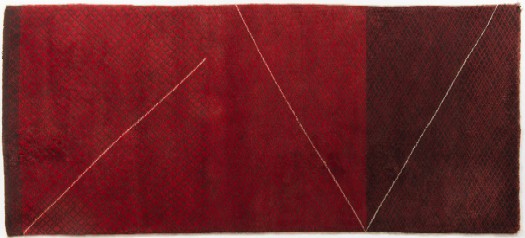
Antonin Kybal, Area Rug, Maroon, Wool, 1930s, Invaluable
When the war ended, Kybal became a teacher at the University of Applied Arts in Prague in 1945. He was asked to create a Department of Textile Art which he called the Kybal Textile School. He was made a professor in 1947 and continued teaching students textile design there until 1970. Since the country was under communist rule, he had to create work in line with Social Realism which draws attention to the socio-political conditions of the working class. Kybal "executed many political projects with surprising elegance and refinement. The most renowned of these commissions was the decorative train coach he designed for Joseph Stalin as a seventieth birthday gift from Czechoslovakia." (Štěch, maharam website)
Kybal also continued producing rugs through the 1960s. He received several commissions during this time including textile designs for the Old Town Hall in Prague, Czechoslovakia, cultural centers in Warsaw and Berlin, the Czechoslovakian embassy in Moscow, and textiles for Prague hotels. Some of his designs were used in historic films. He continued to design and create tapestries until his death in 1971.
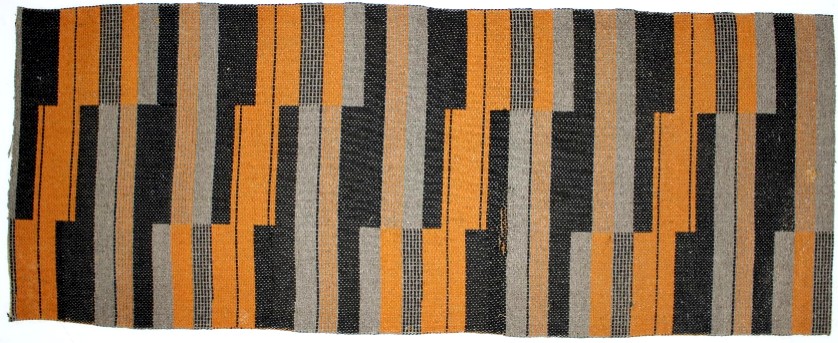
Antonin Kybal, Runner Rug, attributed, 1935, 1st Dibs
Source Not Mentioned Above:
"Antonin Kybal", Wikipedia Czech, gathered 11-11-24
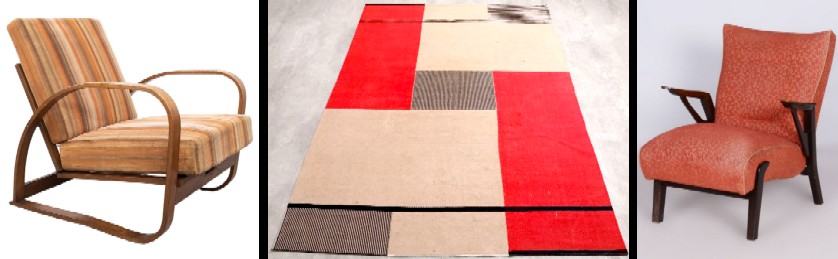 Antonin Kybal Fabrics, From left - Jindrich Halabala Lounge Chair with Fabric Attr. to Kybal, 1930s, 1st Dibs; Constructivist Carpet with Geometric Pattern, Wool, c. 1930, Invaluable; Armchair, Oak with Cromson and Maroon Uphostelry, 1930s, Pamono