Julia Keilowa (1902-1943)
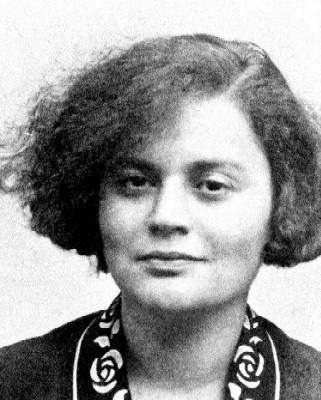
Julia Keilowa
Julia Keilowa nee Ringel was born in Stryj, Austrian Poland (in what is today Ukraine). Upon graduation in 1920, she started to study philosophy at the University of Lviv. She dropped out of the program, however, switching to the Lviv State Industrial School in 1921 spending a semester there studying design, learning stone and wood carving.
Julia married Ignacy Kell in 1922 and the couple moved Königsshutte, Upper Silesia which had been recently been annexed to Poland. However, the couple returned to Lviv the next year due to a lack of work. Upon their return, Julia resumed her studies at the Lviv State Industrial School. In 1923 she gave birth to a son after which the couple moved to Warsaw. She began studying sculpture at the School of Fine Arts in Warsaw in 1925 remaining there until 1931. Many of her teachers had helped to design the Polish Pavilion for the 1925 Exposition internationale des arts décoratifs et industriels modernes. During these years of study, Julia spent six months of each year traveling for her studies, visiting Austria, Italy, Switzerland, France and Germany, Between her instructors at the School of Fine Arts and her travels, she would have been well versed in the new Art Monderne (later Art Deco) style.
During the late 1920s and 30s, Julia was known primarily as a sculptor. She joined the Cooperative Sculptural Form (Spółdzielni Rzeźbiarskiej Forma), which was founded in 1929 by her instructors Tadeusz Breyer and Karol Stryjeński as a way for sculptors to collaborate and show their work. In the early 1930s, she became associated with the Institute of Art Propaganda, established in 1930 by artists and art historians which opposed the more conservative Society for the Encouragement of Fine Arts. Among their other functions the Institute held Salons for the members to display their art. Julia participated in the 3rd Winter Salon in 1932, collaborating from that point on with the organization until 1938. She won the Award of the Minister of Foreign Affairs in 1935.
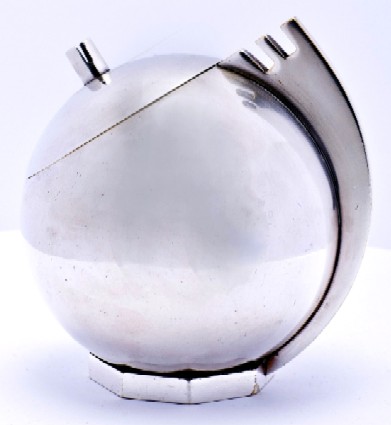
Sugar Bowl for Norblin/NBW, Photo: Michal Radwanski, 1930s, Collection
of Adam Leja, Association of Small Collectors of Antique Silver
Her work also appeared at international exhibitions. She won two gold medals for her designs at the international exhibition "Art and Technology in Contemporary Life" in Paris in 1937 where she displayed a wooden sculpture titled Nina and a set of her platters, among other tableware. She also designed lamps for the Polish Pavilion interiors at that exhibition. Keilowa was well represented at At the 1939 New York World's Fair as well; there were vases, platters, cups, candlesticks, lacteals, sugar bowls, teapots, mugs, salt shakers, gilded cutlery, a cigarette set and tea service included in the exhibition, some of it hand-produced and some of it from her products for industrial clients.
In parallel with her sculpting, Julia begin designing metal objects, using artisanal methods and creating patterns to be used for industrial production. She opened her own metalwork studio in 1933, equipping it with furnaces and etching baths imported from Paris. She began creating vessels and tableware sets for silver plate manufacturers including Józef Fraget, Norblin, Buch i Werner, and the Henneberg Brothers. Fraget commissioned her to design tableware for the sister transatlantic luxury liners M/S Piłsudski and M/S Batory in 1935. She produced a series of elegant spherical shapes with the sort of stable, solid bases that would be appropriate for the ship's movement during travel. Over her short career, she created approximately 400 different designs for industrial production which were reproduced in silver, white metal, or silver-plated brass.
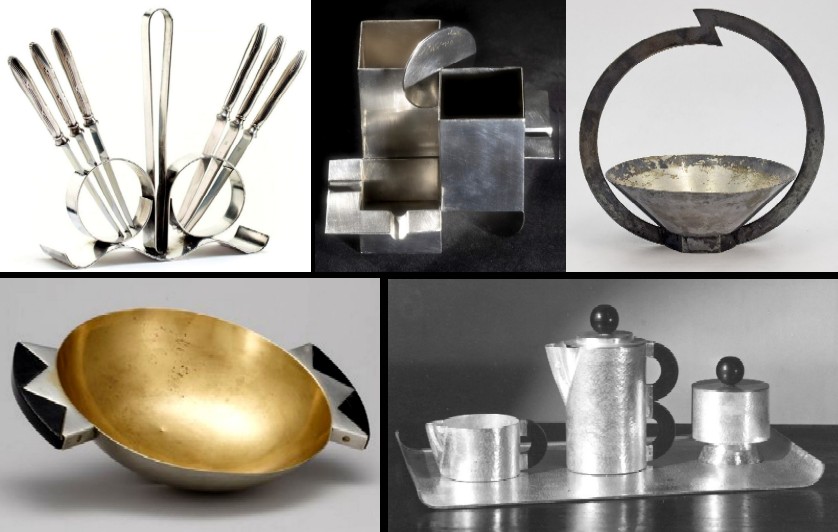 Julia Keilowa's Designs for the Henneberg Brothers Silver Plating Company, [Top] Dessert Knife Stand, 1930s, Invaluable; Smoking Suite - Ashtrays and Cigarette Holders, Silver-Plated Metal, Photo: Filip Preis, 1930s, Architectural Digest; Sugar Bowl, Silver-Plated Metal, 1937, One Bid
[Bottom] Dish with Handles, Brass with Silver Plating and Blackening, 1930s, Warsaw Museum; Coffee Set, Tray, Pot, Cup and Container, Silver-Plated Metal, Photo: Filip Preis, 1930s, Architectural Digest
Independent of her pieces commissioned for industry, Julia forged silver trays, bowls, ashtrays, goblets, cutlery, candlesticks, and vases. She was so well known for her work that an independent exhibition of her works was held at the Institute of Art Propaganda in 1938.
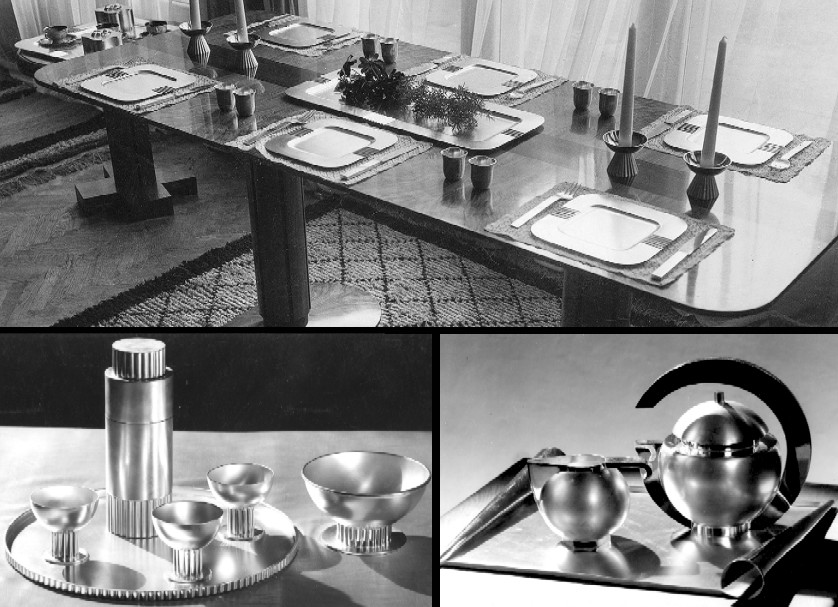 Items from Julia Keilowa's Exhibition at the Institute of Propaganda, Warsaw in 1938, [Top] Table Settings [Bottom] Coffee Set; Tea Set.
All these images are from the National Digital Archives of Poland which do not provide much detail. They are likely silver-plated metal.
Julia's designs are an interesting combination of Modernist simplicity with added decoration not considered to follow the 'function over form" Modernist ethic. Nevertheless, her pieces are quite functional, as the solid bases of her tableware for ships attests. The Poland Cultural website calls her decorative elements 'economical decoration', noting that they displayed "consistency in following the [functional] geometry of the solids [which] resulted in strong styling". ("Julia Keilowa" Culture.pl website, gathered 8-15-25) "As a result, although Keilowa's objects successfully performed the functions assigned to them, they could also work as small sculptures decorating rooms. Keilowa also made great use of the properties of the materials she worked with [using] combinations of various materials and textures". (Culture.pl)
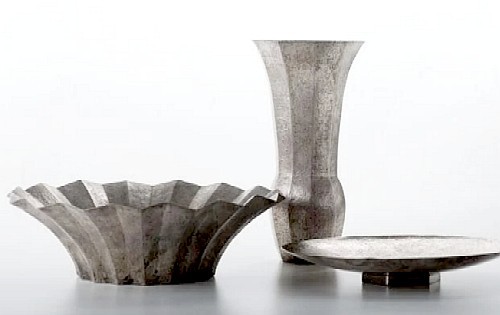
Vase and Centerpieces, Hand Forged, National Museum in Warsaw, Photo: Michel Korga,
1930s
During her zenith in the 1930s, Julia was well-regarded as an artist in the Modernist style in Poland. Her metal pieces were photographed by renowned portrait photographer Benedykt Jerzy Dorys for use in articles and other publicity. She was well-known and highly regarded in the artist circles of Warsaw.
Keilowa was known among friends and fellow artists for her energy and vigour, as well as for her initiative and ideas. ...Today, one could safely state that the designer consciously—and at an extraordinary pace—built a personal brand. Her name stood for beautiful, utilitarian objects, manufactured on a large scale yet still considered works of art. ("Julia Keilowa. Designer", Museum of Warsaw, gathered 8-17-25)
When the Second World War began, the Keil family moved back to Lviv where Julia ran a ceramics studio, employing 20 people. They returned to Warsaw around 1941, with Julia using 'Aryan papers . (She was Jewish by birth.)
She was arrested by officers of the German criminal police (Kripo) in August 1942. She was imprisoned at Szucha Avenue ...Julia Keilowa died in mysterious circumstances, unexplained to this day. According to documents found in the State Archive of the City of Warsaw, three days after his wife’s arrest Ignacy Keil received the news that she had been shot." ("Keilowa Julia", Szetl.org, gathered 8-15-25)
Another website breathlessly explains that she had been denounced to the German occupiers by a Polish caretaker. The explain that she was arrested for being a communist, something that seems to come from an account given by her son after the war was over.
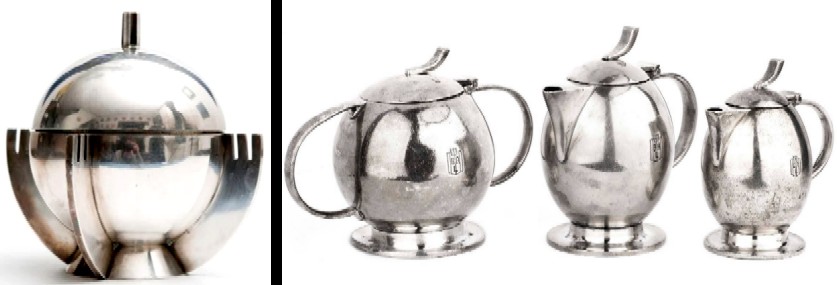 Some Notable Keilowa Designs for Fraget: Royal Apple Sugar Bowl, Silver-Plated Metal, 1930s; Breakfast Set for M/S Pilsudski, Jugs and Sugar Bowl, Gdynia City Museum, 1935, Facebook
Sources Not Mentioned Above:
"Julia Keilowa", Polish Wikipedia, gathered 8-15-25
"Stryj (city)", Wikipedia, gathered 8-15-25
"Julia Keilowa – cross-sectional, in a broad context", Design Doc website, gathered 8-17-25
Magdalena Wróblewska, "Decorative forms: Objects of Julia Keilowa's project in the Photographs of Benedykt Jerzy Dorys", Meijsc Website, gathered 8-17-25
"Karol Tchorek", Wikipedia, gathered 8-15-25
"Institute of Art Propaganda", Wikipedia, gathered 8-15-25
"Adam Mickiewicz Gymnasium", Wikipedia, gathered 8-15-25
"Even seams, new lining, maybe she would have lived on.", Weekend Gazeta.pl website, gathered 8-18-25