Ray Hille (1900-1986)
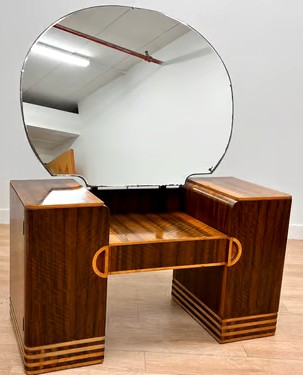
Vanity. Walnut Veneer with Mirror, Ray Hille, 1930s, Attic
Ray Hille was the daughter of Salamon Hille and was born in Sionim, Russian Poland. She came to England with her family when they immigrated in 1905. "[Salamon] Hille was not a craftsman nor a designer and his daughter, Ray, described his passion for furniture as 'all in the brain' because 'he couldn't handle a hammer'." ("Hille, Salamon & Ray; Hille & Co. Ltd (1906-1984)", British and Irish Furniture Makers Online - The Furniture History Society, gathered 9-16-25) Yet furniture fascinated him; he and Ray frequently visited the Museums to look at the historic furniture there.
Lacking the training and skills to create furniture himself, Salamon hired men to create his ideas with the goal of producing excellent furniture. When he started his business in 1906, his "company manufactured quality reproduction Sheraton and Chippendale furniture, with the emphasis on quality rather than volume." ("Hille & Co. (England), furniture", Carters Price Guide to Antiques Website, gathered 9-16-24) By 1914 he employed 80 people, the majority being cabinet makers and carvers. He had people trained in the furniture craft at his workshop and insisted all of them belong to a trade union.
As what would later be called Art Deco designs began to capture the furniture market among the upper classes, Hille's company started producing furniture in that style, designed by his daughter Ray. While nothing is said of her formal schooling, she shared her father's interest in high quality furniture and began spending "long hours researching period furniture at the Victoria and Albert and British museums. ...With her talent for drawing and design, she was painting lacquer furniture in her teens and was soon producing detailed drawings for the craftsmen." ("Mrs. Ray Hille" (Obituary), The Times, July 8, 1986, p. 14) When World War 1 began, Ray served as a Red Cross nurse.
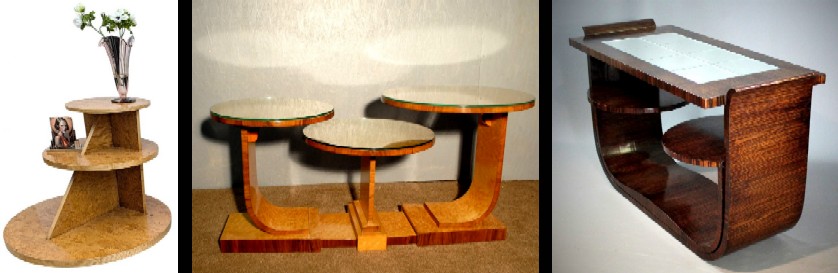 Ray Hille Designed Side and End Tables, 1930s, From Left: Three Tiered Table, Modernist, Wood, Art Deco World; Nest of J Tables, Birdseye Maple with Walnut Trim and Glass Table Tops, Table, Macassar Ebony Mirror Tiled Top with Circular Nesting Tables
After the war Ray returned to the company were she continued to draw designs for furniture. One antique website notes, "The designs of Ray Hille were the most avant garde in British Art Deco furniture".
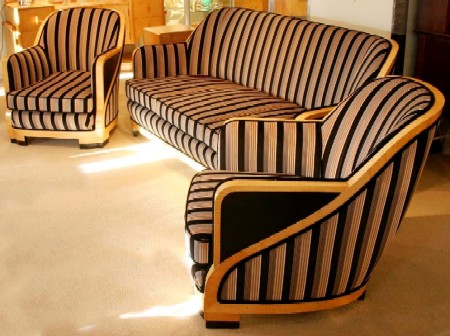
Lounge Suite, Two Armchairs and Couch, Wood and Fabric, The Design Gallery
("Art Deco Dining Suite – attributed to Hille", The Design Gallery, gathered 9-16-24) The Art Deco influence came from trips to Paris. After visiting the 1935 Exposition Internationale des Arts Décoratifs et Industriels Modernes She "was dismayed by the poor showing and critical reviews of British furniture at the 1925 Paris exposition and saw commercial potential in modern design. ...Some of her designs are little more than interpretations of the work of Paul Follot and other designers, made in blond wood or exotic veneers." (Judith Miller, Art Deco (DK Collectors Guides), 2005, p. 59)
"The company's early success was based on the production of high-quality Art Deco furniture, which was very popular in the early 20th century. The company was known for its innovative designs, which incorporated new materials such as chrome and Bakelite. The company's products were widely used in public buildings, including hotels, restaurants, and offices, and were considered symbols of modernity and sophistication." (Carter's Price Guide) Hille's supplied high quality goods to the department stores such as Hampton's, Maples and Waring & Gillow in London as well as exporting about 15% of their furniture during the interwar years to customers in the USA, Australia, Egypt, India and South Africa.

Cocktail Cabinet, Burr Walnut and Satinwood Veneer, Mirrored Lit Interior
with
Glass Shelves, Pull Out Tray and Secret Drawer, Brass Hardware
In 1932, Salamon Hille retired due to health problems and Ray took over, finding outside financing and changing the company into a limited partnership. Under her leadership during the 1930s the company continued to produce high quality Art Deco style furniture, sometimes featuring japanned or lacquered surfaces which had been made popular in France.
During World War II, the Hille factory in and stores in Northern London were destroyed. Materials required to produce furniture, particularly wood, became difficult to obtain because of war restrictions. The company survived by repairing furniture damaged in bombings, using a hired van to pick up the furniture. Ray managed to convince the curators of the Victoria & Albert Museum to recommend Hille to the City Guildhalls as a company which could repair bomb-damaged furniture. After the war, former employees returned and the company relocated to Leytonstone. Ray's husband Maurice, her daughter Rosamind and son-in-law Leslie Julius joined the company.
Robin Day was contracted to design furniture in 1949 at the urging of Rosamind and Maurice, effectively becoming their chief designer for the next 20 years although he was not formally employed by Hille. Some of their best known Hille furniture was designed by him although it was an extreme departure from the type of furniture which the company had created during the interwar period. Thanks to the efforts of Rosamind, Maurice and Day "the company underwent a complete transformation and became a champion of modern design". ("Robin Day (designer)", Wikipedia, gathered 9-16-24) Hille furniture began focusing on lightweight, utilitarian furniture which was modular and mass-produced. Ray's second daughter Cherill Scheer joined the company in 1961, driving the marketing of this new type of product.
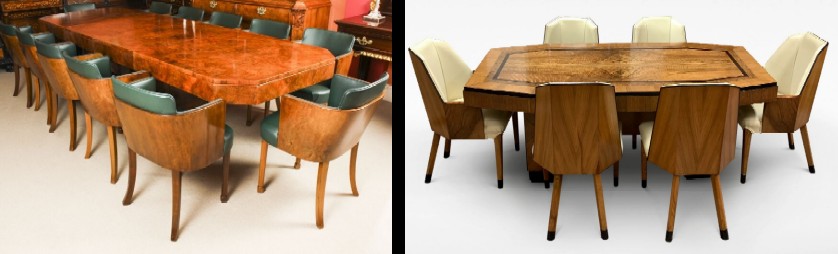 Ray Hille Designed Dining Room Sets, From Left: Table with Twelve Chairs, Burr Walnut with Green Leather, Ray Hille, c1920, Regent Antiques;
Table with Six Chairs, Walnut Veneer with Macassar Ebony Bands, 1930s, The Design Gallery
Ray Hille Designed Dining Room Sets, From Left: Table with Twelve Chairs, Burr Walnut with Green Leather, Ray Hille, c1920, Regent Antiques;
Table with Six Chairs, Walnut Veneer with Macassar Ebony Bands, 1930s, The Design Gallery
Ray remained with the business for the four decades following the war. "[W]ith her sense of adventure and enterprise, she took the business to further successes mid saw it acquire an international reputation for innovative designs." (Times obit) The Victoria and Albert Museum held an exhibition to celebrate Hille's designs in 1981. Two years later, the company was sold by the family although Day continued to design for them.
Sources Not Mentioned Above:
"History of Hille", Hille website, gathered 9-14-25
Samuel Hawkins, "From 'Undereable Alien' to Proud British Jewry: The Jewish Immigrant Experience in Memory and History, 1881 to Present", University of Southampton Doctoral Degree, October, 2017
"Hille Furniture", The Furniture Rooms website, gathered 7-18-25
"Hille Furniture", Regent Antiques website, gathered 7-18-25
"Hille (furniture)", Wikipedia, gathered 7-18-25
Original Facebook Group Profile
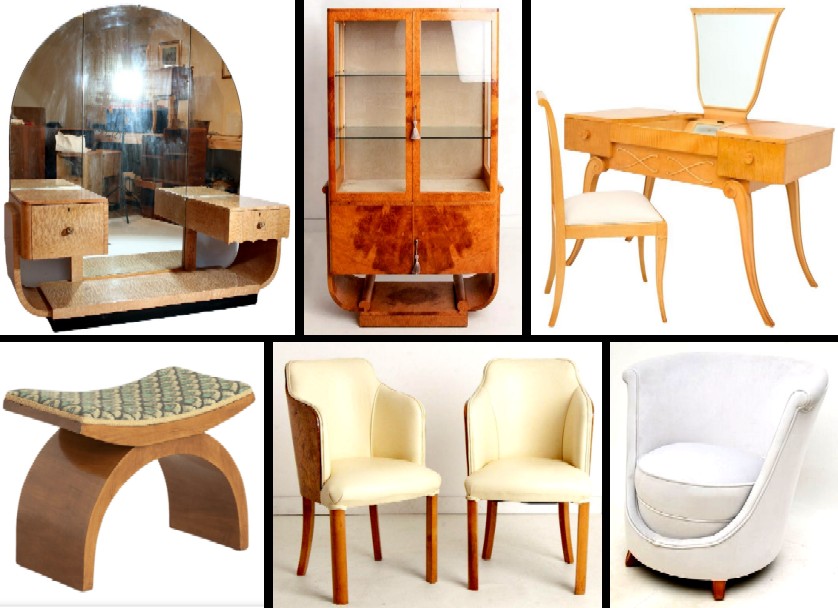 Various Furniture Pieces by Ray Hille, From Top Left: Vanity Table, Mirror with Quilted Maple Veneer and Ebonized Trim, Deco-Original; Display Cabinet, Burr Elm Veneer on U Base with Glazed Glass Door and Sides, c1930, The Old Cinema; Dressing Table and Chair, Sycamore, Scrolled Legs, Fabric and Mirror, 1920s, 1st Dibs; Bentwood Stool, Walnut, Fabric, Reupholstered, 1930s, Vinterior; Salon Chairs, Burr Maple Veneer with Ivory Leather Upholstery, British, 1930s, Pamono; Tub Chair, Birch Legs, White Velvet, Reupholstered, 1920s, Antiques Atlas