Elizabeth Eyre de Lanux (1894 – 1996)
Elizabeth Eyre de Lanux (1894 – 1996) was an artist, designer and writer who explored
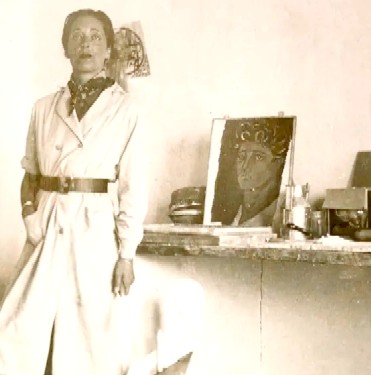
Elizabeth Eyre de Lanux in her Studio (c. 1950)
many creative fields throughout her 102 years. She was born into a well-to-do family. Eyre attended Miss Hazen's School in Pelham Manor, Westchester County, New York and enrolled in classes at the Art Students League in in Manhattan, New York in 1912 and 1914-15. Being in New York during this period exposed her to new developments in the art world which was born out by her several visits to the Armory Show of 1913. She exhibited two paintings in the first annual exhibition of the Society of Independent Artists in 1917 held at Grand Central Palace in New York.
Eyre met French writer and diplomat Pierre Combret de Lanux while working for the Foreign Press Bureau of the Committee on Public Information in New York in 1918. Pierre was there to encourage the United States to enter the war. The two were married in October that year and moved to Paris immediately after the Armistice was signed. There, Pierre introduced Eyre de Lanux to various artistic and literary circles where she met authors Andre Gide, Ernest Hemingway and Antoine de St. Exupery. Their apartment overlooked author Natalie Clifford Barney’s house where Barney hosted a literary salon. She soon became a regular attendee at the weekly salons which hosted a variety of well-known artists and writers. Her marriage to Pierre was an open one and she entered into a relationship with Barney, traveling with her at times. Elizabeth began to create Cubist portraits of those she met. She also continued to study painting and drawing in Paris at Académie Colarossi and Académie Ranson during the next two years. She explained, “Contrary to the desultory way in which French artists conduct their work, I plunged in with unwonted zeal, for I wanted to make the most of my opportunity.” ("Personality Studies of Women Makes Fascinating Exhibition," New York Sun, May 14, 1921, cited by Betsy Fahlman, “Eyre de Lanux”, Women’s Art Journal, Vol. 3, No. 2, p. 44) She exhibited a portrait at the Salon d'Automne, Paris in 1920.
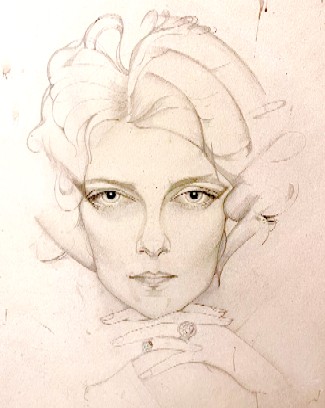
Sketch of Eva le Gallienne by Eyre de Lanux, 1921, Ebay
Elizabeth and Pierre returned to New York in September 1920, residing there until April of 1922. Pierre spent a lot of his time traveling during this period. Eyre exhibited a series of her Cubist portraits called ‘Outlines of Women’ in May 1921 at New York's Kingore Galleries. Included in the show were ‘chic but spare’ portraits of society women, athletes and actresses. (Fahlman, p. 45) Her second major show in New York was at Knoedler Galleries in 1922 which included a six panel series showing the life of Sainte Marie l'Egytienne in which she modeled early Siennese artistic techniques. Art critics praised the six panel work calling it “exquisite”, having a “strangely potent beauty”. (Fahlman, p. 45) Curiously, I was unable to find any images from her Outlines of women show or of the six panel Sainte Marie l'Egytienne wood panels on line. The best I could come up with was the unfinished sketch at left.
She began writing a column for Town & Country magazine in 1922 called “Letters of Elizabeth”, commenting on art, dance, theater, literature and politics from a Parisian viewpoint. She appears to have returned to Paris in 1922, keeping diaries of her time there until 1926. (“Series 4: Diaries, 1922-1988”, Smithsonian Institute Archives of American Art, gathered 5-31-25) Between 1923 and 1933, based primarily in” Geneva. He was placed in charge of the Paris Unit of the League of Nations in 1924. “While de Lanux remained married to Pierre until his death in 1955, she was often ‘left to her own devices,’ as he regularly traveled for diplomatic work.” (Sara Shields-Rivard, “Queer Interwar Design: Eyre de Lanux and her Sapphic Spaces”, Master’s Thesis, Concordia University, p. 27)
Elizabeth began to study frescoe painting with Constantin Brancusi in the late 1920s, exhibiting her first frescoe in 1926. “It was [Brancusi] who exposed her to an unusual fresco technique that continued to absorb her for many years.” (Fahlman, p. 45) The same year, designer and architect Eileen Gray’s showroom manager and publicist Gabrielle Bloch approached Elizabeth about having an article published about the gallery in the American press. Through Bloch, de
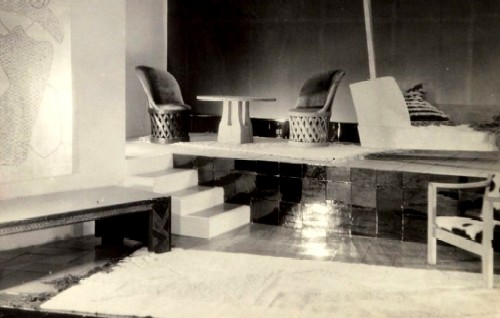
Terrace at the Salon d'Automne by de Lanux and Evelyn Wyld, Photo by Man-Ray (1929)
Rug and Kilm
Lanux met British carpet designer Evelyn Wyld who invited her to join Wyld’s Atelier de Tissage (Weaving Workshop) in 1927.
[T]he two began an affair and formed a partnership to create an interior design firm. They developed an entirely original decorative style that whilst more austere and masculine than Gray, was more feminine than Frank, whose aesthetic still veered toward the Spartan. Somewhat radical in its conception, there was at the time in France no other interior decoration company belonging only to women. Both de Lanux and Wyld shared similar aesthetic sensibilities and this allowed them to develop a creative language entirely divorced from French tradition, which would to some extent explain their unbridled artistic imagination.” (Ben Weaver, “An American in Paris: Eyre de Lanux”, The London List website, gathered 5-19-25)
Working together, the two women exhibited
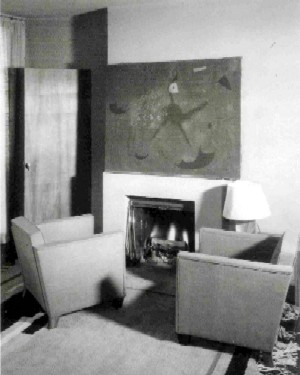
Commissioned Pied-à-Terre Living Room for Helen
Simpson, Eyre de Lanux & Evelyn Wyld (1927-8)
The London List
interior designs at the Salon des Artistes Décorateurs in 1928, 1929 and 1932 and at the Salon d’Automne in 1929. They were invited by the Union des Artistes Modernes to created a display at the Pavillion de Marsan in 1930. De Lanux and Wyld moved to Saint-Tropez in 1929, then to La Roquette-sur-Siagne. De Lanux also took several private interior design commissions during this period. The pair opened the furniture gallery Décor in Cannes in 1932. Unfortunately, the 1929 stock market crash had depressed the market for high-end furniture and the gallery was closed the next year. This appears to have been the end of their working relationship. Of their designs, Wyld said, “Between Eyre and myself, there existed a silent understanding that we were engaged in a revolution of form that our male counterparts could appreciate but never fully comprehend.” ("The Extraordinary Design Legacy of Eyre de Lanux: Art Deco to Modernist Furniture", Rug & Kilm website, gathered 5-3-25)
Their designs were very Modernist in style, exhibiting the ‘form follows

Console Table Showing Eyre de Lanux Color Choices,
Wood
and Lacquer, Instagram
function’ mantra which eliminated most decorative touches. “Their bold aesthetic sensibility, characterized by clean lines and unconventional material combinations, exemplified the Art Deco movement’s rejection of ornate historicism in favor of geometric precision and functional elegance.” (Rug & Kilm website) In true Modernist fashion, De Lanux experimented with materials in her designs, sometimes combining them in unusual ways such as marbled and waxed paper or glass and linoleum, other times tempering hard materials with softer ones - stone floors with soft rugs and soft fringes on rough fabrics. “[T]here was nothing excessive or ostentatious, and throughout her career de Lanux constantly refined her innate taste for simplicity, at least in part, through her unusual choice of materials.” (Weaver, The London List) She chose interesting color combinations, as the third image below suggests. “Her color schemes, which combined terracotta red or pale tobacco brown with grey, white, and black, and unusual arrangements, were considerably at variance with contemporary taste.” (Fahlman, p. 47)
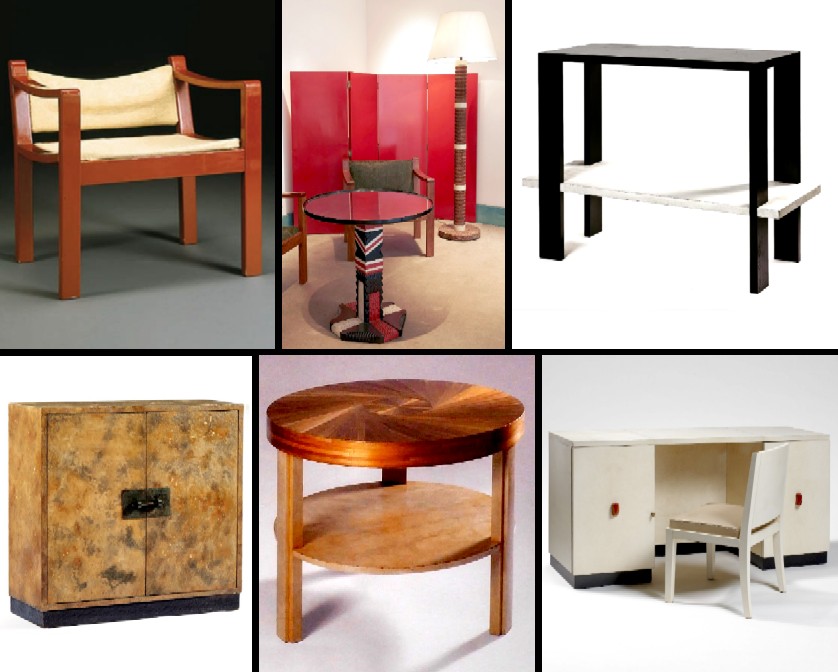 Furniture by Eyre de Lanux, from left - Arm Chair, Red Lacquered Wood and Leather, c. 1925, Christie's; Pedastal Lamp and Table with Four Panel Screen, Lacquer and Wood, Lamp Shaft of Carved and Burnt Fir Lamp with Acid-Etched, Lacquered Rings, Jacques Eveno Interior Design; Console Table, Stained Linoleum Covered Wood, c. 1930, Instagram; Cabinet, Wood with Textured Lacquer, Bronze Keyplates, with Seizo Sugawara, c. 1930, Christie's; Table, Wood Marquetry, c. 1930, 1st Dibs; Dressing Table and Chair, Parchment Covered Wood with Black Lacquered Interiors and Base, Amber Handles. Heroinas
Elizabeth appears to have continued to take commissions after she stopped working with Wyld in 1933, although she chose to stop providing decorative services two years later. (“Dans le goût de Eyre de Lanux”, Sotheby’s, gathered 6-1-25) She visited
Fresco, Painted Bas-Relief, For Helen Simpson's Pied-à-Terre, 1927-8, Bofferding New York
Spain in 1938 and ’39 during their Civil War, creating “vivid war-related sketches.” (Fahlman, p. 47) When the second world war begin in Europe, Elizabeth returned to the United States where Pierre joined her in 1940. In January of 1943, her fresco Persiennes was included in the” Thirty-One Women exhibition” at Peggy Guggenheim's Art of This Century Gallery in New York. She remained in America until she was able to return to Paris in 1945. Little more is recorded about her artistic endeavors during the late 1930s and 1940s in the sources used for this article, although she clearly continued sketching, producing watercolor images, creating frescoes and working on small sculptures, many of which she continued to do for the rest of her life.
In March of 1948 Elizabeth visited Rome where she met Italian writer Paolo Casagrande. (Willy Huybrechts, “Eyre De Lanux, biographie”, gathered from web.archive.org 6-2-25 - http://willy-huybrechts.com/fr/artistes/eyre-de-lanux) He encouraged her to rent a studio and she began working on large frescoes and fresco portraits. Even though Casagrande was married and had children, they traveled together southern Italy, Sicily, Greece, and Morocco. While together in Morocco in 1951 and ’52, Eyre de Lanux began assembling short stories, which were published in 1955 as The Place of Destruction with other stories published in 1963 as The House in the Medina. She held an exhibition which included frescoes and sculpture at Iolas Gallery in New York in 1952.
She returned to New York in 1961 where she lived for the rest of her life. She continued to visit Europe during the 1960s including Rome and Paris. Her last visit to Paris was in 1978. She continued her artistic endeavors throughout her remaining years, sketching, penning a biography of her ancestor Tobias Lear, a secretary to George Washington, illustrating the book Overheard in a Bubble Chamber (1981) and writing short stories.
She all but disappeared after that until some of her Art Deco style furniture was auctioned in 1989, when
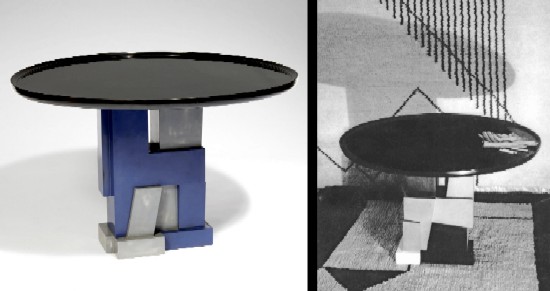
Cubist Pedestal Table, Glue and Grey Lacquer, Famille de Lanux and Rug and Kilm.
(Note that while the table in the vintage ohoto is very similar, it is not identical.)
two pieces she had designed were offered in the widely publicized New York auction of the Art Deco collection of Robin Symes, a London antiquities dealer. One of them, a lacquered table with a Cubist-inspired base from 1929 [seen in the third image below] , was reproduced in announcements of the sale. By 1989, Mrs. de Lanux's whereabouts were unknown in the design world. But her name was listed in the Manhattan telephone book, and despite her great age and infirmities -- she was legally blind -- she granted several interviews. The table "was a joke," she said. "I made it as a caricature of a Cubist sculpture." ("OBITUARY -- Elizabeth Eyre de Lanux", SFGate website, gathered 6-2-25)
As interesting as the table was, it is somewhat different from the rest of her spare, Modernist furniture. She died in a Manhattan nursing home in 1996 at the age of 102.
Sources Not Mentioned Above:
"Biographical Note" (Eyre de Lanux), Smithsonian website, gathered 5-19-25"Newly Discovered Cubist Frescoes by Eyre de Lanux', R. Louis Bofferding Decorative & Fine Art website, gathered 5-30-25
Tim Benton, "Eileen Gray's Jean Désert showroom 217 Rue du Faubourg Saint-Honoré, Paris; marketing design in the 1920s", Open Edition Journals website, gathered 5-31-25 -
"Eyre de Lanux", Wikipedia, gathered 5-19-25
"Natalie Clifford Barney", Wikipedia, gathered 5-30-25
"Gab Sorère", Wikipedia, gathered 5-31-25
"Eileen Gray", Wikipedia, gathered 5-31-25
"Evelyn Wyld: Pioneer of British Interior Design" Encyclopedia of Design website, gathered 5-31-25